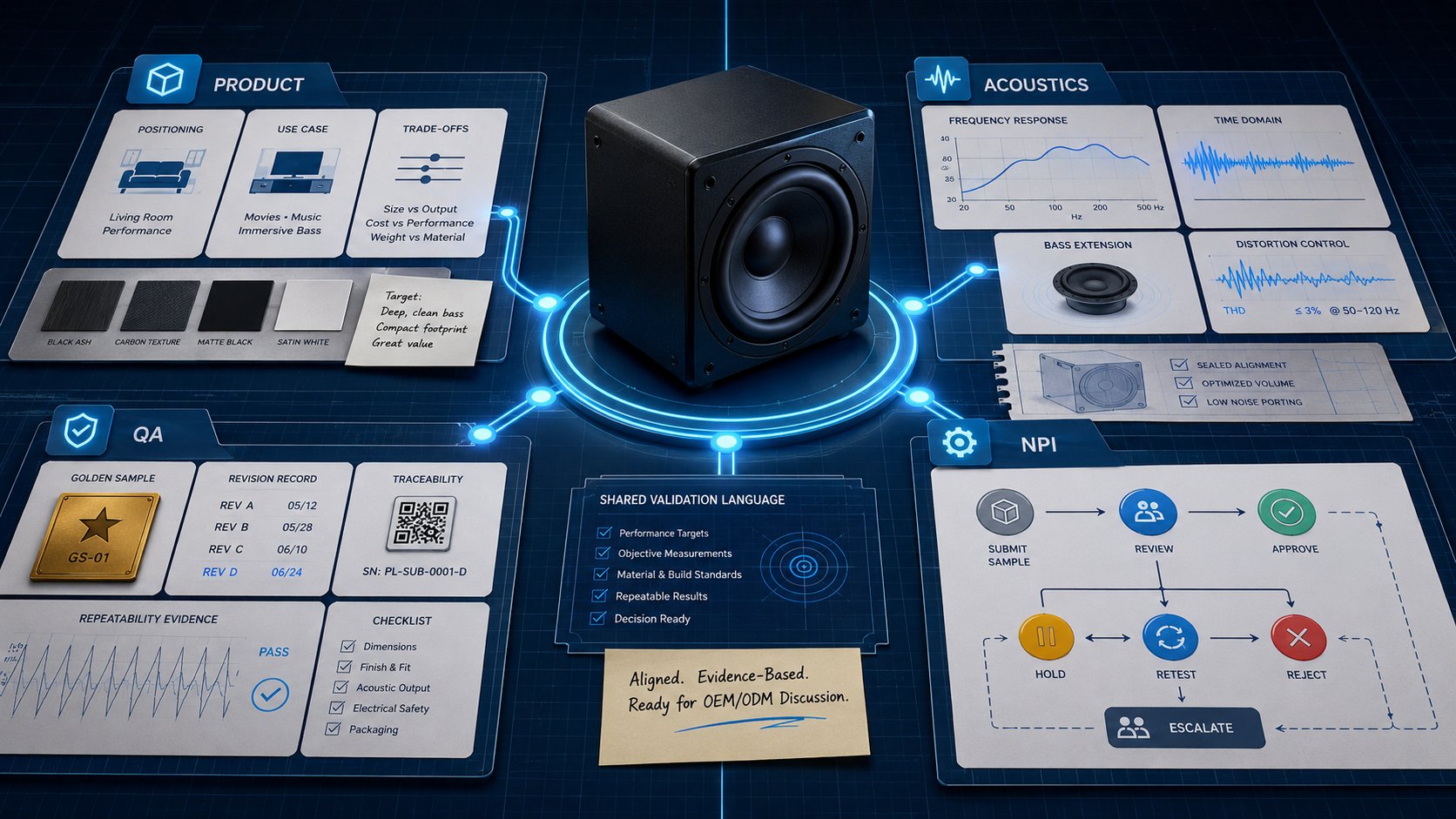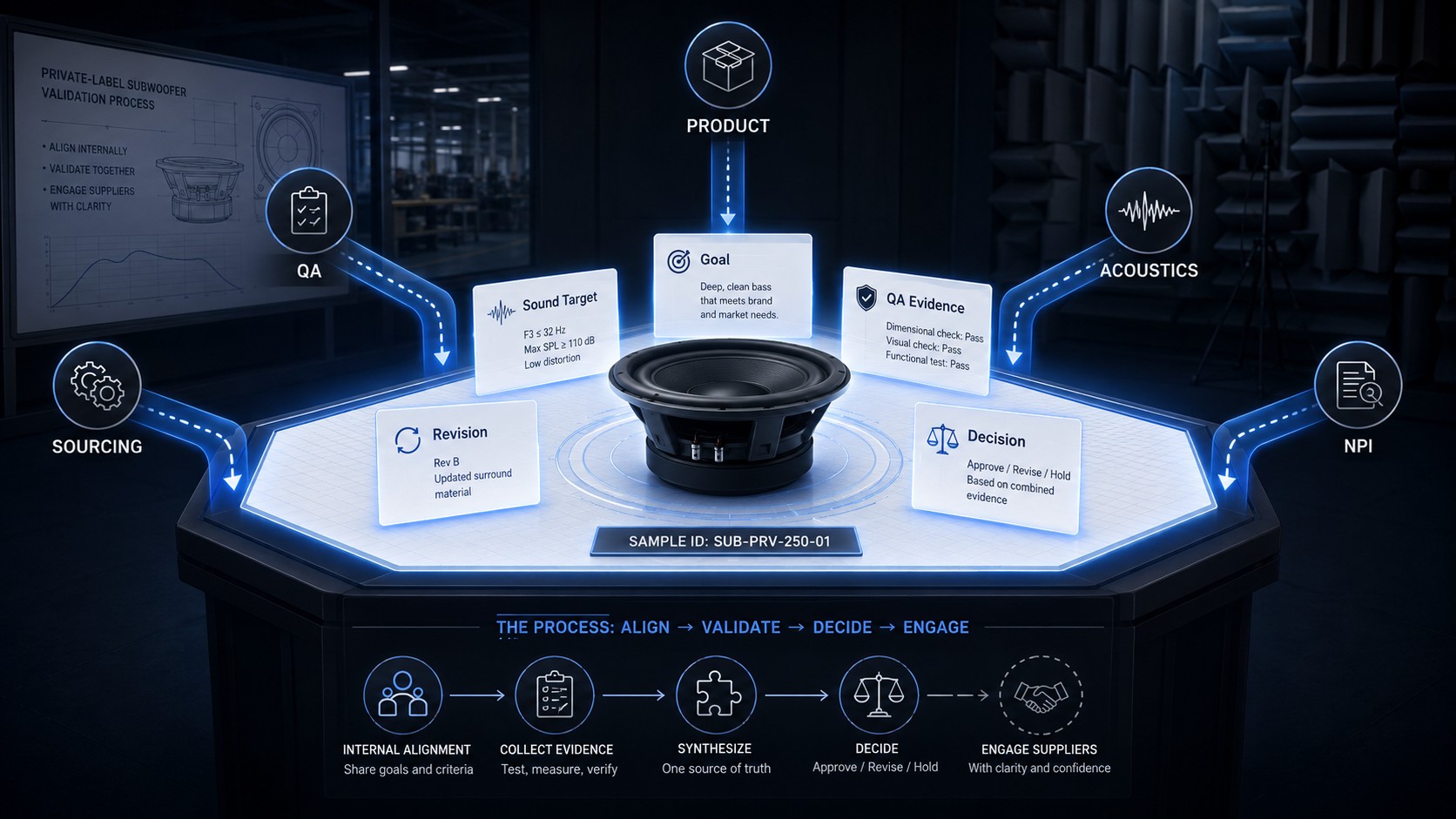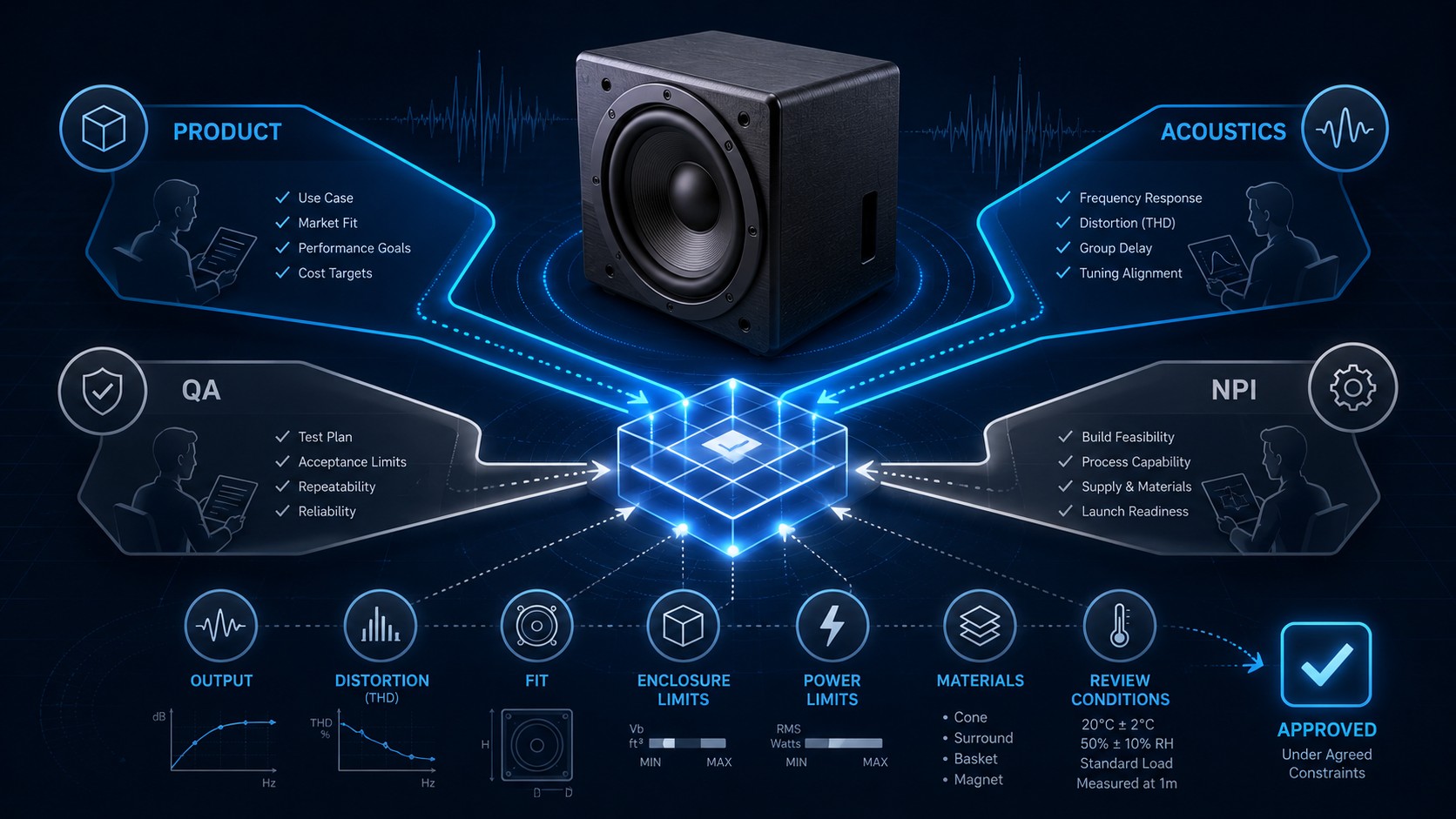
📌 Key Takeaways
Subwoofer sample approval breaks down when teams judge “good bass” before agreeing what the sample must prove.
- Define Targets Early: Clear bass goals help Product, Acoustics, QA, NPI, and suppliers judge samples fairly.
- Separate Taste From Failure: Listening feedback matters, but teams must separate sound preference from real pass/fail issues.
- Name The Limits: Enclosure size, power, fit, and materials shape what the subwoofer can realistically deliver.
- Guide Supplier Revisions: Clear feedback helps suppliers fix the right issue instead of chasing a moving target.
- Align Before Review: Shared approval language turns sample reviews into evidence-based decisions, not opinion battles.
Aligned targets = cleaner reviews, fewer revision loops, and stronger supplier direction.
Private-label audio teams preparing subwoofer samples will gain clearer approval thinking here, preparing them for the detailed overview that follows.
~ ~ ~ ~ ~ ~ ~ ~ ~ ~ ~ ~ ~ ~ ~ ~ ~ ~
A private-label subwoofer sample arrives for review. Product says the bass feels weak. Acoustics says the enclosure is limiting output. QA asks what pass/fail criteria apply. NPI wants to know whether the supplier should revise the driver, enclosure, tuning, material, test condition, or acceptance expectation.
The sample may look like the problem. Often, the breakdown started earlier.
Subwoofer sample approval can become subjective when product goals are not translated into shared acoustic validation criteria before supplier work progresses. “Good bass” is a useful commercial ambition, but it is not enough for sample approval. Product, Acoustics, QA, NPI, and the supplier need a common operating language: what the subwoofer is meant to prove, under which constraints, and against which acceptance language.
The approval question should shift from “Do stakeholders like this sample?” to “Does this sample demonstrate the agreed product intent under the agreed constraints?”
Why Subwoofer Sample Reviews Become Subjective
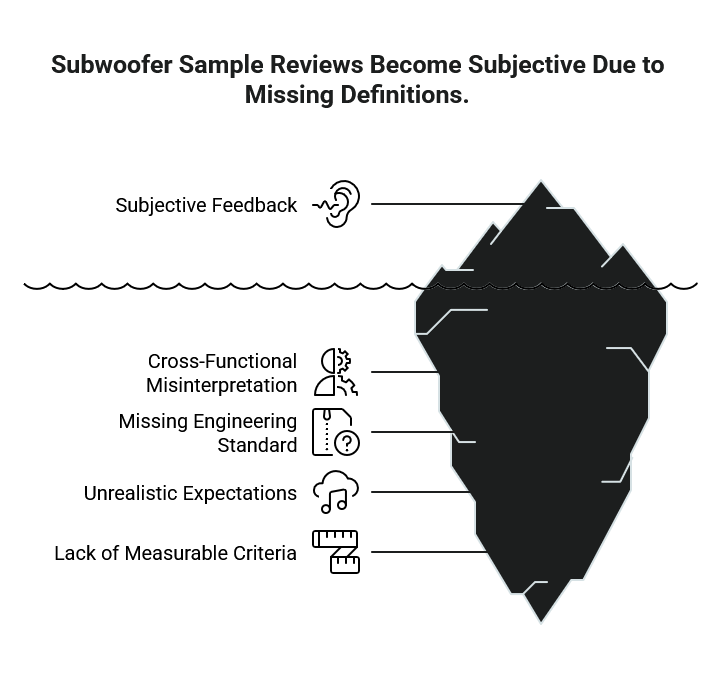
Words like “stronger,” “deeper,” “cleaner,” “tighter,” and “less boomy” sound practical in a meeting. In a cross-functional review, they can mean different things.
Product may be thinking about commercial positioning: whether the subwoofer feels strong enough for the intended category, application, or brand promise. Acoustics may be thinking about feasibility: whether the enclosure volume, amplifier pairing, thermal behavior, and driver design can support that expectation. QA needs repeatability. NPI needs gate readiness and clear supplier direction.
This is usually a missing-definition problem, not a competence problem.
Subjective listening feedback still matters. It can identify preference, tonal direction, obvious artifacts, or concerns that deserve investigation. But by itself, it does not give stakeholders a shared basis for approval. A comment such as “needs more bass” may point to output, extension, control, distortion, review environment, or an unrealistic enclosure expectation.
That is why private-label programs often benefit from an engineering standard for private-label readiness before sample approval becomes a debate over impressions.
As a general industry principle, loudspeaker performance can be measured and specified in structured ways; the Audio Engineering Society maintains standards activity for audio engineering, including loudspeaker-related standards. That does not mean every early sample review needs a lab-level procedure. It does mean teams should avoid treating listening preference as the only approval standard.
The Missing Bridge Between Product Goals And Acoustic Criteria
The bridge is simple, but often skipped:
Product goal → acoustic expectation → program constraint → sample acceptance language.
A product goal might be “stronger perceived bass.” That still needs translation. Does the team mean more low-frequency output at a defined listening level? A fuller tonal balance? Better control at higher power? Less boom? Lower audible distortion? A different enclosure approach?
Vague feedback says:
“Needs more bass.”
Clearer approval language says:
“Review whether the sample delivers the agreed low-frequency character within the approved enclosure and power constraints, without unacceptable noise, boominess, or distortion under defined review conditions.”
That wording does not invent numeric thresholds. It also does not pretend that qualitative review is useless. Instead, it connects commercial positioning to the constraints that determine what the sample can realistically prove.
This is where hard decisions should happen early. If a compact form factor, vehicle fit requirement, marine or pro-audio use case, material choice, or cost target limits the acoustic path, the team should identify that constraint before the supplier is asked to revise the sample. Otherwise, the supplier may chase a bass target the approved enclosure, application, or program constraints never allowed.
Where Subwoofer-Specific Trade-Offs Create Disagreement
Subwoofers expose trade-offs quickly because low-frequency performance is closely tied to physical and electrical constraints. Evaluating these compromises relies on foundational acoustic principles rather than arbitrary, unsupported numeric thresholds.
The highest-value trade-offs include:
| Trade-off | Why it matters for approval |
|---|---|
| Bass output vs. enclosure volume | A compact enclosure can limit what the sample can realistically demonstrate. |
| Low-frequency extension vs. distortion control | More apparent output is not useful if unacceptable artifacts appear under review conditions. |
| Output target vs. thermal or power-handling expectations | A sample may need to prove control and stability, not only loudness. |
| Brand sound signature vs. measurable repeatability | Product preference must become something QA and NPI can evaluate consistently. |
| Fit constraints vs. performance expectations | Mounting depth, size, material, and application can shape the acoustic compromise. |
A supplier cannot revise toward a moving target. If Product wants stronger bass, QA flags noise, Acoustics sees enclosure limits, and NPI needs readiness evidence, the team needs to decide which concern has approval authority.
China Future Sound (CFS) supports this objective framework through a dedicated R&D infrastructure comprising Acoustics, Electronics, Structure, and Software Development teams. To eliminate subjective approval metrics, CFS utilizes finite element simulation and KLIPPEL R&D sample testing, alongside destructive and long-term power testing. For mass production quality control, the documented controls include ERP/WMS, KLIPPEL QC with golden samples, barcode/QR route control, IQC, IPQC, FQC, and reliability lab testing.
For readers evaluating subwoofer production capabilities, the practical question is not only whether acoustic testing exists. It is whether the testing, sample review, and supplier feedback are connected to the intended product role and acceptance criteria.For general context, KLIPPEL’s public measurement overview lists loudspeaker and transducer measurement areas such as sound pressure, vibration, nonlinear distortion, compression, rub and buzz, power handling, and heat dissipation. Those categories illustrate why “sounds good” is too broad for supplier-facing acoustic validation.
How Unclear Targets Create Supplier Revision Loops
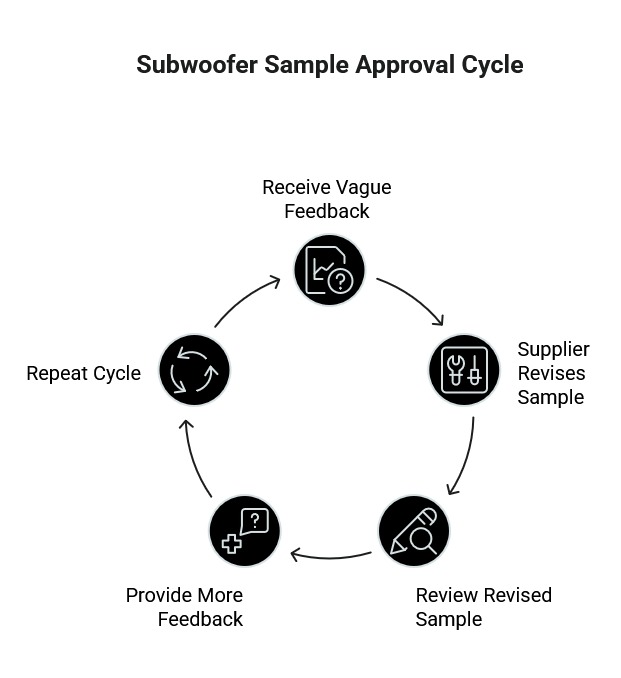
When targets are undefined, supplier feedback can become vague. The supplier may not know whether the issue is driver design, enclosure volume, acoustic tuning, damping material, amplifier pairing, review condition, or stakeholder expectation.
Consider a scenario where a supplier receives a consolidated, yet contradictory, feedback report: a demand for deeper low-end impact, a mandate to eliminate high-volume noise, and a strict requirement to maintain the existing compact enclosure volume.
If the supplier receives one combined instruction—“improve bass and clean up the sound”—the next revision can move in several directions. Some may improve loudness but worsen control. Others may reduce artifacts but disappoint Product’s desired sound character. Another may require enclosure changes that conflict with fit or cost expectations.
A clearer instruction would be:
“The next sample should prioritize controlled low-frequency output within the approved enclosure and amplifier pairing. Treat audible mechanical noise and unacceptable distortion as pass/fail concerns under defined review conditions. Capture tonal preference separately from acceptance issues.”
That language does not guarantee faster approval. It can, however, reduce ambiguity and make the next review more focused.
Subwoofer Sample Review Alignment Matrix
| Product goal | Acoustic target question | Constraint to clarify | Sample approval language | Risk if undefined |
|---|---|---|---|---|
| Stronger perceived bass | At what listening level and enclosure condition? | Cabin or enclosure volume, amplifier pairing, review environment | Sample should demonstrate controlled low-frequency output under agreed test/listening conditions. | Teams argue over loudness versus control. |
| Compact enclosure fit | What bass compromise is acceptable? | Mounting depth, volume, material, thermal limits | Sample should meet agreed fit constraints without unacceptable distortion or noise under defined review conditions. | Supplier chases an unrealistic bass target. |
| Premium sound quality | Which artifacts are unacceptable? | Distortion, rattles, boominess, excursion behavior | Review notes should separate tonal preference from pass/fail concerns. | Feedback becomes subjective. |
| Application-specific performance | Which use case matters most? | Vehicle fit, marine/pro-audio environment, placement, power pairing | Sample should be reviewed against the intended application, not a generic listening impression. | Teams approve or reject against the wrong context. |
| Production consistency | What should the approved sample represent? | Golden sample scope, QA evidence, test route | The approved sample should represent defined product intent and validation criteria. | Later production teams may not know what must be replicated. |
What To Define Before The Next Sample Round
Before another supplier review, teams should align the assumptions the sample is expected to test. Exact criteria will vary by product architecture, application, and engineering plan.
Product intent: What market or application role should the subwoofer fill? A compact vehicle-fit program, marine application, pro-audio use case, or premium sound-quality position may require different trade-offs.
Listening context: What environment matters most? A sample reviewed in the wrong context can create misleading feedback.
Acoustic priorities: Which matters most for this program: output, extension, control, distortion tolerance, thermal behavior, or brand sound character?
Enclosure constraints: What limits are already accepted? Size, mounting depth, internal volume, material, and fit constraints can determine whether the bass goal is realistic.
Review conditions: What conditions make feedback comparable? Teams should avoid comparing impressions gathered under inconsistent listening levels, amplifier pairings, or enclosure setups.
Acceptance language: What counts as acceptable, needs revision, or out of scope? This is where preference becomes approval language.
Ownership: Product should own product intent and acceptable market compromise. Acoustics should own feasibility and acoustic interpretation. QA should own repeatable evidence and pass/fail concerns. NPI should own gate readiness and cross-functional closure.
This is also where aligning procurement and QA during NPI becomes relevant. Subwoofer sample approval is not only an acoustic decision. It is a program-readiness decision.
FAQ
Why is subjective listening feedback not enough for subwoofer sample approval?
Subjective listening can reveal preference, tonal direction, and obvious issues. It is not enough when Product, Acoustics, QA, NPI, and the supplier need shared approval criteria. Listening notes become more useful when tied to agreed product goals, constraints, and acceptance language.
What acoustic targets should be defined before a subwoofer sample review?
Teams should define bass-output expectations, low-frequency character, distortion tolerance, enclosure constraints, use case, review conditions, and acceptance language. Specific numeric thresholds should come from the program’s engineering criteria, not generic assumptions.
How do enclosure constraints affect subwoofer sample approval?
Enclosure size, depth, internal volume, material, and application can shape what low-frequency performance is realistic. If the enclosure is fixed but the bass expectation remains open-ended, the sample may be judged against a target it was never designed to prove.
Who should own acoustic acceptance criteria in a private-label subwoofer program?
Ownership should be shared but explicit. Product owns intent and positioning. Acoustics owns feasibility and acoustic interpretation. QA owns repeatability and evidence. NPI owns readiness for the next gate. The supplier needs this alignment translated into clear revision direction.
Align before the sample becomes the argument
Subwoofer sample approval works best when the review is about evidence, constraints, and trade-offs—not competing preferences. Define acoustic targets early so the sample can test aligned assumptions instead of exposing unresolved ones.
For teams preparing a private-label subwoofer program, align product intent, acoustic priorities, and validation language before the next sample round.
Discuss your next subwoofer program with China Future Sound.
For teams moving from sample approval toward production consistency, a golden sample approval checklist can help clarify what the approved sample is supposed to represent.
Disclaimer: This article is for general informational purposes only. It is not a substitute for advice from a qualified professional, provider, or official source relevant to your situation. Always verify important decisions with the appropriate expert, authority, or service provider.
Our Editorial Process:
Our expert team uses AI tools to help organize and structure our initial drafts. Every piece is then extensively rewritten, fact-checked, and enriched with first-hand insights and experiences by expert humans on our Insights Team to ensure accuracy and clarity.
About the China Future Sound Insights Team
The China Future Sound Insights Team is our dedicated engine for synthesizing complex topics into clear, helpful guides. While our content is thoroughly reviewed for clarity and accuracy, it is for informational purposes and should not replace professional advice.