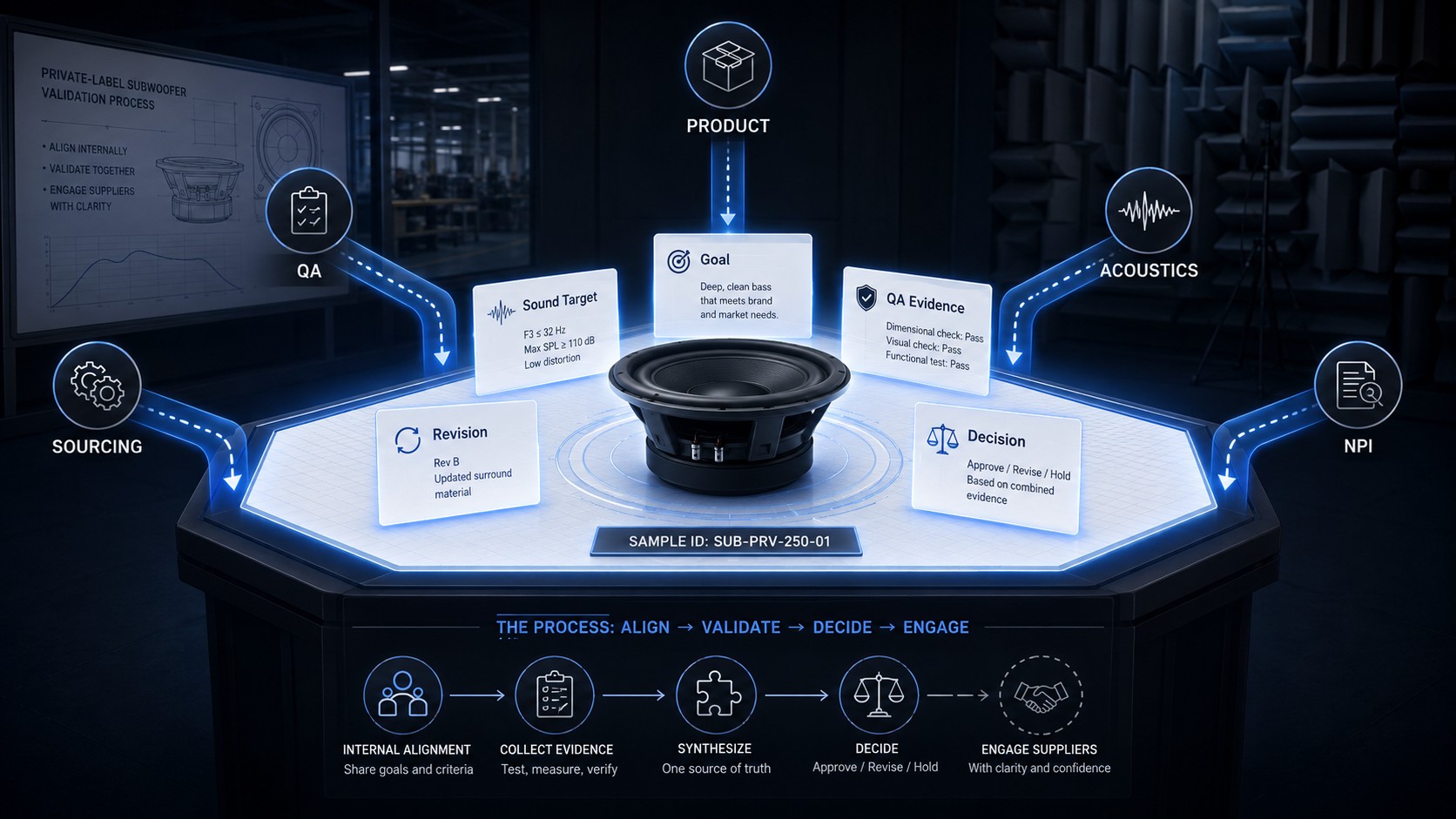
📌 Key Takeaways
Approving a private-label amplifier based on how it looks and sounds isn’t enough — you need proof it can be built the same way every time.
- Samples Lie About Scale: A hand-built prototype can sound perfect, but mass production introduces component drift that only structured testing catches.
- Five Gates Beat One Glance: Engineering-grade approval confirms repeatability, defined test routes, measurable pass/fail rules, governed reference samples, and controlled post-approval changes.
- Track Every Unit, Not Just Batches: Binding test data to each amplifier’s QR code creates a digital fingerprint that speeds up warranty investigations and protects dealer trust.
- Ask Better Questions Up Front: Before signing off, confirm how the golden sample is stored, how drift is caught mid-production, and how changes are formally controlled after approval.
- Consistency Protects Your Brand: When every shipped unit matches the approved design, warranty costs drop, dealer confidence grows, and competitors can’t simply relabel your edge away.
Engineering-grade approval turns a one-time sample into a repeatable, traceable product.
Sourcing directors, QA managers, and procurement leads evaluating private-label audio programs will sharpen their approval process here, preparing them for the detailed engineering and audit insights that follow.
~ ~ ~ ~ ~ ~ ~ ~ ~ ~ ~ ~ ~ ~ ~ ~ ~ ~
The sample sounds flawless.
Fourteen people around the conference table nod. The finish is clean, the labels sharp, and the bass hits exactly where the spec sheet promised. Someone signs the approval form. The program is green-lit.
Six months later, the first warranty claims arrive. Units from the third production run exhibit a subtle but measurable frequency response shift. The amplifiers look identical to the approved sample. They are not.
How did this happen? We approved it.
That question haunts more private-label launches than most distributors admit. The answer is almost always the same: the approval standard was cosmetic, not structural. What passed was appearance. What failed was repeatability.
Why “Visual Approval” Fails at Scale
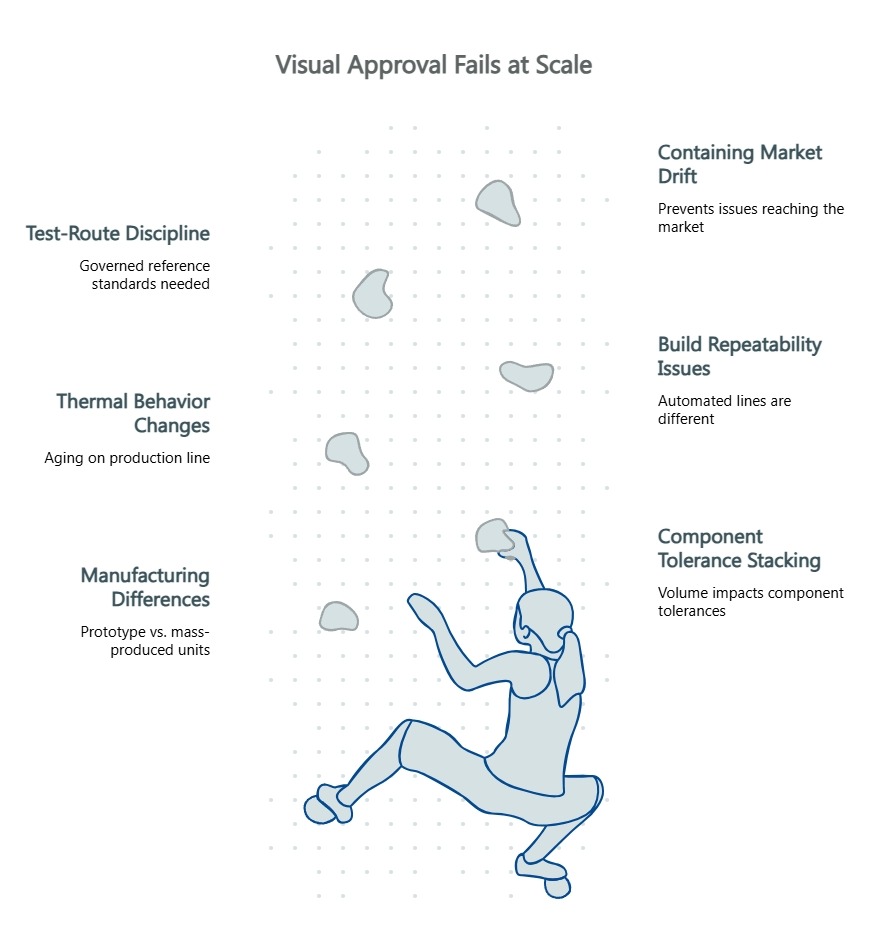
Visual approval captures a moment. It does not predict a program’s future behavior.
Most distributors evaluate samples the way experienced buyers evaluate anything — by looking, listening, and comparing against expectations. That instinct is not wrong. It is incomplete. A bench-built prototype and a mass-produced unit share a surface resemblance, but their manufacturing conditions are fundamentally different. The prototype is assembled by senior engineers using hand-selected components in a controlled environment. The production unit moves through automated SMT lines, wave soldering stations, and functional test fixtures at hundreds per shift. Component tolerances stack differently at volume. Thermal behavior changes when units age on a production line rather than a lab bench.
None of that shows up in a visual check. What a distributor is actually approving is not a sound signature or a cosmetic finish — it is the future behavior of the program. That includes build repeatability, test-route discipline, governed reference standards, and the ability to contain drift before it reaches the market. For a Sourcing Director staking margin and dealer reputation on a private-label program, the gap between what visual approval captures and what production demands is real financial exposure.
Prototype vs. Product: The Mental Model Distributors Actually Need
The shift required here is not procedural. It is conceptual. A prototype proves that a concept can exist. A product proves that the concept can be built, verified, and controlled repeatedly.
That distinction sounds simple, but it changes the approval conversation entirely.
| Dimension | Prototype | Production-Ready Product |
|---|---|---|
| Build context | Hand-assembled by R&D engineers | Built on automated lines at volume rate |
| Tuning approach | Individually optimized on the bench | Governed by golden sample parameters and KLIPPEL QC |
| What gets verified | Appearance, sound, basic specs | Repeatability, process stability, test-route compliance |
| Evidence produced | Subjective listening notes, photos | Unit-level test data bound to serial numbers via QR codes |
| Change control | Informal, engineer-driven | Governed through ECO/ECR with documented cut-in points |
| Confidence basis | Based on impression | Based on governed verification |
| What approval means | “This unit is acceptable” | “This design is ready for repeatable, traceable manufacturing” |
This distinction is the core of a first-article approval framework — a systematic set of engineering gates that validate whether a design can survive the transition from lab to line. Think of it as a flight readiness review: every system has to be confirmed before launch, not just the ones visible from the outside.
What First-Article Approval Really Proves
When structured correctly, first-article approval proves five things that visual sign-off cannot touch.
First, it proves the design can be built the same way repeatedly. This is a manufacturability question — touching DFM/DFX judgment, process discipline, and handoff quality between development and production — not a visual one. The bill of materials, assembly sequence, and process parameters have been validated against actual production conditions, not just documented in theory.
Second, it confirms a defined test route exists. Every unit follows the same sequence of inspection and measurement gates, from incoming quality control through in-process checks to final testing. KLIPPEL QC systems, for example, compare each unit’s acoustic performance against a governed golden sample to catch drift before it reaches the dock. The unit does not drift through production on informal checks alone.
Third, it establishes pass/fail logic that is measurable, not subjective. A unit either meets the parametric window or it does not. A Program Owner, QA Manager, and Procurement lead all need the same answer to a basic question: what exactly counts as acceptable, and where is that standard documented? There is no room for “close enough.”
Fourth, it ensures the reference standard itself is governed. A signed sample is not enough if nobody controls which version is authoritative after sign-off. Golden sample governance means the benchmark unit is stored, version-controlled, and periodically re-validated — turning a good unit into a governed benchmark rather than a memory of what “good” once looked like. Without that discipline, one perfect unit is not enough.
Fifth, it makes the post-approval handoff controllable. If firmware changes, component substitutions, or lead-time pressure alter the build, the program needs a disciplined way to protect the approved standard. Changes after sign-off flow through formal engineering change orders with documented cut-in points, not informal adjustments on the floor. Otherwise approval collapses into a historical event with no operational force.
How Traceability Turns Approval Into a Controllable System
Approval is only as strong as the system that can prove the shipped unit still belongs to the approved standard.
Standards without enforcement are suggestions. The mechanism that converts a first-article approval framework from paperwork into operational reality is production traceability — specifically, binding individual unit performance data to unique identifiers at every QC gate.
Each amplifier receives a QR code at the start of the production line. As it moves through IQC, IPQC, functional testing, AP testing, and FQC, test data from each station is logged and bound to that unit’s identifier. The result is a digital fingerprint for every amplifier — not a batch average, but unit-level evidence. Robust traceability systems are supported by comprehensive R&D capabilities—leveraging finite element simulation, KLIPPEL measurement systems, and destructive and long-term power testing—to define ‘acceptable’ performance before mass production begins.
This changes the economics of quality problems. When a warranty issue surfaces, traceability typically lets the brand isolate affected units by serial number, component lot, and production date — often accelerating root-cause analysis from a weeks-long investigation into a targeted containment action, though complex latent defects may still necessitate extended engineering evaluation. For a Program Owner managing a national launch, that precision largely protects both dealer trust and warranty cost exposure.
At a broader industry level, end-to-end provenance is increasingly recognized as a strategic requirement — not just for regulatory compliance, but for protecting commercial value across complex manufacturing relationships. This principle is well reflected in frameworks such as NIST’s supply chain traceability framework, ISO 9001 quality management systems, and ASQ’s quality resources.
What Distributors Should Ask Before They Approve a Program
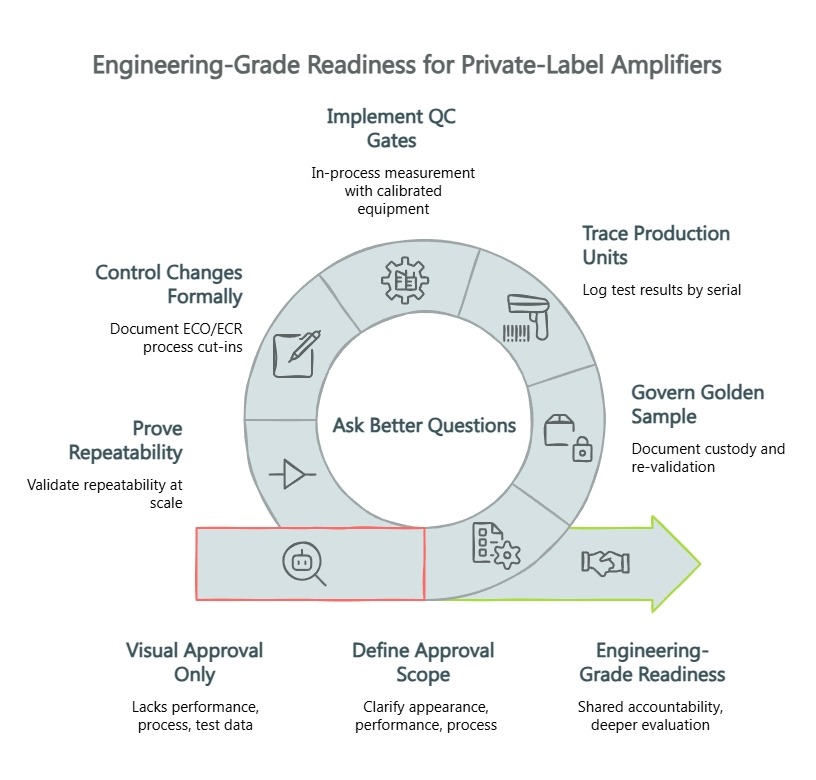
The shift from visual approval to engineering-grade readiness does not require becoming a manufacturing engineer. It requires asking better questions. Before approving any private-label amplifier program, a QA Manager or Procurement lead should get clear answers to these:
- What exactly is being approved? Appearance only, or performance, process stability, and test-route compliance together?
- How is the golden sample governed after sign-off? Is there a documented custody and re-validation protocol, or does the sample sit unmanaged?
- What evidence binds production units back to the approved standard? Are test results logged per unit and traceable by serial number?
- Which QC gates catch drift before shipment? Is there in-process measurement using calibrated equipment, or only end-of-line visual checks?
- How are changes controlled after approval? Does the manufacturer operate a formal ECO/ECR process with documented cut-in points?
- What part of the validation is one-off sample success, and what part proves repeatability at scale?
These questions are not adversarial. They form the basis for a partnership built on shared accountability — and they create natural starting points for deeper evaluation through tools like the OEM audit checklist. Manufacturers who operate under rigorous ISO 9001 quality management systems generally have the foundational process controls to address these areas, though specific capabilities—such as unit-level QR traceability—must still be explicitly verified during an audit.
Why This Shift Protects Margin, Reputation, and Differentiation
The private-label audio market is crowded with products that look different on the outside and perform identically — or worse, inconsistently — on the inside. That “sea of sameness” follows weak governance. Engineering-grade approval breaks the pattern.
When a distributor’s approval standard extends beyond the surface, the downstream effects compound. Warranty exposure drops because production units actually match the approved design. Dealer trust strengthens because performance is consistent across shipments. The brand becomes harder to commoditize because the differentiation is structural, not cosmetic.
Remember the conference room? Same table, same fourteen people. But now the approval conversation sounds different. Instead of “it looks right and sounds right,” the standard is: does the data prove this design is ready for repeatable, traceable, warranty-safe production?
That question separates a sample from a product. It protects everything a distributor stakes on a private-label program — margin, reputation, and differentiation that competitors cannot simply relabel away.
Ready to explore how engineering-grade approval applies to your program? Browse our engineering and manufacturing insights or start a conversation when the timing is right.
Our Editorial Process
Our expert team uses AI tools to help organize and structure our initial drafts. Every piece is then extensively rewritten, fact-checked, and enriched with first-hand insights and experiences by expert humans on our Insights Team to ensure accuracy and clarity.
About the China Future Sound Insights Team
The China Future Sound Insights Team is our dedicated engine for synthesizing complex topics into clear, helpful guides. While our content is thoroughly reviewed for clarity and accuracy, it is for informational purposes and should not replace professional advice.