📌 Key Takeaways
Sound-quality and high-power subwoofer lines stay distinct through different roles, tradeoffs, and proof—not arbitrary gaps between specifications.
- Protect Each Role: Give each platform a clear job and selection reason, even when components or power ratings overlap.
- Separate Architecture Axes: Treat packaging, performance promises, applications, and commercial tiers as different dimensions before comparing products.
- Define Boundaries Early: Set each line’s winning behavior, allowed tradeoffs, application conditions, and required evidence before writing specifications.
- Test Real Differentiation: Reconsider two lines when customers choose them for the same reason and the same evidence supports both.
- Govern Meaningful Changes: Reopen reviews when new parts, supplier platforms, claims, or product plans weaken a line’s distinct purpose.
Protect the role, not an arbitrary numerical gap.
Product, engineering, quality, marketing, and sourcing teams will align platform roles and supplier decisions using the boundary matrix that follows.
~ ~ ~ ~ ~ ~ ~ ~ ~ ~ ~ ~ ~ ~ ~ ~ ~ ~
An SQ subwoofer and a high-power model can begin to look nearly identical on a specification sheet. Rated power, frame size, nominal impedance, sensitivity, material families, and selected components may converge as a roadmap develops. The reflex is often to widen one visible number so the range still looks orderly.
That response may preserve a spreadsheet ladder while weakening the reason each line exists.
A durable distinction requires more than numerical distance; it comes from four connected decisions: the role assigned to each platform, the boundaries protecting that role, the proof supporting its promise, and the governance used when later SKUs cross those boundaries.
Specification Overlap Is Not the Same as Portfolio Overlap
Specification overlap means two products share ratings, dimensions, technologies, components, or measured characteristics. Portfolio overlap means the products have become difficult to distinguish by job, primary promise, deliberate tradeoff, proof package, or internal decision logic.
| Harmless convergence | Tier collapse |
|---|---|
| Some components or visible specifications are shared. | Both lines solve essentially the same problem. |
| Each platform retains a distinct selection reason. | Names and adjectives carry most of the difference. |
| Tradeoffs are stated before detailed development. | Neither team can explain what one line prioritizes. |
| Each promise has an appropriate evidence package. | The same evidence is used to justify both products. |
| Exceptions are reviewed against documented boundaries. | Exceptions accumulate without revisiting the architecture. |
Numerical distance can coexist with weak differentiation. Two models may have widely separated wattage ratings yet still serve the same use case for the same reason. Numerical similarity can also coexist with clear roles when the application assumptions, priorities, and proof differ.
Shared technology is therefore not automatically a problem. It may be a rational platform choice. The management test is whether both products still create distinct decisions. That principle also supports broader efforts to differentiate a private-label audio line without forcing every component to be unique.
Separate the Architecture Axes Before Comparing the Lines
A common planning error is placing automotive, slim, SQ, high-power, entry, and flagship on one ladder. Those labels can describe different dimensions.
Under the portfolio architecture model used here, automotive is the application umbrella. Slim is primarily a packaging or integration constraint. SQ means sound-quality-oriented and describes a performance promise, not a universal engineering checklist. High-power describes an output- and durability-oriented promise within the program, not a fixed wattage threshold. Entry, core, and flagship are commercial tiers.
Do not put every label on one ladder.
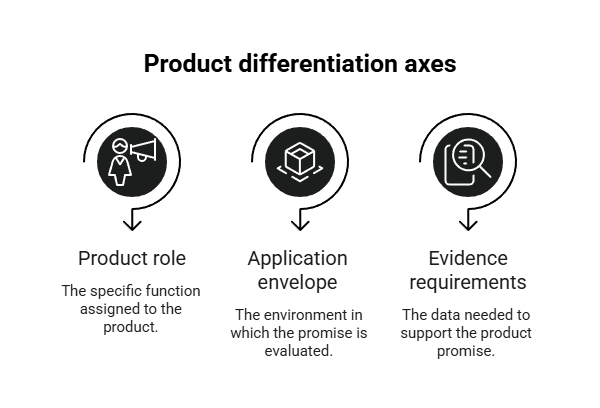
A product may occupy several dimensions at once. Consider an illustrative slim automotive model. Its reduced-depth packaging does not decide whether its primary promise should be SQ-oriented, output-oriented, or deliberately balanced. That decision must come from the role assigned to the product, the application envelope in which the promise is evaluated, and the evidence required to support it.
The distinction matters before specifications are written. When packaging and performance are mixed, a slim product may be treated as a lower-quality tier by default. When application and commercial position are mixed, “automotive” may be mistaken for a performance category. Separating the axes prevents false comparisons and lets teams debate the actual portfolio choice.
Build a Boundary Matrix Around Role, Tradeoff, and Proof
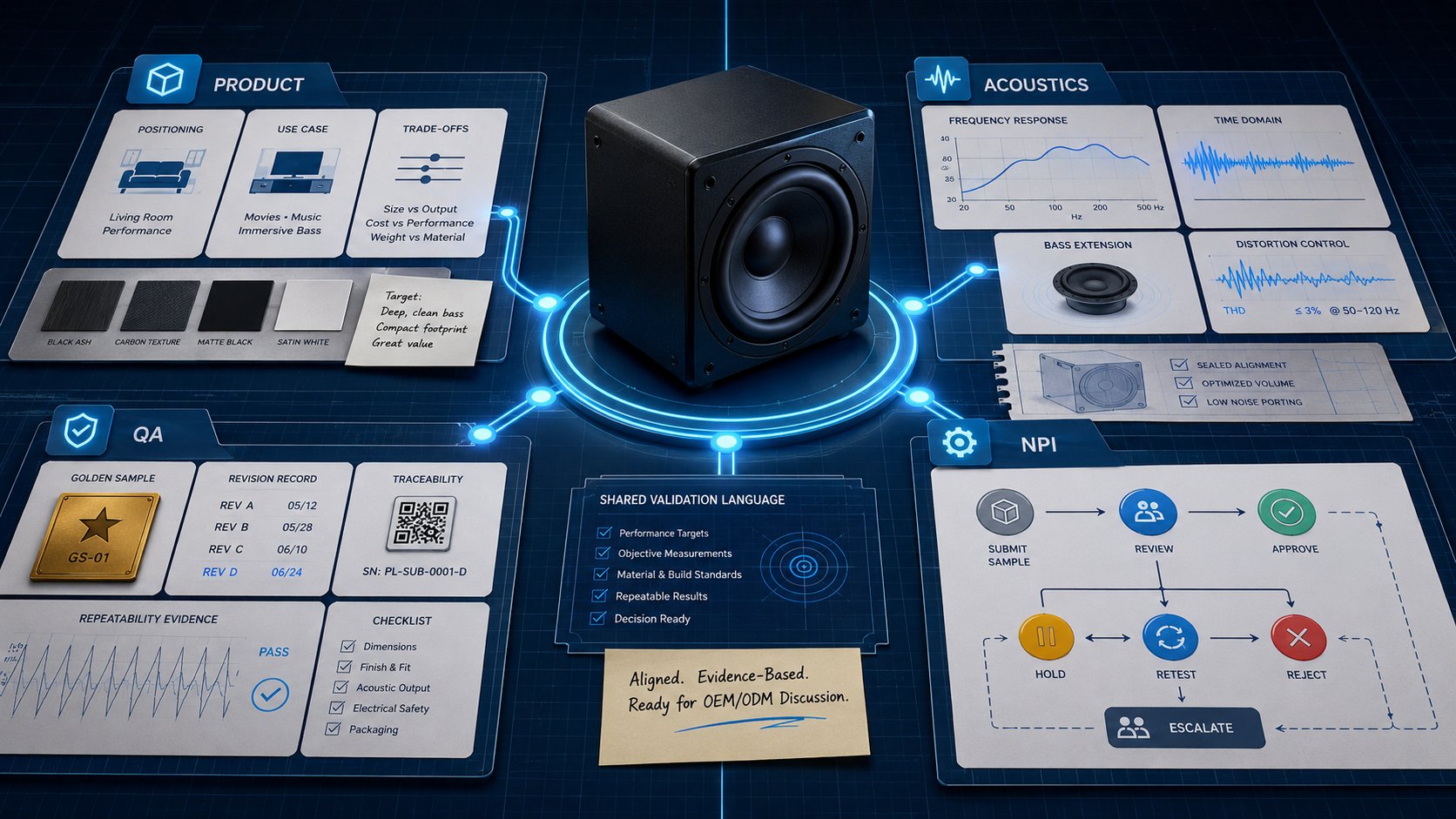
The platform boundary should be understandable to Product, PMM, Acoustics, Hardware, QA, NPI, sourcing, and the OEM/ODM partner. A practical matrix turns broad positioning into decisions that can guide development without inventing universal thresholds.
SQ and High-Power Portfolio Boundary Matrix
| Matrix field | Question the platform brief must answer |
|---|---|
| Architecture axis | Does the label describe an application, packaging constraint, performance promise, or commercial tier? |
| Primary job | What distinct decision or use case is the platform intended to serve? |
| Application envelope | Under which installation, enclosure, input, duty-cycle, or usage assumptions should the promise hold? |
| Must-win behavior | Which behavior receives priority when engineering tradeoffs appear? |
| Deliberate tradeoff | What is the platform allowed not to maximize? |
| Allowed overlap | Which ratings, materials, components, processes, or technologies may be shared without weakening the role? |
| Non-negotiable separation | Which promise, proof category, or use-case boundary must remain distinct? |
| Proof required | What evidence must support the promise at sample and production review? |
| Exclusion condition | Which use case or claim is outside the platform’s intended scope? |
| Owner and review trigger | Who approves the brief, and which changes require another architecture review? |
Start with the primary job, not the wattage target. “Premium sound” and “more power” remain too broad to govern a roadmap. The job should identify the distinct reason a program owner, internal team, or intended buyer would select the platform.
Next, define the application envelope. The same headline specification can represent different evidence when enclosure assumptions, inputs, duty cycles, or evaluation conditions differ. The brief does not need to prescribe every laboratory step, but it must state the conditions that make the promise meaningful.
The must-win behavior and deliberate tradeoff create strategic separation. For example, an SQ brief might prioritize controlled response, selected distortion or linearity criteria, and production consistency under defined conditions. A high-power brief may prioritize sustained output, thermal behavior, power compression, mechanical margin, or durability under a stated duty cycle. These are illustrative categories only. The relevant variables, methods, and limits depend on the particular program and require qualified engineering review.
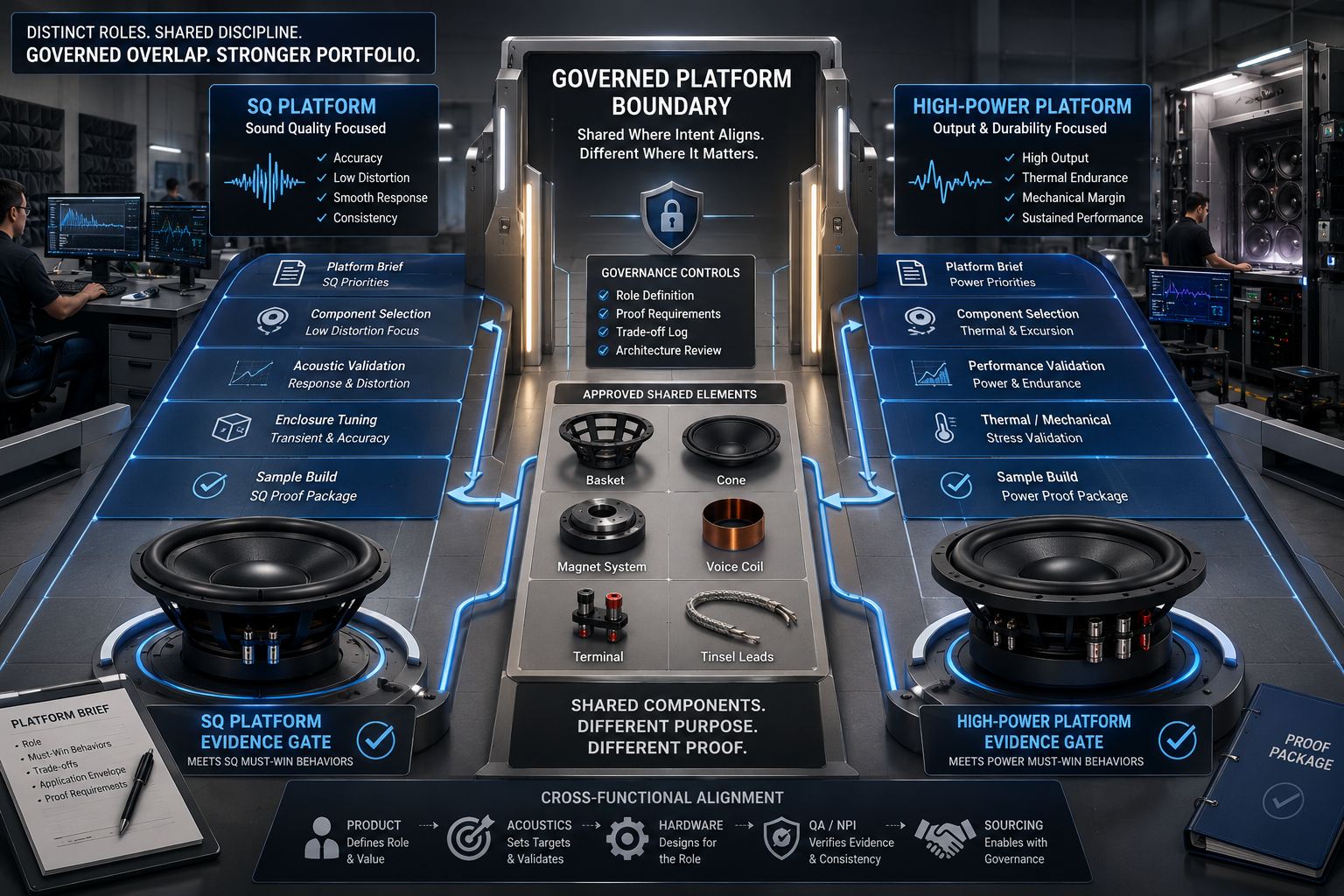
Allowed overlap gives teams permission to reuse technology. A frame size, nominal impedance, material family, motor architecture, or quality-control method may be shared when the platform priorities and proof remain distinct. Non-negotiable separation identifies the point at which reuse would erase the reason for maintaining two lines.
Finally, connect each promise to proof required. The related guide on turning subwoofer performance goals into acoustic validation criteria provides a deeper bridge from positioning to reviewable evidence.
When a brief names a measurement method, use current authoritative documentation rather than informal conventions. Official references such as AES75 and the CTA-hosted U.S. adoption of IEC 60268-5 can define particular measurement procedures or reported characteristics. They do not, however, decide whether a portfolio should label a platform SQ or high-power; that remains a program-level architecture decision.
Decide Which Overlaps Are Acceptable—and Which Signal Tier Collapse
Potentially acceptable overlap may include frame size, nominal impedance, some rated-power bands, common material families, selected components, manufacturing processes, baseline reliability expectations, and quality-control methods. None is universally safe or unsafe. The question is whether the shared element changes the platform’s selection reason, intended tradeoff, or evidence package. For example, two models might share the same cast aluminum frame and ferrite magnet grade. This is acceptable overlap if the SQ line uses a lighter voice coil and highly compliant suspension to prioritize low-level linearity, while the high-power line employs a heavier high-temp coil and stiffer spider for thermal survivability. However, if both use the exact same moving assembly and motor force, tier collapse has occurred.
Consider two hypothetical models with overlapping power ratings and related motor technology. The SQ platform is reviewed against one prioritized proof package within a defined application envelope. The high-power platform is reviewed against another. The shared ratings and architecture are not automatically fatal because each line still answers a different product decision.
A proposed SKU needs additional review when three answers converge:
- Role: Would the same customer, program, or internal team choose either product for the same reason?
- Proof: Would essentially the same evidence justify both promises?
- Tradeoff: Is the organization unable or unwilling to say what one line prioritizes over the other?
Three “yes” answers indicate probable portfolio overlap rather than harmless specification convergence.
Other warning signs include PMM distinguishing the products only through adjectives, a SKU with no deliberate tradeoff, or two OEM/ODM briefs that differ only in cosmetics and nominal ratings. Creating a larger wattage gap after the role has blurred changes the appearance of the range, not its logic.
The matrix is a decision aid rather than an automatic score. Shared components do not prove sameness, just as unique components do not prove meaningful differentiation.
Translate the Boundary Into a Platform Brief and OEM/ODM Proof Package
Once leadership approves the boundary, it should enter the development handoff. The platform brief should identify the role, intended application envelope, must-win behavior, deliberate tradeoff, candidate target categories, required test conditions, evidence expected at sample review, production-consistency expectations, supported and excluded claims, functional owners, and change-control triggers.
A supplier specification should implement the platform promise. It should not silently define the promise because an existing design is convenient or already proven in another context.
That distinction is especially important when one OEM/ODM platform is proposed for two branded lines. Reuse may be legitimate, but the proposal should be tested against both boundary matrices. If the same platform can support each line only by giving them the same job, tradeoff, and proof package, the architecture has probably collapsed. If the implementation preserves distinct priorities and evidence, reuse may remain compatible with the roadmap.
Decision rights should also be explicit. Product or category leadership owns the platform role. Acoustics and Hardware translate that role into technical criteria. QA defines evidence and production-consistency expectations. PMM aligns claims with available proof. Sourcing and the OEM/ODM partner assess implementation fit without replacing the brand’s architecture decision.
Govern Exceptions Before the Roadmap Converges Again
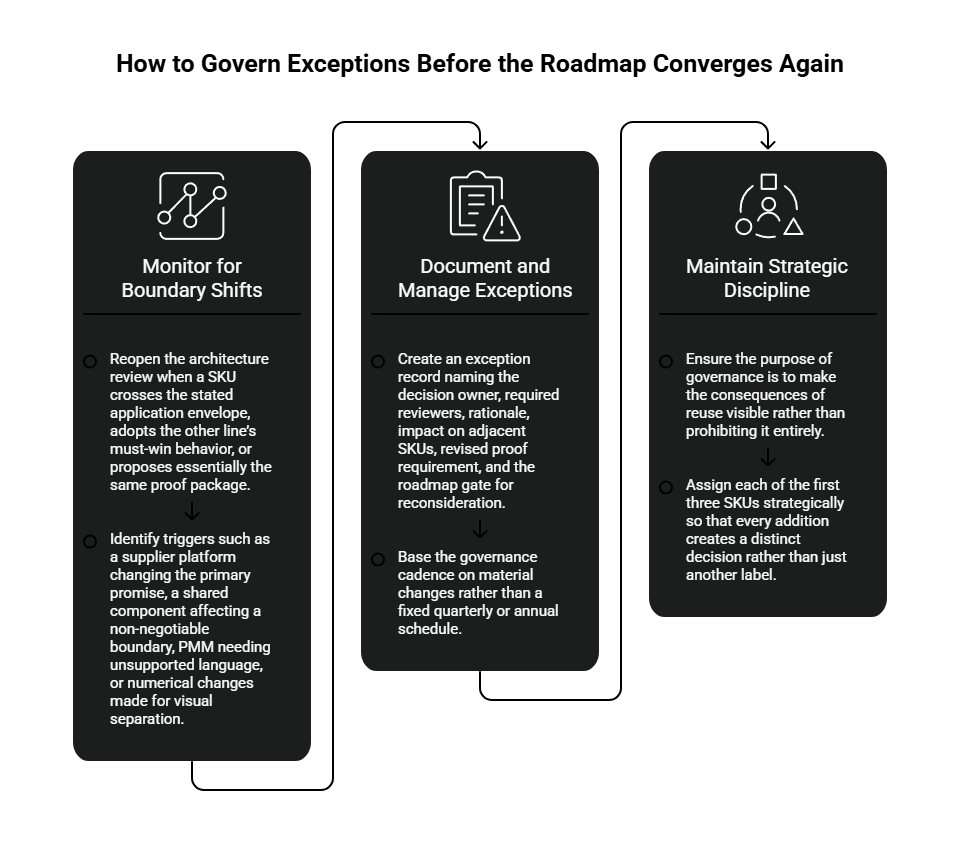
A boundary established during one planning workshop will not protect the portfolio indefinitely. New components, supplier proposals, packaging constraints, and adjacent SKUs can shift the logic.
Reopen the architecture review when a SKU crosses the stated application envelope, adopts the other line’s must-win behavior, or proposes essentially the same proof package. Other triggers include a supplier platform that changes the primary promise, a shared component affecting a non-negotiable boundary, PMM needing unsupported language to explain the difference, or a numerical change made mainly to preserve visual separation.
An exception record should name the decision owner, required reviewers, rationale, impact on adjacent SKUs, revised proof requirement, and the roadmap gate for reconsideration. A fixed quarterly or annual cadence is not necessary; the trigger should be the material change.
Exceptions can be valid. The purpose of governance is not to prohibit reuse but to make its consequences visible. The same discipline can strengthen decisions when planning the first three strategically assigned SKUs: each addition should create a distinct decision rather than another label for substantially the same role.
Protect the Role, Not an Arbitrary Numerical Gap
Similar specifications are not the core risk. The risk is losing a distinct role, deliberate tradeoff, proof package, and governance rule.
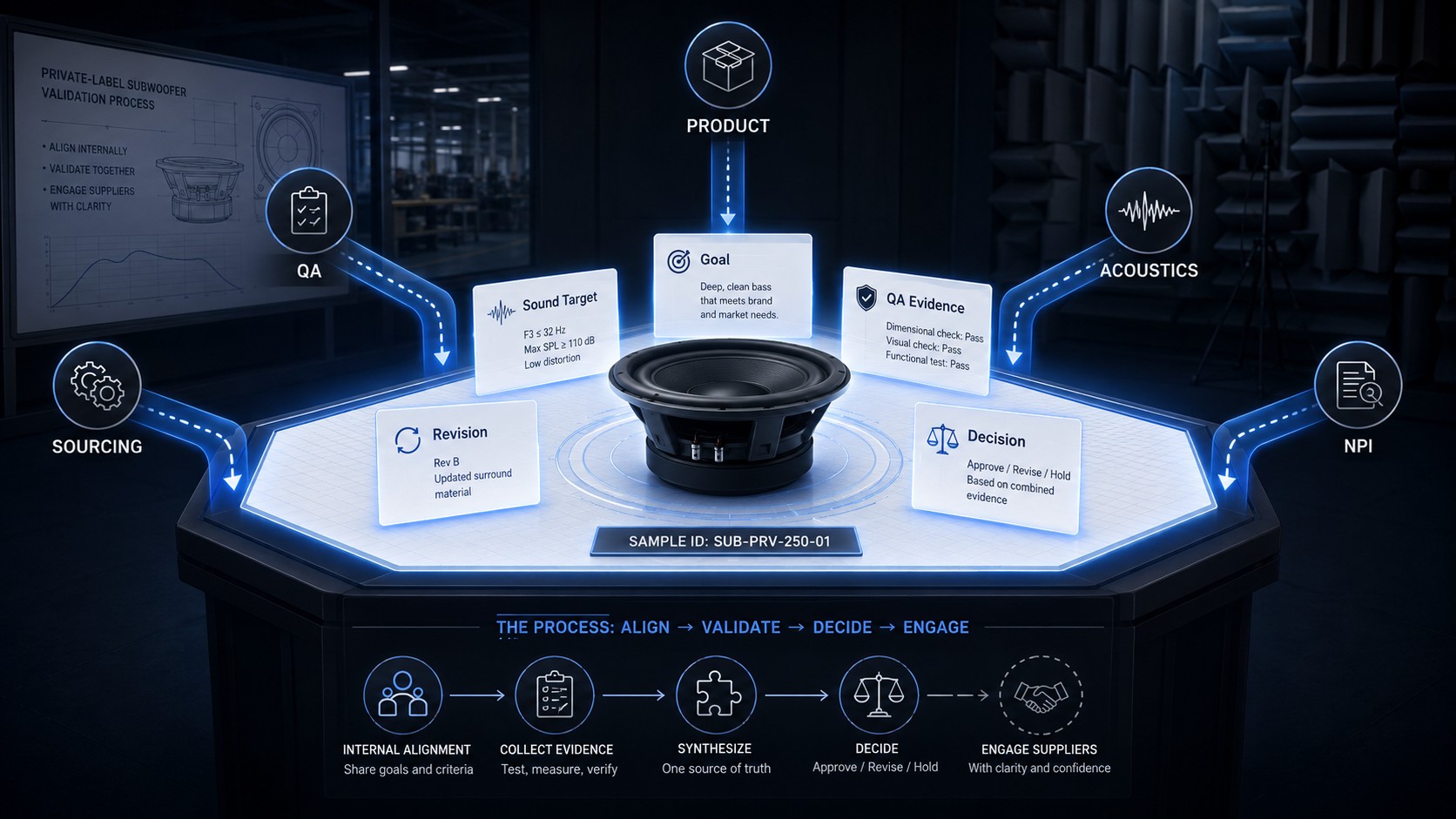
Before specification lock or OEM/ODM sampling, review the next SQ and high-power platform briefs with the boundary matrix. Confirm why each line exists, what it must win, what it may share, what it is allowed not to maximize, and what evidence will support its promise.
For a product-development discussion with China Future Sound, get in touch.
Frequently Asked Questions
Can SQ and High-Power Subwoofers Share Similar Power Ratings?
Yes, potentially. Similar ratings do not erase the distinction when the platforms serve different roles, prioritize different behaviors, operate within defined application envelopes, and rely on appropriately differentiated proof. The exact boundary depends on the program.
Should an SQ Line Be Defined by Lower Distortion?
Distortion may be one relevant evidence category, but it is not a universal or sufficient definition of SQ. The brief should identify which behaviors support the intended sound-quality promise and under which conditions they will be reviewed.
Is a Slim Subwoofer a Separate Performance Tier?
Not automatically. In this architecture model, slim primarily describes a packaging or integration constraint. The product still needs a performance promise, a commercial position, and proof appropriate to its intended application.
When Should the Platform Boundary Be Reviewed Again?
Review it when a proposed change affects the role, application envelope, must-win behavior, non-negotiable separation, proof package, or claims. The trigger should be a material architecture change rather than an arbitrary calendar date.
Disclaimer: This article provides general product-portfolio and development guidance. Acoustic targets, power ratings, test conditions, and validation criteria should be confirmed for the specific product, application, and engineering program.
Our Editorial Process:
Our expert team uses AI tools to help organize and structure our initial drafts. Every piece is then extensively rewritten, fact-checked, and enriched with first-hand insights and experiences by expert humans on our Insights Team to ensure accuracy and clarity.
About the China Future Sound Insights Team
The China Future Sound Insights Team is our dedicated engine for synthesizing complex topics into clear, helpful guides. While our content is thoroughly reviewed for clarity and accuracy, it is for informational purposes and should not replace professional advice.