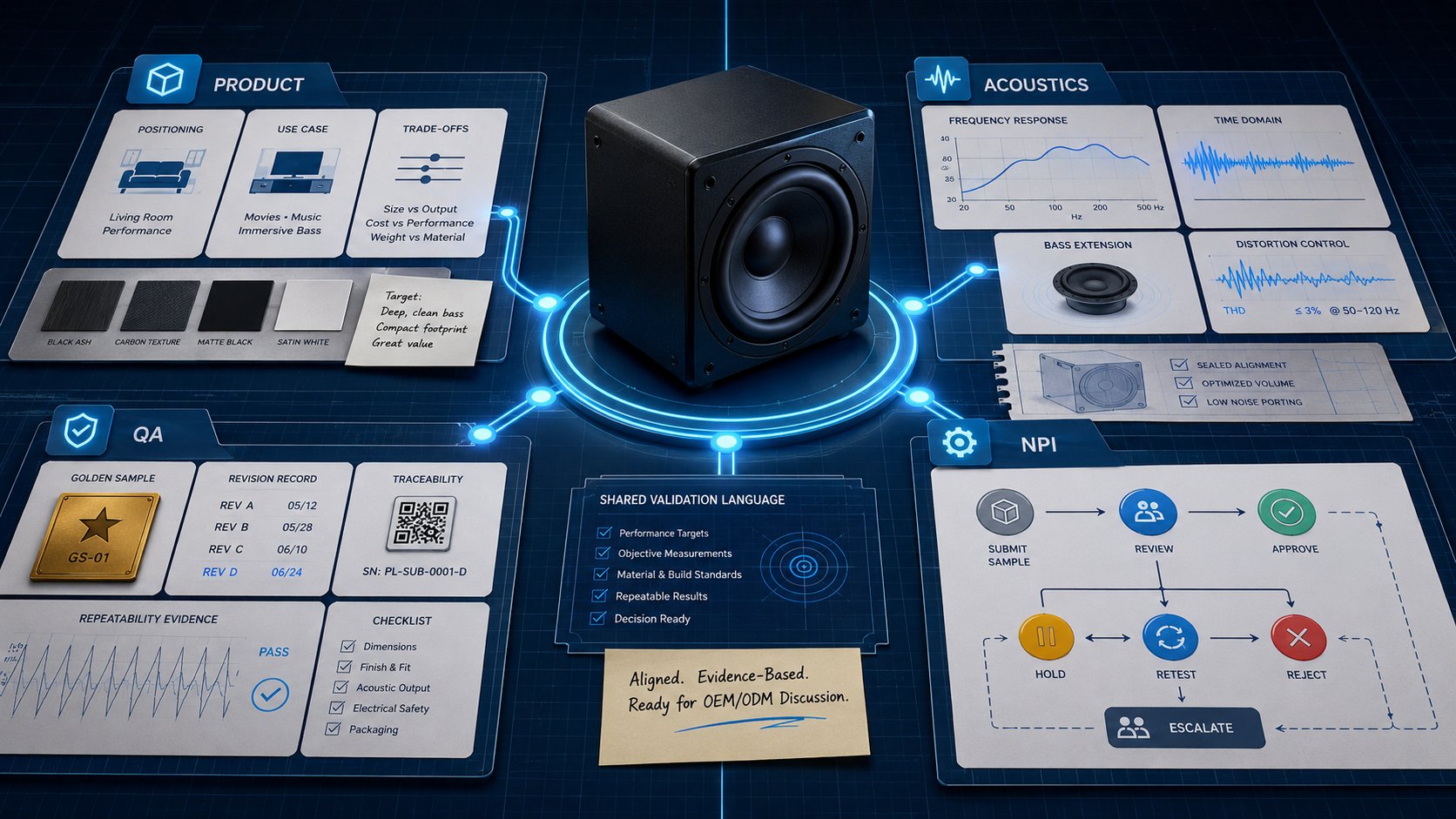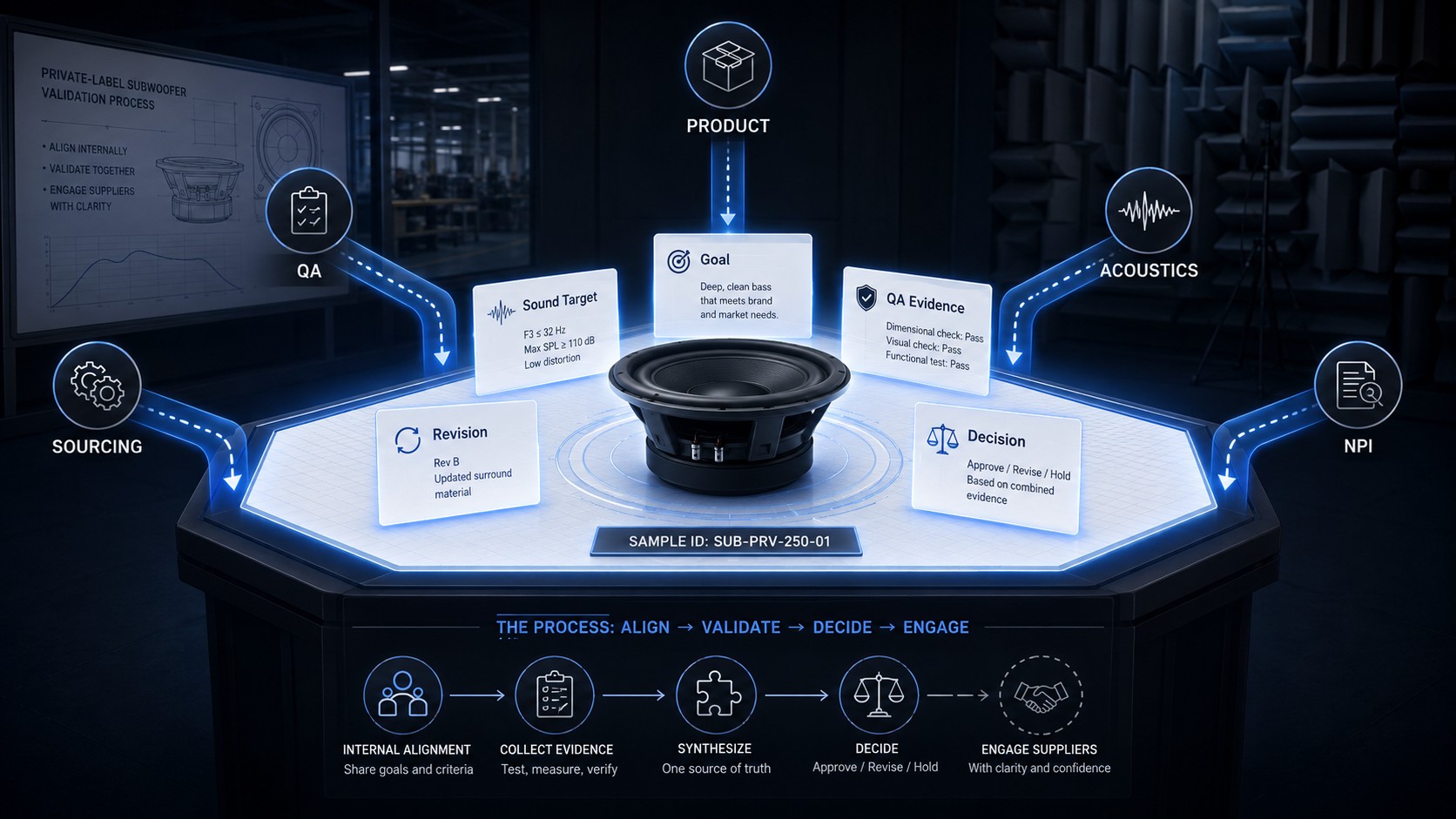
📌 Key Takeaways
Clear subwoofer positioning starts with each platform’s role, priority, trade-off, proof, and claim boundary—not its tier name or specifications.
- Define The Platform’s Job: Explain why a program would choose each platform over its nearest alternative before naming the tier.
- Make Trade-Offs Clear: State which goal wins and what the platform does not need to maximize when priorities conflict.
- Require Evidence For Claims: Specifications become useful messages only when verified results connect them to a clear customer benefit.
- Set Firm Claim Boundaries: Every promise must preserve its test conditions and avoid implying benefits that the evidence cannot support.
- Use Cross-Team Approval: Product, Engineering, QA, and PMM must confirm the role, proof, conditions, wording, and adjacent-tier distinction.
Distinct roles create credible product stories.
Product, Engineering, QA, and PMM teams will build clearer tier distinctions using the evidence matrix and review process below.
~ ~ ~ ~ ~ ~ ~ ~ ~ ~ ~ ~ ~ ~ ~ ~ ~ ~
Messaging teams cannot create a durable tier distinction when the underlying platform brief explains only specifications, components, and proposed names. Those inputs may describe a subwoofer, but they do not explain why the product belongs in the portfolio or what it may credibly promise.
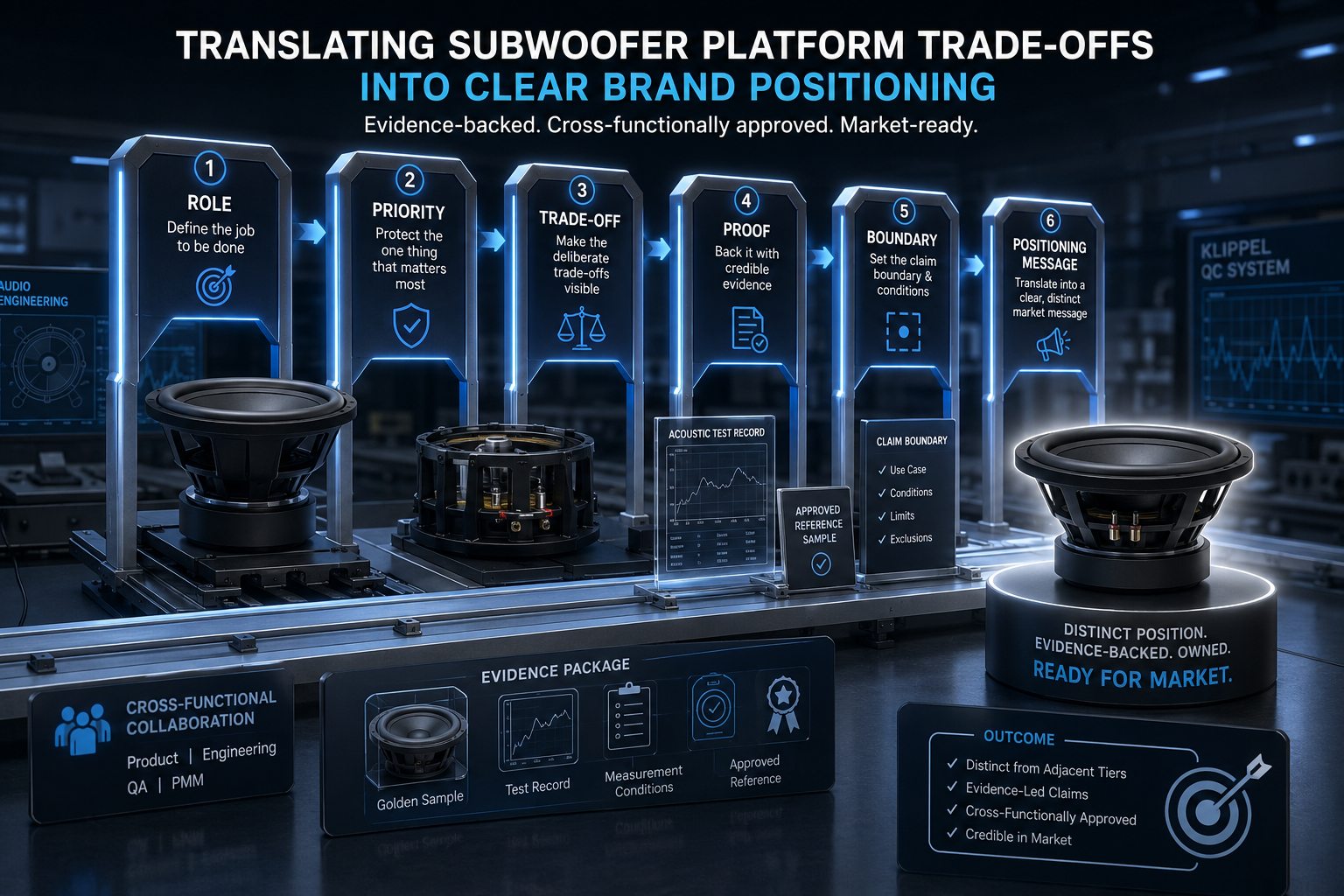
The weak translation is specification → adjective: more power becomes “powerful,” a material becomes “premium,” and a shallow design becomes “space-saving.” The stronger translation is role → priority → trade-off → proof → boundary → message. Maintains 500W of sustained output specifically engineered for shallow-depth marine enclosures, validated through long-term power tests to prevent thermal failure.
That sequence does not guarantee successful positioning. It provides a practical cross-functional framework for deciding which distinctions are relevant, supportable, and clear enough to survive Product, Engineering or Acoustics, QA, and PMM review.
Start with the platform’s job, not its tier name
A platform role is the specific decision, application, or use case a product family is intended to serve. It should be defined before the organization treats a proposed label as a meaningful tier distinction.
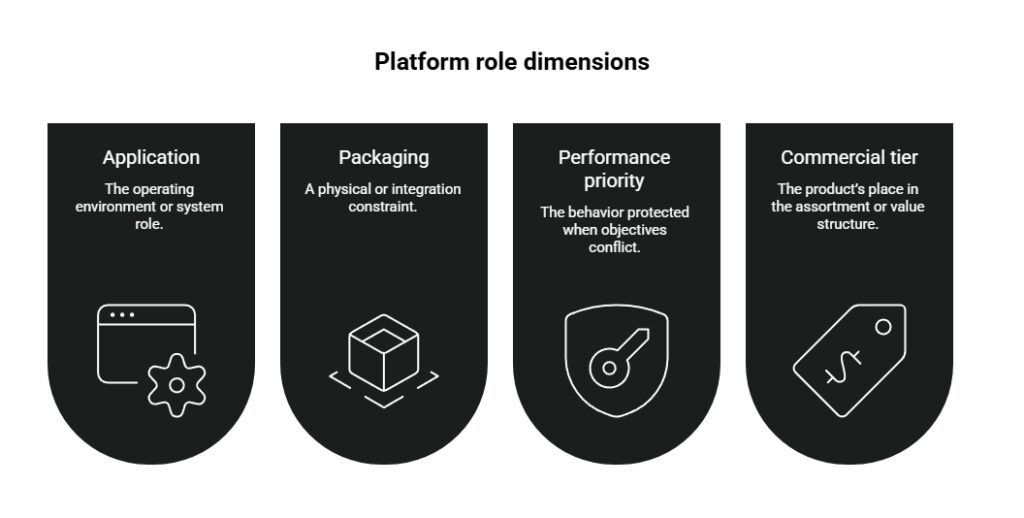
SQ, slim, high-power, and commercial tier names may describe different dimensions:
- Application: The operating environment or system role.
- Packaging: A physical or integration constraint.
- Performance priority: The behavior protected when objectives conflict.
- Commercial tier: The product’s place in the assortment or value structure.
This is an editorial architecture model, not a universal industry classification. “Slim” may describe packaging, while “SQ” and “high-power” may express program-specific priorities. Entry, core, and flagship describe another dimension. A single product can occupy more than one.
The exact distinction depends on the program. An SQ product is not inherently superior, a slim architecture is not necessarily compromised, and a high-power rating does not independently establish a higher-quality tier.
The first positioning question is therefore not, “What should this product be called?” It is, “Why would an intended program choose this platform rather than its nearest alternative?”
Translate each platform through a role–trade-off–proof–boundary chain
The following framework is intended as a cross-functional decision aid rather than an established technical standard:
- Role: What job is the platform meant to perform?
- Priority: What behavior must it protect when objectives conflict?
- Deliberate trade-off: What is it not required to maximize? A deliberate trade-off is an accepted design choice, not automatically a defect.
- Proof category: What type of measurement, comparison, test record, or review is required to support the intended promise?
- Claim boundary: What must the market-facing statement not imply?
Products described as maximizing output, integration flexibility, accuracy, durability, efficiency, and value simultaneously are difficult to differentiate credibly. The team needs to state which objective wins when all objectives cannot receive equal priority.
For example, two platforms might share the same headline power rating. One is intended for shallow-integration programs, while the other prioritizes a different output or enclosure objective under defined conditions. The shared rating does not make the platforms identical, but neither role proves better overall performance.
The same framework can be used across broader private-label subwoofer platforms, provided website categories are not treated as evidence of separate technical architectures.
Platform-to-Positioning Evidence Matrix
Complete one row for each platform or product family. Keep every entry to one sentence or a short phrase.
| Platform or family | Dimension and primary job | Must-win behavior and deliberate trade-off | Use-condition assumptions | Evidence category and message implication | Claim boundary and adjacent-tier distinction | Approval owners | Re-review trigger |
|---|---|---|---|---|---|---|---|
| [Name] | Is the distinction based on application, packaging, performance priority, commercial tier, or another dimension? What decision does it serve? | What receives priority, and what is the platform not expected to maximize? | Under which enclosure, installation, input, duty-cycle, or application conditions should the promise hold? | What approved evidence supports the restrained conclusion PMM may communicate? | What must the message not imply, and why would the intended program select this platform over the nearest alternative? | Which Product, Engineering/Acoustics, QA, and PMM stakeholders must approve the logic? | What platform, evidence, use-case, adjacent-SKU, or messaging change requires another review? |
A use-condition assumption records the circumstances under which a promise is expected to remain valid. It prevents a result obtained under one condition from becoming an unrestricted claim.
Separate specifications from message-worthy evidence
Specifications matter, but they do not arrive with an automatic market interpretation. A technical value becomes relevant to positioning only when the team can explain what decision it affects, how it was established, whether it is repeatable, how it differs from the adjacent platform, and what it does not prove.
| Layer | Definition | Decision question | Primary owner | Risk if skipped |
|---|---|---|---|---|
| Specification | A stated technical value or construction detail | Why is this input relevant to the platform’s job? | Product and Engineering | An available number or component is mistaken for a customer benefit. |
| Evidence | A verified result, record, comparison, or test artifact | Under which conditions, sample identity, and acceptance basis was it established? | Engineering/Acoustics and QA | The intended message relies on unsupported or non-repeatable data. |
| Message implication | The restrained conclusion that may be drawn from the evidence | What can PMM communicate without exceeding the result? | Product, Engineering, and PMM | Technical nuance becomes a broader promise than the evidence supports. |
| Claim | The final market-facing statement | Have the wording, conditions, and boundary been approved? | PMM or Brand, with technical review | Simplification becomes exaggeration. |
Evidence may include defined test conditions, version-controlled sample data, approved-reference or golden-sample controls, production-consistency records, comparisons against an agreed target, and documented limitations. These are evidence categories, not proof that a particular claim is already valid.
For instance, a larger voice coil or higher rating may be relevant to a product decision. PMM should not translate it into “cleaner bass,” “better control,” or “greater reliability” without evidence connecting that input to the claimed behavior.
Only differences that are relevant, understandable, and supportable should become customer-facing messages. Additional technical improvements may remain important to Engineering without becoming central positioning claims. More testing also cannot determine which promise matters; evidence supports a strategic decision but does not replace one.
Teams developing the proof package can review how to turn subwoofer performance goals into acoustic validation criteria.
When a claim depends on a named measurement method, verify the method’s current scope through official sources such as the AES standards directory and the relevant IEC standards catalog. If KLIPPEL results are referenced, use the company’s Large Signal Identification documentation to explain its vendor-specific methodology, not as independent proof of a product benefit.
Build distinct SQ, slim, and high-power promises without false absolutes
These labels should prompt different review questions rather than supply fixed answers.
For an SQ-oriented platform, define the behavior being prioritized, the operating conditions, and the evidence that supports the chosen interpretation. The team should also decide which output, packaging, cost, or application objective is not required to be maximized. Subjective wording such as “accurate,” “controlled,” or “musical” needs an agreed meaning before it becomes an approved claim.
For a slim platform, establish whether the principal value is installation depth, enclosure flexibility, packaging efficiency, or another integration constraint. Then determine which applications benefit and which performance promises remain supportable within that constraint. Packaging should not imply unverified parity with a larger architecture, but it should not be treated as evidence of inherent inferiority either.
For a high-power platform, define what the rating means within the program. Duration, impedance, thermal state, enclosure, and input conditions may affect the interpretation. The intended promise might concern sustained capability, short-term output, headroom, or another behavior; those possibilities require different evidence. A higher rating alone does not prove lower distortion, better sound quality, greater reliability, or higher commercial status.
The same product may combine dimensions. A slim architecture may also carry an SQ-oriented priority or occupy a flagship commercial position. Increasing the wattage gap between products would create numerical distance, but it would not by itself define distinct jobs, use cases, or product promises.
Materials and components require the same restraint. A premium material may be a deliberate engineering input, yet it does not independently prove a premium audible outcome.
Define the positioning boundary before naming the tier
A usable positioning brief should state what the platform is for, what it is not for, what it prioritizes, what it does not claim to maximize, and which adjacent product it should not replace.
Use the following three-question overlap test as an editorial diagnostic:
- Role: Would the same customer, program, or internal stakeholder choose either platform for essentially the same reason?
- Proof: Would both promises rely on materially the same evidence?
- Trade-off: Is the organization unable to state what one platform prioritizes over the other?
If all three answers are yes, additional portfolio review is warranted. This does not prove that one platform should be removed. Rational overlap can exist when roles, evidence packages, or deliberate trade-offs remain distinct.
An allowed claim might be: “Designed for programs where reduced installation depth is a primary integration requirement,” provided the dimensional and application basis is verified.
Claim boundary: Do not extend that statement into “delivers the same output and sound quality as larger architectures” unless approved comparative evidence supports those specific conclusions.
Another hypothetical warning sign appears when an SQ line and a high-power line both promise “deep, powerful, accurate bass,” rely on the same ratings, and cannot identify different use cases or trade-offs. The issue is not merely weak copy. The platform distinction remains unresolved.
A broader discussion of how to differentiate a private-label audio line may support this review, but the actual boundary must come from the program.
Create a cross-functional platform-to-positioning sign-off
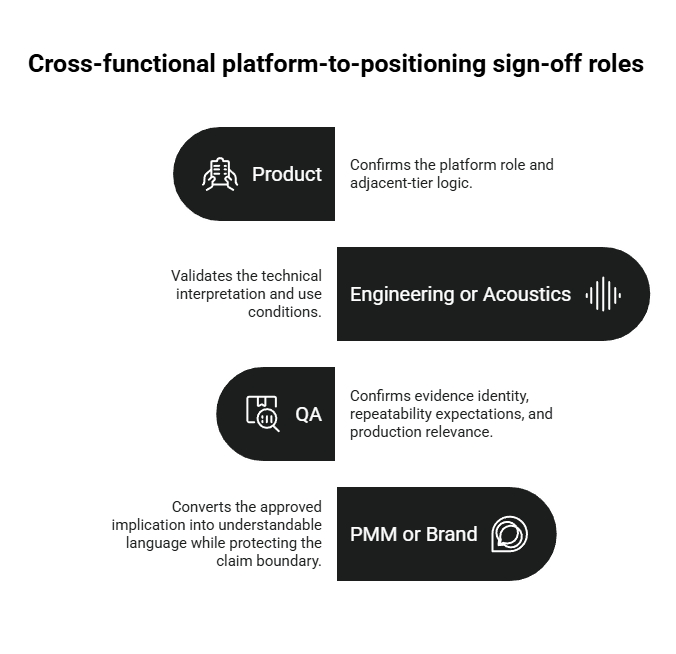
Neither Engineering nor Marketing should own the translation alone.
Product confirms the platform role and adjacent-tier logic. Engineering or Acoustics validates the technical interpretation and use conditions. QA confirms evidence identity, repeatability expectations, and production relevance. PMM or Brand converts the approved implication into understandable language while protecting the claim boundary.
Marketing simplification is necessary, but it must preserve material conditions and limitations. Engineering should not be expected to write the complete positioning story, while QA should not be made responsible for brand strategy.
The final review should return to the matrix and confirm:
- The primary job is distinct.
- The deliberate trade-off is explicit.
- The proof category matches the promise.
- Relevant test conditions and sample identity are documented.
- The adjacent platform does not make materially the same promise.
- The wording stops at the approved claim boundary.
In a practical sign-off scenario, Product confirms that a platform serves a distinct integration job; Engineering confirms what the available data supports; QA confirms which sample and controls the evidence represents; PMM removes wording that implies an unsupported broader benefit.
Full review is unnecessary for routine copy editing. Re-review becomes appropriate when a platform revision, component or enclosure change, new evidence, expanded use case, adjacent SKU, or stronger message could change the approved implication. Teams may also benefit from choosing to align hardware and acoustics before OEM sampling.
Positioning is the final expression of an earlier product decision
Positioning should not manufacture a difference that the platform brief cannot explain. A defensible product story requires a distinct role, a protected priority, an accepted trade-off, an appropriate proof category, and a boundary that prevents the message from claiming more than the program supports.
Before naming the tiers, complete the Platform-to-Positioning Evidence Matrix with Product, Engineering or Acoustics, QA, and PMM.
Frequently asked questions
Can two subwoofer tiers share the same power rating and still have different positioning?
Yes, potentially. A shared rating does not establish identical use cases, packaging constraints, design priorities, proof packages, or claim boundaries. The distinction must be documented through the platform role rather than assumed from the number or tier name.
Should SQ, slim, and high-power be treated as mutually exclusive tiers?
Not automatically. Slim may describe packaging, while SQ or high-power may describe program-specific performance priorities. Commercial hierarchy is another dimension. The precise architecture should be defined by the brand and program rather than presented as an industry-wide rule.
What evidence should PMM request before using a subwoofer performance claim?
Request the measurement or test basis, operating conditions, sample or version identity, comparison target, repeatability expectations, limitations, and approved message implication. Product-specific methods and conclusions should receive appropriate Product, Engineering or Acoustics, QA, and PMM review.
Disclaimer: This article is for general informational purposes only. It is not a substitute for advice from a qualified professional, provider, or official source relevant to your situation. Always verify important decisions with the appropriate expert, authority, or service provider.
Our Editorial Process:
Our expert team uses AI tools to help organize and structure our initial drafts. Every piece is then extensively rewritten, fact-checked, and enriched with first-hand insights and experiences by expert humans on our Insights Team to ensure accuracy and clarity.
About the China Future Sound Insights Team
The China Future Sound Insights Team is our dedicated engine for synthesizing complex topics into clear, helpful guides. While our content is thoroughly reviewed for clarity and accuracy, it is for informational purposes and should not replace professional advice.