📌 Key Takeaways
A high-power subwoofer line deserves separate portfolio status only when it creates a distinct choice with clear proof and tradeoffs.
- Define a Separate Role: A bigger rating supports a new tier, but it cannot define the product’s job or selection reason.
- Choose Clear Tradeoffs: State what the line must protect and what it need not maximize before engineering decisions begin.
- Demand Distinct Proof: Every main promise needs evidence that answers a different question from the proof supporting existing lines.
- Lead Suppliers With Strategy: Suppliers should answer a role-led brief; available designs cannot establish the portfolio gap.
- Allow Shared Parts: Shared parts do not create duplication when each line keeps distinct selection logic, priorities, proof, and boundaries.
A separate line must create a separate decision.
Product, engineering, marketing, and quality teams can test each proposal against the role framework that follows below.
~ ~ ~ ~ ~ ~ ~ ~ ~ ~ ~ ~ ~ ~ ~ ~ ~ ~
A proposed high-power subwoofer line can look differentiated before its role is clear. A larger wattage figure, heavier component package, or stronger name may suggest a new tier, yet none explains why the line deserves a separate place in the portfolio.
The decision is not simply whether the product can be built. It is whether it creates a distinct choice supported by a defined job, explicit tradeoffs, credible proof requirements, and a clear boundary relative to existing lines. The following warning signs expose weak tier logic before naming, supplier sampling, or launch communication advances.
What a Distinct High-Power Role Must Contain
“High-power” is not treated here as a universal wattage threshold. It is a program-specific promise defined by the intended application, the behavior the platform must prioritize, the claims the brand expects to make, and the evidence required to support them.
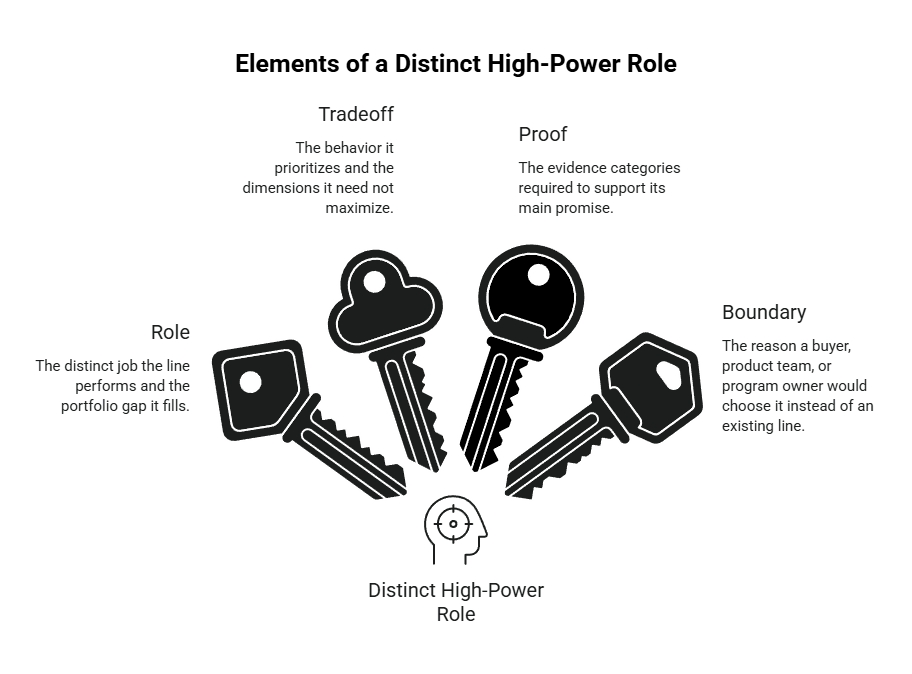
A defensible role contains four elements:
- Role: The distinct job the line performs and the portfolio gap it fills.
- Tradeoff: The behavior it prioritizes and the dimensions it need not maximize.
- Proof: The evidence categories required to support its main promise.
- Boundary: The reason a buyer, product team, or program owner would choose it instead of an existing line.
Specification difference: A visible or measured product attribute that changes.
Portfolio difference: A difference in why the line exists, when it should be selected, and what decision becomes possible because it exists.
The two are not interchangeable. A specification change may support a portfolio distinction, but it does not create one by itself.
Across a broader subwoofer product range, products may overlap in size, materials, ratings, or supplier architecture without becoming strategically identical. The problem begins when the team cannot explain a separate application, priority, proof question, or selection reason.
Seven Warning Signs the Proposed Line Is Duplicating the Portfolio
No single warning sign automatically proves that a proposal should be canceled. Each one indicates that the role needs clarification before the product receives a separate platform identity.
| Warning sign | Why it matters | Question to ask | Likely implication |
|---|---|---|---|
| 1. The larger headline number is the only clear difference | A higher rating does not define the application, priority, evidence context, or selection reason. | What decision becomes possible because the number is higher? | Define the role or treat the product as a rating extension. |
| 2. The line targets the same application and selection reason | Different specifications can still compete for the same use case and buyer decision. | Why would the existing line be the wrong choice? | Consider an extension, replacement, or combined platform. |
| 3. The team cannot state a deliberate tradeoff | Without priorities, Engineering has no stable basis for resolving design conflicts. | What must this line protect, and what may it avoid maximizing? | Revise the brief before architecture decisions advance. |
| 4. The proposed claims use the same proof as an existing line | Stronger adjectives do not create a separate evidence requirement. | What must this line prove that the existing line does not? | Clarify the claim and proof package. |
| 5. PMM is creating the distinction before Product and Engineering define it | Messaging may invent differentiation that cannot survive technical review. | Can every claim be traced to an agreed priority and evidence category? | Pause naming and claims until the role is agreed. |
| 6. The supplier’s available design is the main reason the line exists | Availability answers an execution question, not a portfolio question. | Which defined portfolio gap does the proposal fill? | Reassess strategic fit before sampling. |
| 7. The line adds coordination burden without creating new coverage | Separate naming, evidence, and governance are difficult to justify without a new decision. | What new portfolio choice requires separate governance? | Reframe it as a SKU, extension, or specification update. |
1. The Larger Headline Number Is Carrying the Tier Logic
A numerical increase can be meaningful, but it is not a complete strategy. When the line is described only as “the higher-wattage series,” the rating has replaced the product role.
The more useful question is what the increased rating enables within the intended program. Depending on the application, it may support a different operating expectation, proof requirement, or system role. Those possibilities require technical review; they cannot be assumed from the number alone.
2. Both Lines Serve the Same Application for the Same Reason
Consider an illustrative planning scenario: an existing line and a proposed high-power line target the same application envelope, system assumptions, and buyer objective. The proposed product has a higher rating, but Product and PMM expect the same customer to choose either line for the same reason.
The product may add useful coverage, yet still belong as an extension, replacement, or higher-rated option. A durable distinction creates situations in which the new line is appropriate and the existing one is not.
3. The Brief Refuses to Name a Tradeoff
A platform brief becomes unstable when output, sound quality, compactness, durability, efficiency, and cost are all treated as unrestricted must-wins. This does not mean a high-power product must sacrifice any particular attribute. It means the specific program should state which behavior governs decisions when objectives compete. For example, if the goal is to maximize SPL in a shallow-mount enclosure, the team must explicitly agree to trade off extreme low-frequency extension or accept a higher BOM cost for a specialized Neodymium motor structure.
Without that priority, Engineering, QA, PMM, and Sourcing may resolve the same conflict differently. Cross-functional disagreement often signals that the role needs greater precision.
4. The New Promise Does Not Create a New Proof Question
A separate line should not depend on stronger adjectives supported by the same generic evidence. If both lines rely on broad statements such as “built for demanding use,” the distinction remains weak.
Some validation categories may be shared. The important point is that the proposed promise creates a meaningfully different question for the evidence to answer. Exact methods, conditions, and limits vary by program and require qualified technical review. Product strategy should establish what must be proven before the test plan determines how.
5. Messaging Is Advancing Ahead of the Platform Decision
Early naming work can make a vague concept appear settled, pressuring teams to defend the line rather than evaluate it.
PMM should translate an agreed platform role into claims; it should not invent that role after development begins. The sequence should run from product decision to evidence requirement to message. This supports more defensible private-label differentiation because the story reflects actual priorities and boundaries.
6. Supplier Availability Has Become the Strategy
A mature supplier design can be useful when it fits the brand’s requirements, but it does not establish why the portfolio needs a separate line.
The supplier proposal should answer the brand’s role-led platform brief. Reversing that sequence encourages teams to define the portfolio gap around whatever is available. Platform reuse remains acceptable when the role, evidence, and selection boundaries are still distinct.
7. Separate Governance Produces No New Decision
A new line requires naming rules, positioning boundaries, evidence ownership, future variant decisions, and agreement about exceptions. Those requirements are justified when the line creates meaningful new coverage.
The practical question is whether the coordination supports a new portfolio decision. If not, the proposal may belong within an existing platform, using clearer principles for assigning distinct SKU roles.
Run the Role–Tradeoff–Proof–Boundary Test
The following framework is a planning tool, not an industry standard. Product or Category leadership should own the final decision, with PMM, Acoustics, QA, Sourcing, and NPI contributing evidence and implementation constraints.
| Field | Review question |
|---|---|
| Existing portfolio gap | What decision, application, or promise is currently unserved? |
| Proposed line job | What distinct job does the high-power line perform? |
| Intended selection reason | Why choose it instead of an existing line? |
| Must-win behavior | What does the platform prioritize when tradeoffs appear? |
| Deliberate tradeoff | What does the platform not need to maximize? |
| Claim boundary | What may PMM say, and what must it not imply? |
| Proof package | What evidence categories support the promise? |
| Allowed overlap | Which components, specifications, or processes may be shared? |
| Non-negotiable separation | Which role, proof category, or application boundary must remain distinct? |
| Governance owner | Who approves the role, exceptions, and re-review triggers? |
| Decision | Separate line, extension, combine, revise, or hold? |
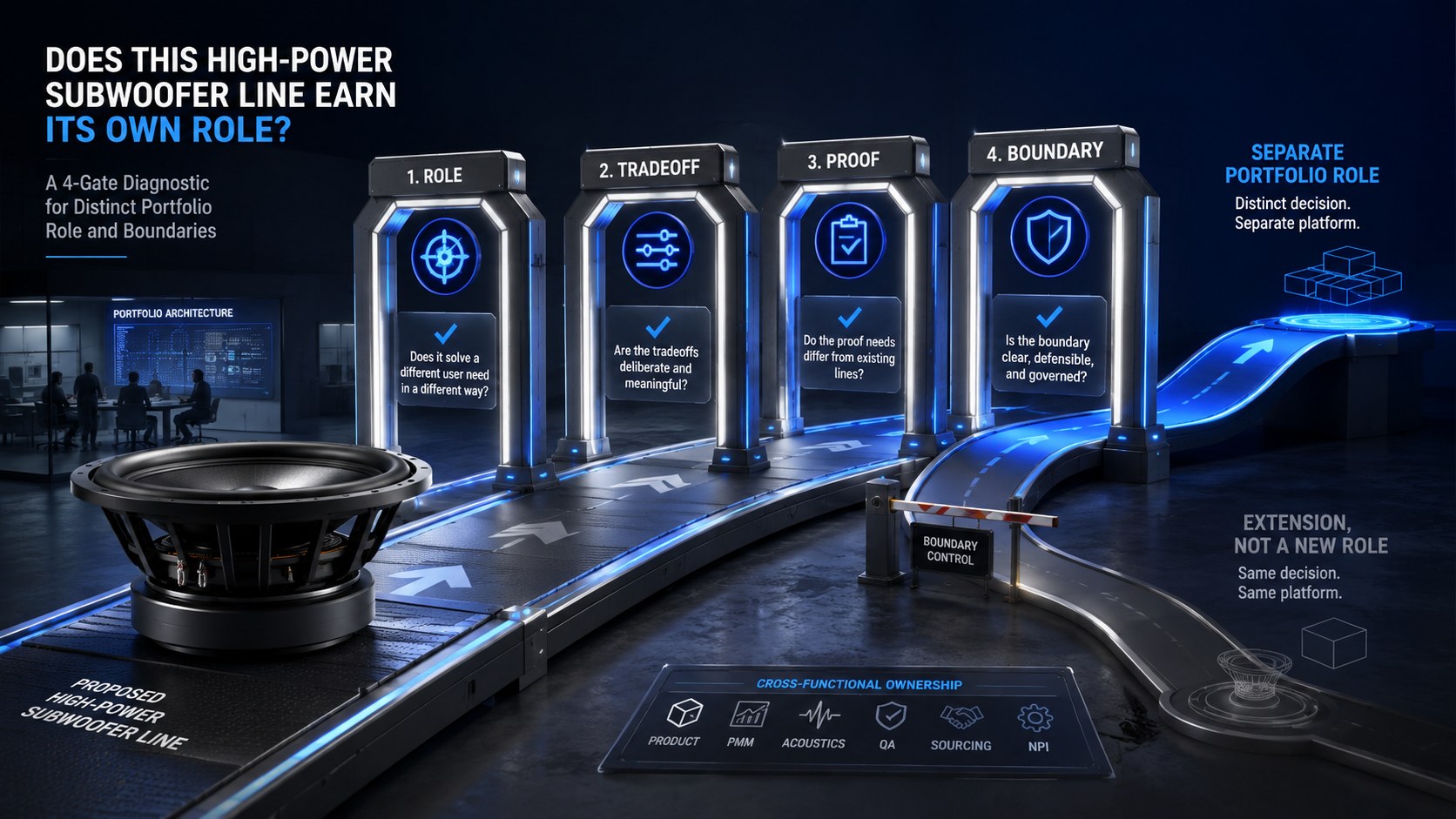
The core diagnostic asks four questions:
- Does the proposed line serve a distinct job?
- Can the team state what it prioritizes and what it does not?
- Does it require a meaningfully distinct evidence package?
- Is there a clear reason to choose it instead of an existing line?
As an editorial decision rule, a proposal that cannot answer at least three questions clearly should not advance as a separate line without revision.
The outcome may be to proceed, revise the concept as an extension, combine it with an existing platform, or hold it until the rationale and evidence plan are complete. A technically credible product can still be a weak portfolio addition.
Once the role is stable, teams can begin turning performance goals into practical validation criteria without allowing validation activity to define the strategy retroactively.
Shared Architecture Does Not Automatically Mean Duplication
Distinct portfolio roles do not always require fully separate engineering. Depending on the program, products may share baskets, motors, tooling, materials, manufacturing processes, or supplier platforms.
| Shared architecture with distinct roles | Different hardware with duplicated roles |
|---|---|
| Different application or selection reason | Same application and selection reason |
| Clear priority and claim boundary | Similar promises despite visible differences |
| Evidence reflects the separate promise | Evidence does not explain the separation |
| Overlap is documented and governed | Hardware variation substitutes for role clarity |
Reuse is not duplication. Conversely, different hardware does not guarantee differentiation. The deciding issue is whether each line creates separate selection logic, priorities, proof requirements, and boundaries.
Any claim that reuse lowers cost, shortens development, or reduces quality risk requires program-specific evidence and should not be assumed.
What to Resolve Before Naming, Sampling, or Launch Communication
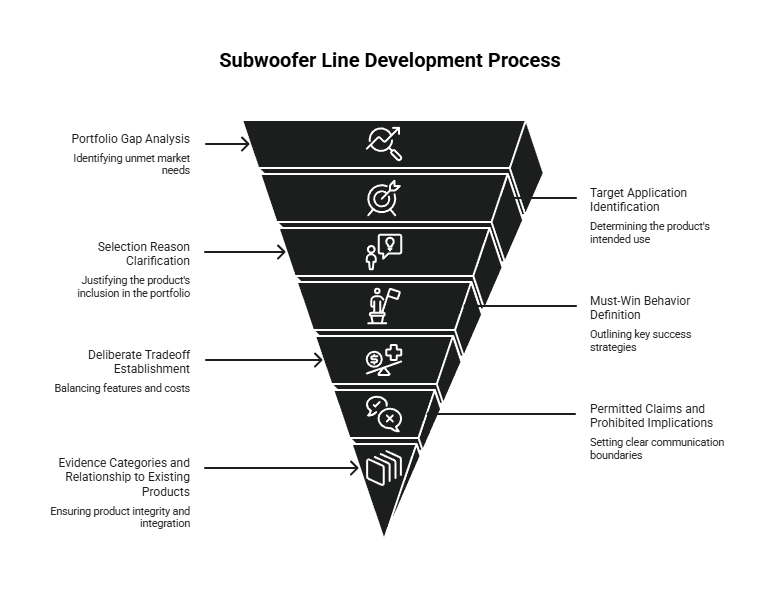
Before advancement, the team should agree on the portfolio gap, target application, selection reason, must-win behavior, deliberate tradeoff, permitted claims, prohibited implications, evidence categories, relationship to existing products, and decision owner.
Exact technical targets can follow after the strategic role is stable. Suppliers should receive a role-led platform brief, not a general request for “more power.”
The governance owner should also define re-review triggers. Changes to the application, claim scope, architecture, or evidence plan may require the role decision to be reconsidered before the product proceeds.
A Separate Line Should Create a Separate Decision
A high-power line earns a distinct position when it changes why, when, or under what evidence a product is selected. A larger rating may support that distinction, but it cannot replace it.
Before development advances, Product, PMM, Acoustics, and QA should review the proposal using the Role–Tradeoff–Proof–Boundary Test. The result should be a clear decision: proceed as a separate line, revise it as an extension, combine it with an existing platform, or hold it for clarification.
For a broader OEM/ODM platform discussion, Get in Touch!.
Frequently Asked Questions
What should define a high-power subwoofer line?
It should be defined for the specific program through its intended application, prioritized behavior, tradeoffs, claim boundary, and evidence requirements. No universal wattage threshold is assumed.
Is a higher wattage rating enough to justify a separate tier?
No. The rating may support the distinction, but the line still needs a separate job and selection reason. Otherwise, it may be better treated as an extension or higher-rated model.
Can a high-power line share components with another platform?
Potentially, yes. Shared components do not erase separate roles when application, priority, proof, and positioning boundaries remain clear. Suitability depends on the program.
When is a line extension more appropriate?
An extension is often clearer when the product adds useful size, rating, fit, or configuration coverage but does not establish a new platform promise, evidence package, or selection reason.
Disclaimer: This article provides general product-strategy information. Technical targets, test conditions, product claims, and portfolio decisions should be reviewed against the requirements of the specific product program.
Our Editorial Process:
Our expert team uses AI tools to help organize and structure our initial drafts. Every piece is then extensively rewritten, fact-checked, and enriched with first-hand insights and experiences by expert humans on our Insights Team to ensure accuracy and clarity.
About the China Future Sound Insights Team
The China Future Sound Insights Team is our dedicated engine for synthesizing complex topics into clear, helpful guides. While our content is thoroughly reviewed for clarity and accuracy, it is for informational purposes and should not replace professional advice.