📌 Key Takeaways
A multi-year subwoofer platform needs clear boundaries, controlled changes, reliable evidence, named owners, and visible supply dependencies.
- Define Platform Boundaries: Separate shared elements from controlled options and new development before approving the platform for future product roles.
- Map Critical Dependencies: Identify vulnerable components, materials, tools, and outside sources instead of trusting broad availability promises.
- Control Every Change: Link each approved revision to its records, final production setup, and exact manufacturing start point.
- Assign Clear Ownership: Name who controls the master specification, resolves conflicts, approves changes, and decides when reuse should stop.
- Demand Traceable Evidence: Use versioned records tied to specific products and revisions, since one successful sample cannot prove future support.
A roadmap needs proof, ownership, and honest platform limits.
Product leaders evaluating subwoofer manufacturing partners will gain a practical question framework in the guidance that follows.
~ ~ ~ ~ ~ ~ ~ ~ ~ ~ ~ ~ ~ ~ ~ ~ ~ ~
A subwoofer platform can be a strong fit for the first planned SKU and still be a weak foundation for the next three product decisions. The issue is not necessarily poor engineering. It may be an unclear boundary between what the architecture already supports, what can change through controlled configuration, and what becomes a new development program.
That distinction matters when a roadmap may later include slim, sound-quality, mainstream automotive, high-power, or adjacent variants. Current specifications and one successful sample describe the product in front of the team. They do not, by themselves, establish future variant fit, continuity, revision control, or differentiation capacity.
A more useful evaluation examines platform boundaries, critical dependencies, evidence, ownership, and change governance. The following framework helps product leaders test those areas before treating an OEM or ODM platform as a multi-year roadmap foundation.
Start by Defining What “Roadmap Support” Means
An original equipment manufacturer, or OEM, generally produces a product against brand-led requirements. An original design manufacturer, or ODM, typically offers an existing design that a brand can adopt or adapt. In practice, the division can vary by program, so the relevant question is not the label alone. It is how the proposed architecture will be governed.
For this discussion, a platform means the shared design elements, components, tooling, processes, specifications, and evidence that related products may reuse. Roadmap support means more than producing several similar SKUs. It requires visible platform boundaries, controlled revisions, continuity awareness, evidence stewardship, and coordinated decisions across relevant functions.
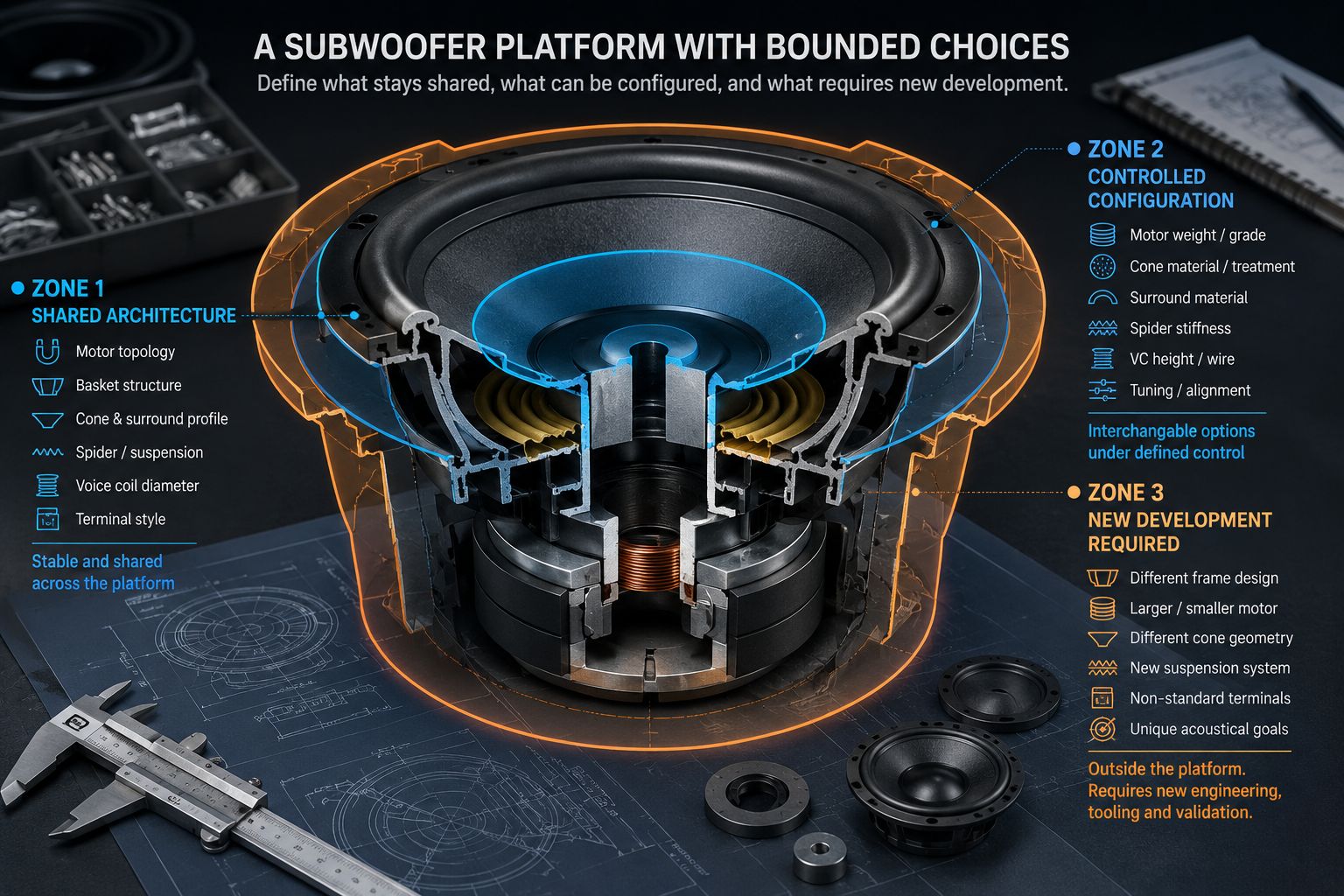
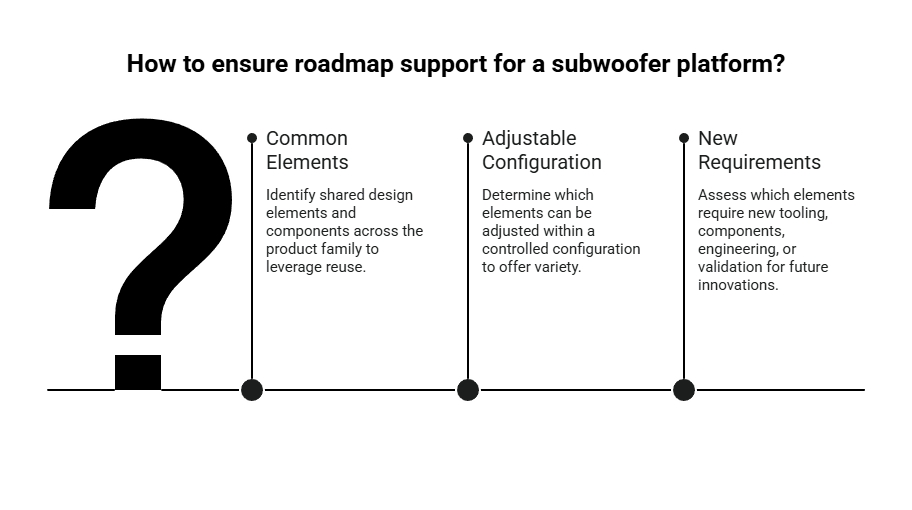
A useful discussion separates three categories:
- What remains common across the product family.
- What can be adjusted within a controlled configuration.
- What requires new tooling, components, engineering, or validation.
This is an evaluation framework rather than a universal industry definition. The exact boundary depends on the proposed product role and the supplier’s actual architecture.
Roadmap Support Question Matrix
| Question to clarify | Why it matters | Evidence that strengthens the answer | Incomplete or risky response |
|---|---|---|---|
| Which elements are fixed across the platform? | Defines the real shared architecture. | Platform-family view and a controlled common-element list. | “Everything is customizable.” |
| Which planned variants already fit? | Connects the supplier’s platform to the brand’s roadmap. | Variant review tied to stated product-role assumptions. | “We can decide after the first SKU.” |
| What would require new development? | Prevents redesign work from being presented as a minor option. | Clear boundaries for tooling, components, architecture, and validation. | No distinction between configuration and redesign. |
| Which dependencies affect continuity? | Reveals exposure to components, materials, tooling, and external sources. | Critical-dependency list, tooling records, and substitution rules. | A long availability promise without supporting conditions. |
| How are changes communicated and approved? | Keeps revisions visible and traceable. | Change record, approval route, and production cut-in evidence. | Informal messages or notification after implementation. |
| Who owns the authoritative specification? | Prevents conflicting instructions and undocumented decisions. | Named owner, document hierarchy, and current configuration baseline. | Several files with no governing version. |
| What evidence exists from earlier variants? | Separates demonstrated control from general assurances. | Versioned records linked to a specific product and revision. | Examples with no identity, scope, or documentation. |
| Who decides when reuse no longer fits? | Tests whether tradeoffs can be escalated honestly. | Cross-functional responsibility and escalation map. | Pressure to force every variant onto one architecture. |
The matrix presents decision criteria, not universal supplier obligations. Notification periods, availability durations, technical standards, and product thresholds require program-specific evidence.
Clarify Where the Platform’s Boundaries Actually Are
“Customizable” can refer to branding, cosmetic changes, tuning, structural modification, component changes, or complete redesign. Without clearer categories, the word provides little engineering or roadmap value.
Map each planned product role to a small set of assumptions: packaging direction, intended differentiation, likely shared elements, and performance intent. Exact specifications may not yet exist. Directional roles can still reveal whether the platform has room to evolve.
Consider a scenario where a brand has a successful mainstream automotive platform and plans a slim variant. A stronger answer identifies which common elements may remain viable, which structural assumptions change, and what needs further engineering or validation. A lower-profile frame alone would not establish that the broader architecture still fits.
The same reasoning applies when product management wants one architecture to support both sound-quality and high-power roles. Commonality may remain useful in selected areas, but forced reuse can restrict differentiation or create excessive exceptions. This may indicate that separate development is more appropriate.
Request a platform-family diagram, a controlled list of common and configurable elements, examples of prior approved variants, and a clear account of what triggers new development. Avoid treating any generic depth, power, excursion, or acoustic threshold as universal.
Determine What Continuity Depends On
No responsible roadmap should assume that every component, material, process, or external source will remain unchanged indefinitely. The stronger objective is visibility into the dependencies that support the current platform.
Clarify which inputs are critical, which can be replaced without altering the approved product, and which substitutions require review. For example, a specific voice coil supplier or a proprietary cone material that cannot be easily dual-sourced. Distinguish documented commitments from planning assumptions. A transparent dependency map is often more useful than an unsupported promise of long-term availability.
If a critical component becomes unavailable and the supplier proposes an alternative, the key questions concern. The key questions concern the evidence supporting equivalence, the functions required to review the change, the approval owner, any renewed validation, and the production point at which the revised configuration becomes effective.
Useful evidence may include a critical-component list, tooling records, component-change or discontinuation practices, approved-alternative rules, and named notification and escalation owners.
No universal notification period or continuity duration applies to every supplier relationship. Confirm how these matters apply to the proposed platform and document the assumptions before development begins.
Examine How Changes Are Controlled
Change control is the governance used to review, approve, record, and introduce revisions. It matters because a product family can accumulate several drawings, bills of materials, samples, test records, and digital settings that appear similar but represent different approved configurations.
Clarify which changes require brand review and how affected records are versioned. A bill of materials, or BOM, is the controlled list of parts and materials used in a product. Where software, firmware, or digital signal processing settings apply, those items also need revision identity.
The supplier should be able to show how an approved change connects to the resulting production configuration. The effective production cut-in point—the point at which the revised version enters manufacturing—should also be identifiable.
Informal messages are a weak substitute for a controlled record because they may not establish the affected products, approval authority, or implementation timing. Request an example revision record, change approval, current master specification, approved-reference identity, and production cut-in documentation.
The existence of documents is not enough. The question is whether the records form one coherent, traceable change process.
Establish Who Owns the Specification and Evidence Trail
Specification stewardship means maintaining the authoritative product definition and resolving conflicts. It is not merely document storage.
A configuration baseline is the approved set of specifications, component information, samples, settings, and supporting evidence for a defined product version. Each variant should have an identifiable baseline, even when much of the architecture is shared.
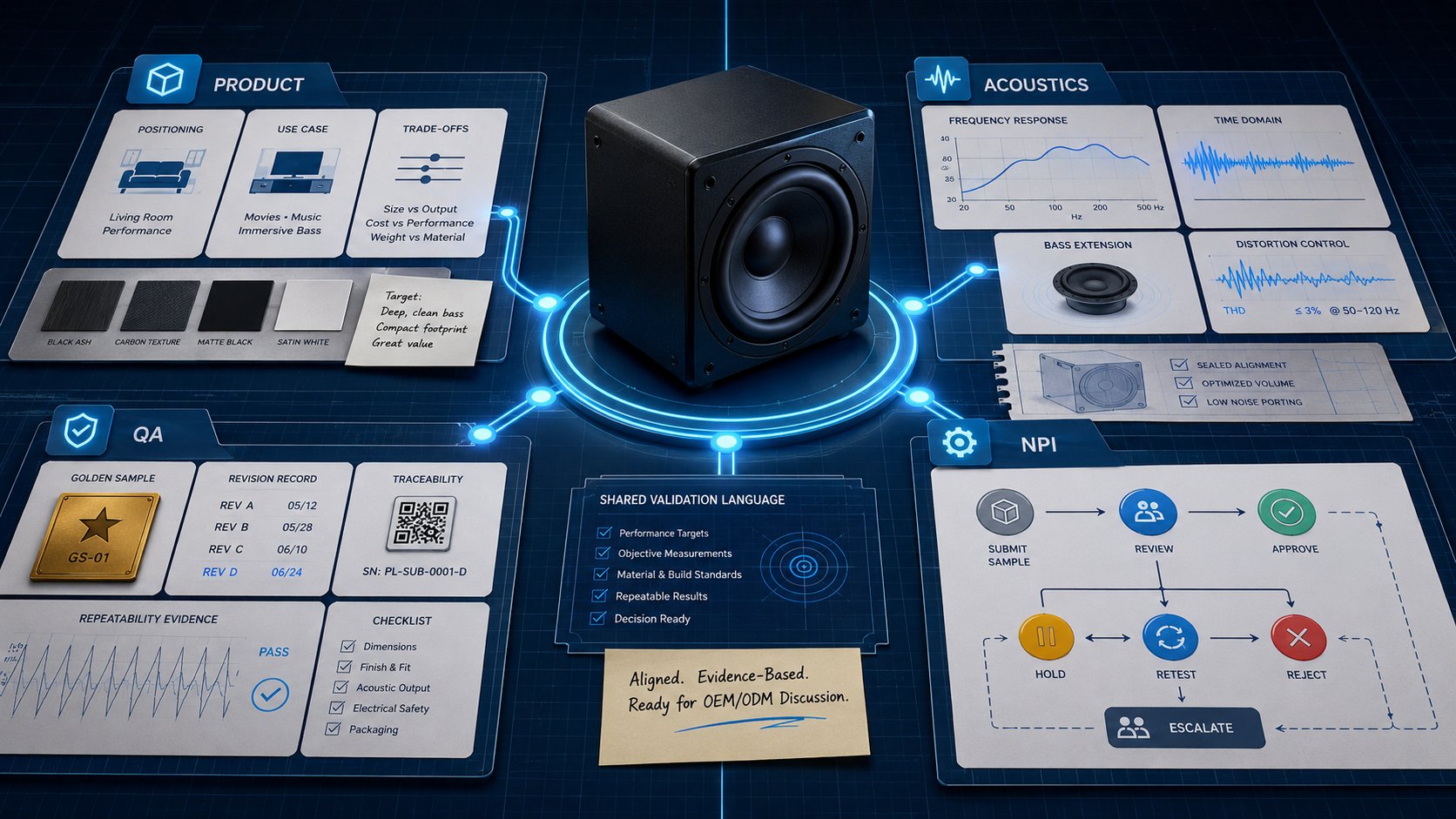
Clarify which document governs when a drawing, spreadsheet, sample, report, and message disagree. Identify who maintains the brand-approved baseline and who resolves conflicts among Product, Acoustics, Quality Assurance, Sourcing, and Production.
A golden sample—an approved physical reference—may support this system, but it should not be treated as sufficient on its own. A physical unit cannot fully communicate every document revision, approved substitution, test condition, or variant-specific requirement.
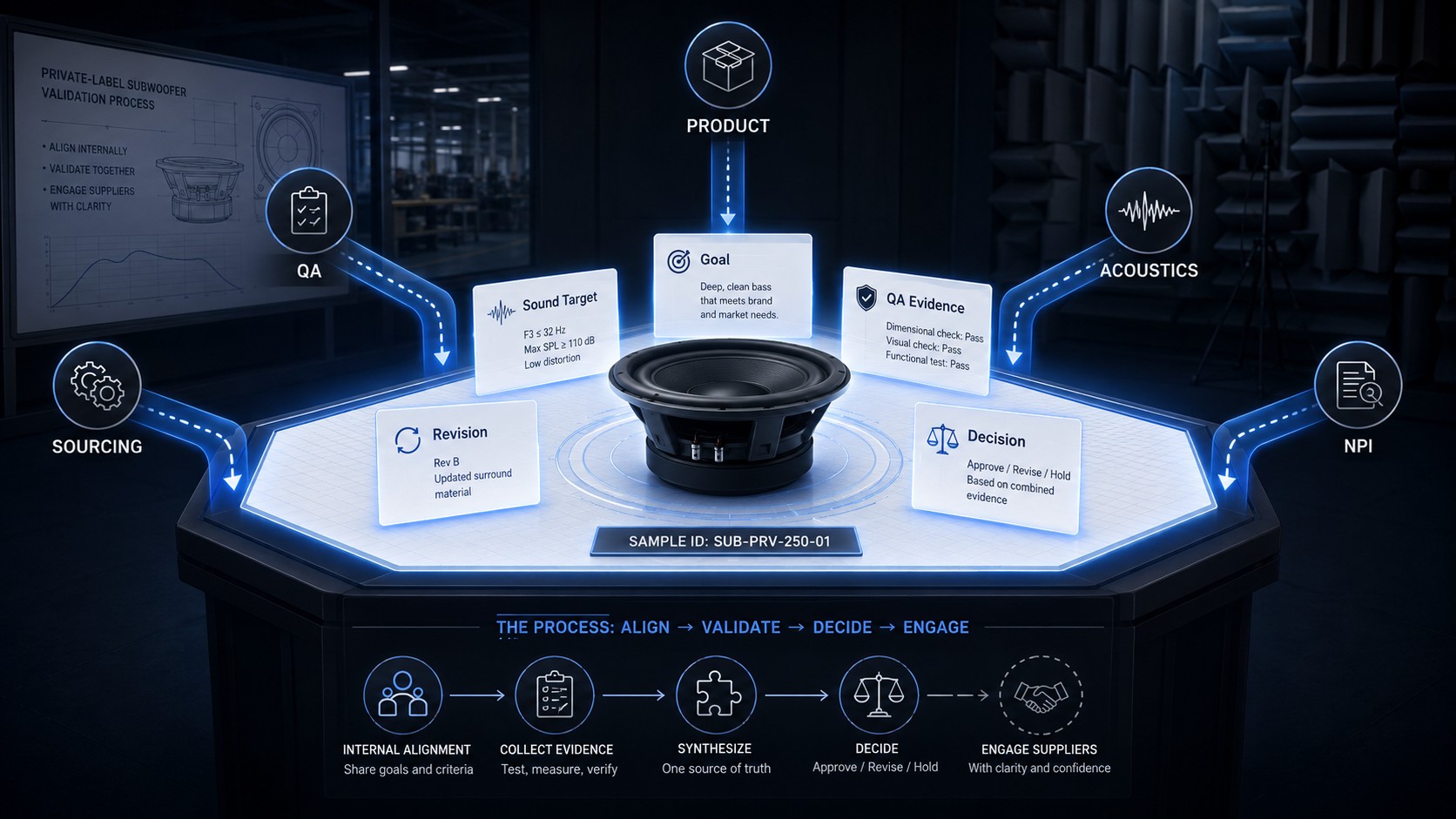
Evidence should link the sample identity, applicable specification, revision decision, and product version. This guide to comparing subwoofer validation documentation provides related decision-level guidance without turning the review into a laboratory procedure.
Test Cross-Functional Support for Future Variants
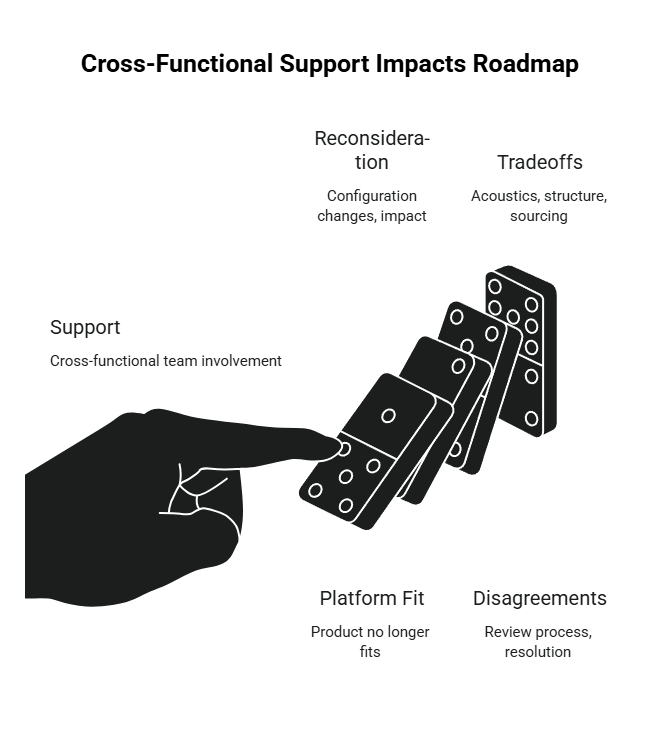
Roadmap support requires more than one capable salesperson or engineer. Planned extensions may involve acoustics, structure, sourcing, QA, production, and product-management tradeoffs.
Clarify which functions review a proposed variant, how disagreements are resolved, what must be reconsidered when the configuration changes, and who can state that the requested product no longer fits the platform.
An equipment list may show that a supplier can generate certain types of data. It does not prove that evidence is controlled, interpreted consistently, linked to revisions, or used in accountable decisions.
Stronger evidence may include a responsibility map, a prior cross-functional review, a versioned history for an earlier variant, and a defined escalation owner. The supplier should also explain which evidence would need to be refreshed when a shared element changes.
Related guidance on questions about OEM engineering capability and evaluating subwoofer acoustic-validation evidence can support deeper follow-up.
Interpret the Answers, Not Just the Language
| Strong answer | Incomplete answer | Warning sign |
|---|---|---|
| Defines limits and tradeoffs. | Describes general capability. | Claims that anything is possible. |
| Names accountable owners. | Refers vaguely to “engineering.” | No owner for the master specification. |
| Provides versioned evidence. | Shares examples without product or revision context. | Relies on one sample as proof of future support. |
| Separates commitments from assumptions. | Defers governance questions until later. | Promises continuity without explaining dependencies. |
| Identifies when new development is appropriate. | Lists equipment instead of controlled records. | Uses informal change notification. |
One incomplete response does not automatically make a supplier unsuitable. It identifies where follow-up evidence and cross-functional review are required.
A stronger answer is usually bounded. It identifies what the platform can support, where uncertainty remains, who owns the decision, and when reuse should stop. Overly broad assurances may indicate that the practical limits have not yet been examined.
Convert the Conversation Into Roadmap Assumptions
Record the outcome of the discussion in four categories:
Documented commitment: An approved obligation or decision supported by current records.
Current evidence: Information demonstrating the present configuration or a prior controlled example.
Working assumption: A planning input that has not been confirmed as a commitment.
Open question: An unresolved issue with a named internal owner and defined follow-up need.
This distinction prevents an assurance from gradually becoming an internal requirement without supporting evidence. It also shows which planned product roles appear to remain inside the shared architecture and which may require separate development.
Revisit the record when the roadmap changes, the platform is revised, or a critical dependency moves. The goal is visibility, not absolute certainty.
Before beginning your platform evaluation, review these common questions that often arise during the selection process:
Frequently Asked Questions
Can One Subwoofer Platform Support Several Product Tiers?
Potentially. Fit depends on which architectural elements remain common, what each tier must differentiate, and which changes require new engineering or validation.
What Evidence Should an OEM or ODM Provide Early?
Useful examples may include a platform-family view, controlled configuration records, revision history, named owners, change-notification practices, and evidence from prior variants. The appropriate package varies by program.
Can a Supplier Guarantee Several Years of Platform Availability?
Avoid a universal yes or no. Clarify which components, tooling, policies, and documented commitments support the statement and which factors remain outside the supplier’s control.
When Should a Variant Become a Separate Development Program?
Separate development may be appropriate when the product role, packaging, components, tooling, performance intent, or validation needs no longer fit the shared architecture without unacceptable compromise.
Make the Roadmap Visible Before Building Around It
The first SKU proves only what the approved configuration demonstrates. A multi-year roadmap requires a broader view of platform boundaries, continuity dependencies, evidence, ownership, and controlled change.
Use these questions to structure the first roadmap discussion and record which answers require supporting evidence.
Discuss your planned subwoofer roadmap with China Future Sound.
Disclaimer: This article is for general informational purposes only and does not constitute compliance, safety, technical, or professional advice. Requirements, risks, and best practices may vary by context, jurisdiction, system, provider, or use case. Confirm important decisions with the appropriate qualified professional, authority, or technical expert.
Our Editorial Process:
Our expert team uses AI tools to help organize and structure our initial drafts. Every piece is then extensively rewritten, fact-checked, and enriched with first-hand insights and experiences by expert humans on our Insights Team to ensure accuracy and clarity.
About the China Future Sound Insights Team
The China Future Sound Insights Team is our dedicated engine for synthesizing complex topics into clear, helpful guides. While our content is thoroughly reviewed for clarity and accuracy, it is for informational purposes and should not replace professional advice.