📌 Key Takeaways
Pre-production gates protect subwoofer programs when they connect sample approval to proof, controls, and change rules.
- Define The Reference: Teams need one clear approval basis, so production never compares output against mixed references.
- Use Evidence Early: Listening notes help, but targets, tests, records, and inspections make production approval stronger.
- Match The Program: Car, marine, and pro audio subwoofers need different proof because their risks differ.
- Control Supplier Changes: Suppliers need clear rules for when materials, parts, finishes, or processes need brand review.
- Keep Gates Practical: The best gate fits the risk, not the largest pile of paperwork.
Clear proof beats a good sample alone.
Audio brand teams will reduce handoff risk, preparing them for the production-readiness questions and supplier checks below.
~ ~ ~ ~ ~ ~ ~ ~ ~ ~ ~ ~ ~ ~ ~ ~ ~ ~
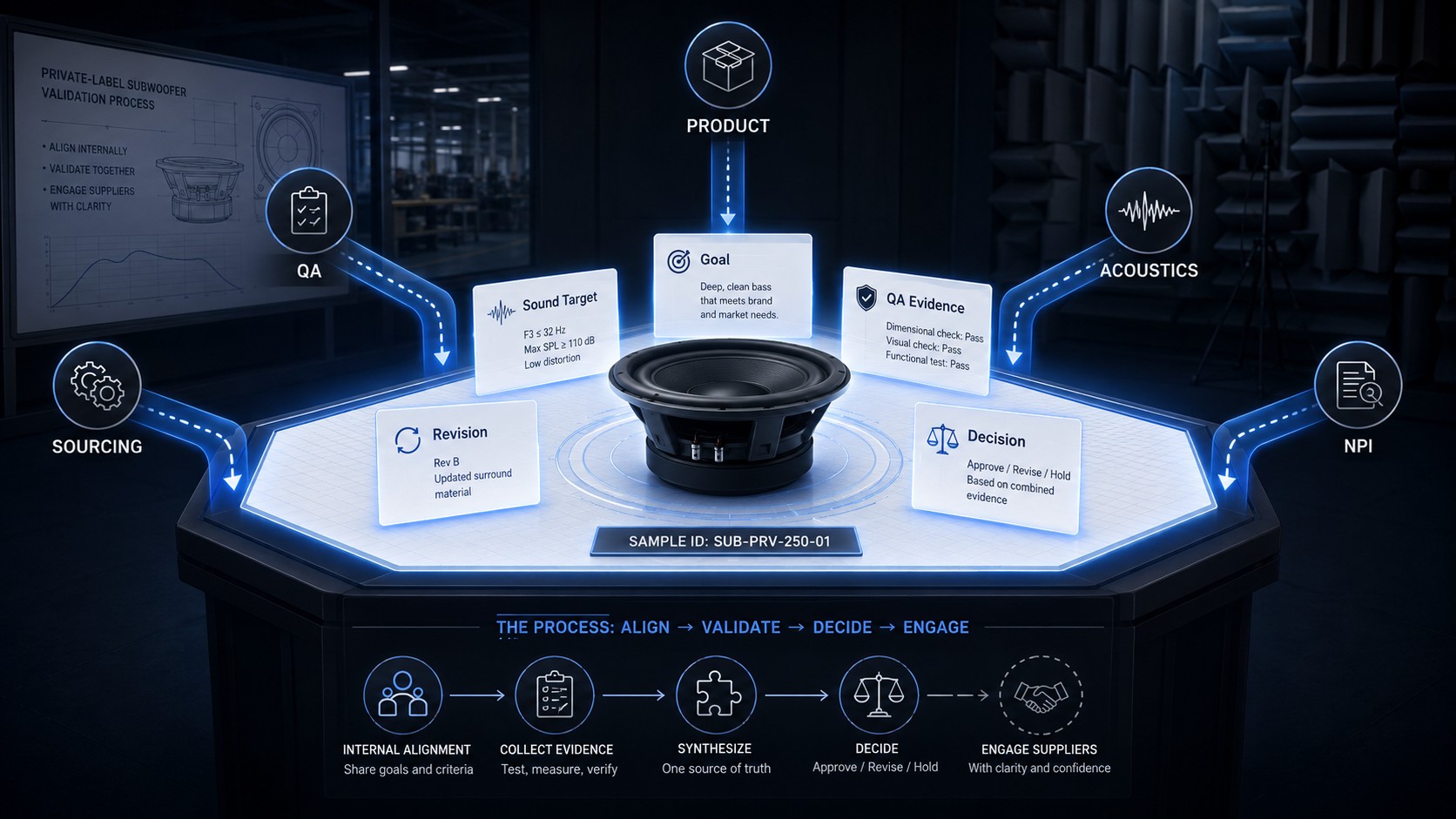
A subwoofer sample can sound acceptable, meet the immediate review target, and still fail as a reliable production reference. Risk rarely resides in the sample itself; rather, it often sits in the space between sample approval, specification handoff, change-control rules, and the evidence production teams will use after SOP.
For enterprise audio brands managing private-label or OEM/ODM subwoofer programs, this is a cross-functional business issue. Product may want launch speed. QA may want deeper validation records. Operations may need a clear production route. Sourcing may need supplier flexibility. Acoustics may care most about whether the approved sound target can be repeated.
A pre-production quality gate should consolidate these views into one decision: is the program ready to move forward with enough controlled evidence to protect the approved intent?
What a Pre-Production Quality Gate Should Decide
A pre-production quality gate is not just a checklist, meeting, or signature block. It should answer whether the approved sample can function as a practical production reference.
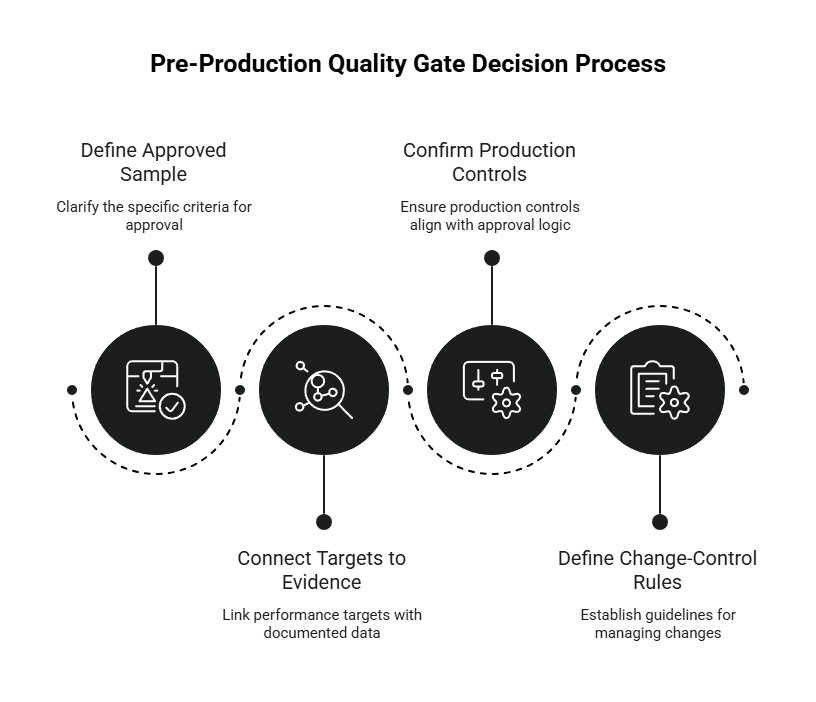
Four decisions matter most before handoff.
First, the team should define exactly what was approved. Was approval tied to a physical sample, revision, BOM, acoustic target, cosmetic finish, inspection record, or all of these? If the answer is unclear, production teams may later compare output against different references.
Second, the gate should connect performance targets to documented evidence. Listening feedback can support development, but it should not stand alone as the production-readiness basis. Acoustic targets, inspection criteria, test snapshots, and review notes make the decision less dependent on memory.
Third, the gate should confirm that production controls match the approval logic. If sample approval used one acceptance basis and production QC uses another, drift can occur without an obvious decision point.
Fourth, the team should define change-control rules before production begins. Material substitutions, adhesive changes, finish adjustments, component alternatives, or process changes may be reasonable in some cases, but the brand and supplier should agree which changes require notification, evidence, or re-approval.
Why Car, Marine, and Pro Audio Gates Should Not Look Identical
Car, marine, and pro audio subwoofer programs can share a development platform, but their pre-production risk emphasis may differ. The gate should reflect those differences without turning the process into a lab-level testing manual.
| Program context | Main pre-production risk | Gate priority | Trade-off to discuss | Evidence to request before production |
|---|---|---|---|---|
| Car audio subwoofer | Approved sample may not translate cleanly into repeatable fit, acoustic output, or production consistency | Sample identity, fit constraints, acoustic targets, and QC route alignment | Speed to launch vs. tighter sample-to-production control | Approved sample record, acoustic target file, fit constraints, production QC route, golden sample rule |
| Marine subwoofer | Material and environment assumptions may not be explicit enough for production control | Material/spec handoff, corrosion or moisture-related design intent, and change triggers | Added validation depth vs. program timing | Material records, environmental assumptions, reliability evidence, supplier change-control rules |
| Pro audio subwoofer | High-demand use may expose power, thermal, or mechanical assumptions that were not fully tied to production checks | Power-test evidence, acoustic consistency, golden sample governance, lot checks | Performance headroom vs. cost and production complexity | Power-test records, acoustic target records, golden sample custody, lot consistency checks |
These priorities are not universal rules. A marine subwoofer program does not automatically require every environmental test imaginable. A pro audio program does not need unnecessary documentation that slows decision-making without reducing risk. The critical objective is identifying which empirical evidence eliminates subjectivity from the production release?
For related CFS product contexts, brand teams may also review CFS pages on subwoofer manufacturing capabilities, car audio production, marine audio production, and pro audio programs.
Where Sample-to-Production Handoff Gaps Usually Appear
The most common handoff problem is not lack of effort. It is lack of shared reference.
One team may approve a sample based on sound. Another may rely on a drawing revision. A supplier may treat a component substitution as minor. QA may expect notification. Operations may not know which inspection gate should compare output to the approved unit.
Gaps usually appear in five places.
Sample identity is the first. If the approved unit is not tied to a version, BOM state, build record, and golden sample, it can become difficult to prove whether production still matches the approved intent.
Acoustic approval is the second. Informal approval may be useful early, but production needs measurable targets or retained records that can guide future comparison.
Specification handoff is the third. Materials, components, adhesives, finishes, tolerances, and process-sensitive details should not remain trapped in emails or meeting memory.
QC linkage is the fourth. Production checkpoints should reflect the same acceptance logic used during approval, especially where acoustic consistency and repeatability matter.
Change ownership is the fifth. ECO/ECR rules should define who approves changes, what evidence is required, and when supplier discretion ends.
These gaps create warranty-risk anxiety because the team may not know whether later issues came from the design, the supplier process, the material set, or an undocumented change.
The Core Trade-Offs Before Gate Approval
The strongest pre-production gate is not the heaviest gate. It is the gate that fits the program risk.
Speed vs. evidence depth
Moving quickly may be reasonable when a program uses a familiar platform, known supplier, and limited change scope. A new design, new supplier, new material set, or new use environment generally deserves stronger evidence before release. This is a general quality principle, not a fixed rule.
Single sample approval vs. repeatability evidence
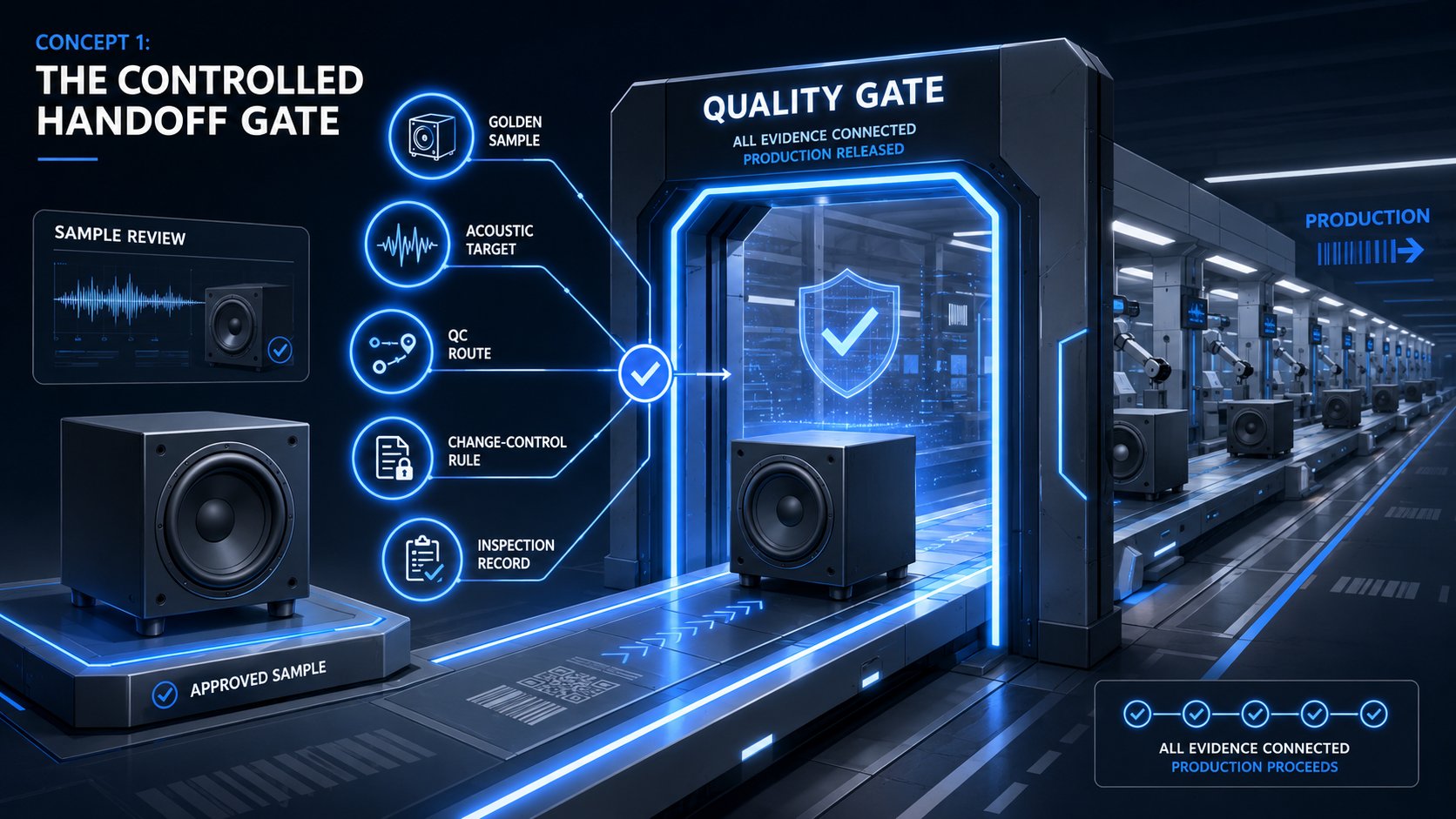
One good sample shows that a target can be reached once. It does not prove production repeatability. Golden sample control, version records, and QC linkage help convert sample approval into a usable production reference.
Supplier flexibility vs. change-control discipline
Some supplier flexibility can improve manufacturability and resolve practical sourcing constraints. Undocumented substitutions, however, can weaken the approval basis. The gate should define acceptable supplier adjustments and brand-side review triggers.
Technical completeness vs. decision usability
Too little documentation creates ambiguity. Too much detail can slow executive decisions and hide the evidence that matters. The right gate gives Product, QA, Operations, Acoustics, and Sourcing enough information to make a confident release decision without turning the review into a lab procedure.
Common platform logic vs. vertical-specific risk review
Platform reuse can support speed and consistency, but a shared platform still needs context review. Car, marine, and pro audio programs may require different emphasis in the evidence package.
Automotive-industry frameworks like AIAG’s Production Part Approval Process (PPAP) provide a proven architecture for linking engineering requirements to mass-production consistency.
Production-Readiness Questions for Brand Teams
Before approving the gate, Product, QA, Operations, Acoustics, Sourcing, and the supplier should be able to answer these questions:
- What exactly was approved: sample unit, revision, BOM, acoustic target, cosmetic finish, or all of the above?
- Which measurements, listening notes, inspection records, or test snapshots support that approval?
- What is the golden sample, and who controls it?
- Which production checkpoints compare output against the approved reference?
- Which supplier changes require notification or re-approval?
- Which changes can the supplier accept without brand-side review?
- What evidence will QA receive before pilot or mass production?
- Are car, marine, and pro audio assumptions being reviewed separately?
- What would cause the team to hold production, request retesting, or revise the specification?
These questions are useful because they expose weak handoff logic before the program reaches a more expensive decision point.
How CFS-Aligned Capabilities Can Support the Gate
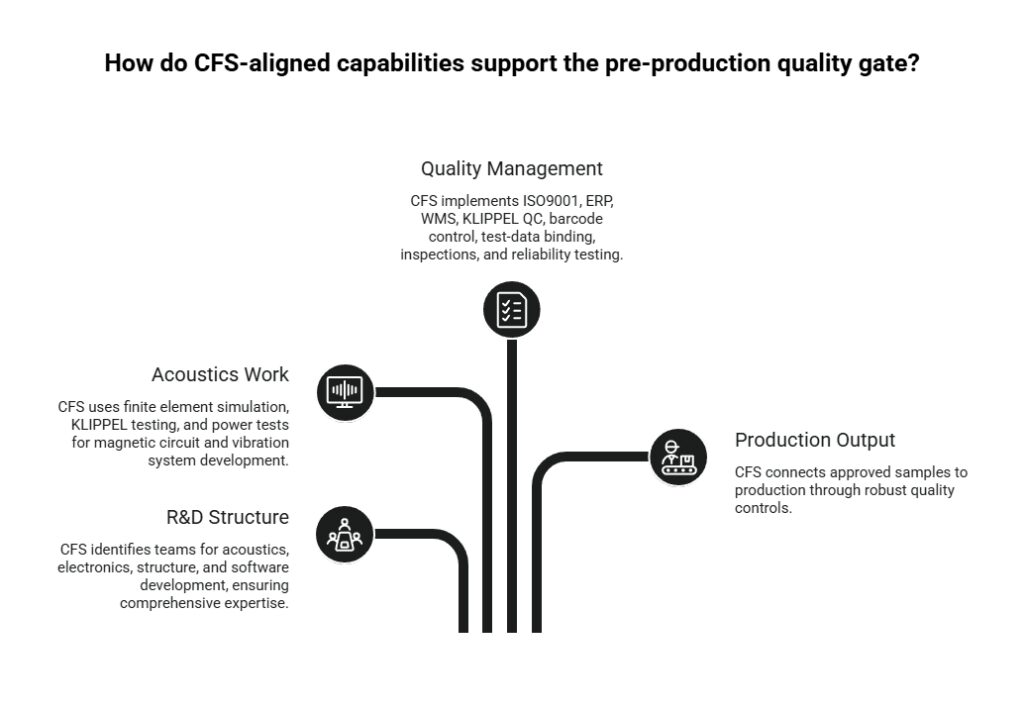
CFS source material identifies an R&D structure that includes Acoustics, Electronics, Structure, and Software Development teams. For acoustics work, the provided material references finite element simulation for magnetic circuit and speaker vibration system development, KLIPPEL R&D sample testing, short-term destructive power tests, long-term power tests, and golden sample management.
On the quality side, the same source material identifies ISO9001-2015 quality management, ERP and WMS material management, KLIPPEL QC combined with golden samples, barcode/QR route control, test-data binding for traceability, IQC/IPQC/FQC inspection links, and reliability laboratory testing according to design requirements.
For a brand partner, the relevant supplier question is not simply, “Do these capabilities exist?” A better question is, “How will these controls connect the approved sample to production output, change review, and quality documentation?”
Teams comparing supplier evidence may also find this related CFS article useful: How to Compare Subwoofer Manufacturer Validation Documentation Without Turning It Into a Lab Procedure.
FAQs
Why is sample approval not enough to prove production readiness?
Sample approval confirms that a reviewed unit met the approval basis at that moment. Production readiness also requires controlled identity, documented targets, repeatability evidence, production QC alignment, and change-control rules.
Should car, marine, and pro audio subwoofer programs use the same quality gate?
They may share common gate logic, but the evidence emphasis should vary by use context. Car audio may emphasize fit and repeatability, marine programs may emphasize material and environment assumptions, and pro audio may emphasize power, thermal, and mechanical stress assumptions.
What is the role of a golden sample?
A golden sample helps preserve a controlled physical reference for production comparison. Its value depends on version control, custody rules, linked documentation, and production QC practices.
What should trigger re-approval after sample sign-off?
Re-approval may be appropriate when a supplier proposes a material, component, cosmetic, process, acoustic, or structural change that could affect the approved product intent. The exact trigger should be defined before production begins.
Conclusion: Make the Gate Fit the Program Risk
A pre-production quality gate should reduce interpretation risk before production begins. It should clarify what was approved, which evidence supports approval, which controls preserve the reference, and which changes require review.
For private-label subwoofer programs, the best gate is not the one with the most paperwork. It is the one that gives Product, QA, Operations, Acoustics, Sourcing, and the supplier a shared decision basis before production handoff.
Brand teams preparing for subwoofer sample approval, golden sample control, validation documentation, or production-readiness planning can discuss the next program with CFS through the contact page.
Disclaimer:
This article is for general informational purposes only and does not constitute compliance, safety, technical, or professional advice. Pre-production quality-gate decisions, validation scope, production-readiness criteria, and supplier controls should be reviewed against the specific product design, application environment, brand requirements, supplier agreement, and applicable professional or regulatory guidance before production release.
Our Editorial Process:
Our expert team uses AI tools to help organize and structure our initial drafts. Every piece is then extensively rewritten, fact-checked, and enriched with first-hand insights and experiences by expert humans on our Insights Team to ensure accuracy and clarity.
About the China Future Sound Insights Team
The China Future Sound Insights Team is our dedicated engine for synthesizing complex topics into clear, helpful guides. While our content is thoroughly reviewed for clarity and accuracy, it is for informational purposes and should not replace professional advice.