📌 Key Takeaways
Procurement and QA teams pick better suppliers when they score the same evidence on one shared checklist.
- Share One Scorecard: Separate spreadsheets create conflicting verdicts — a single checklist forces both teams to weigh the same proof before approving a supplier.
- Price Isn’t Total Cost: A 15% savings on parts can vanish fast if failure rates triple and you’re stuck covering returns, replacements, and brand damage.
- Demand Proof, Not Promises: Suppliers who talk about quality but can’t show automated route control, unit-level tracking, or documented test results are selling confidence they haven’t earned.
- Flag Deal-Breakers Early: If a factory can’t trace a defect to a single unit — or skips steps when production speeds up — that should stop the conversation before contracts start.
- Align Language Across Teams: When QA says “route control,” Procurement should hear “recall prevention” — translating technical terms into business risk keeps everyone on the same page.
One shared checklist turns quality debates into faster, lower-risk supplier decisions.
Brand partners and sourcing teams evaluating OEM audio suppliers will gain a ready-to-use alignment framework here, preparing them for the detailed evaluation criteria that follow.
~ ~ ~ ~ ~ ~ ~ ~ ~ ~ ~ ~ ~ ~ ~ ~ ~ ~
Same supplier. Two verdicts.
Procurement’s spreadsheet shows healthy margins and competitive lead times. QA’s binder shows three failed tolerance checks and no evidence of route enforcement. The conference room goes quiet — and the shortlist stalls.
This scene plays out more often than it should during OEM audio vendor selection. Procurement is measured on unit cost, delivery reliability, and supply chain risk. QA is measured on process enforcement, traceability, and defect prevention. Both functions protect the same brand, but they’re reading different scorecards. For brand partners navigating supplier qualification, the result isn’t a disagreement about quality — it’s a disagreement about what counts as evidence.
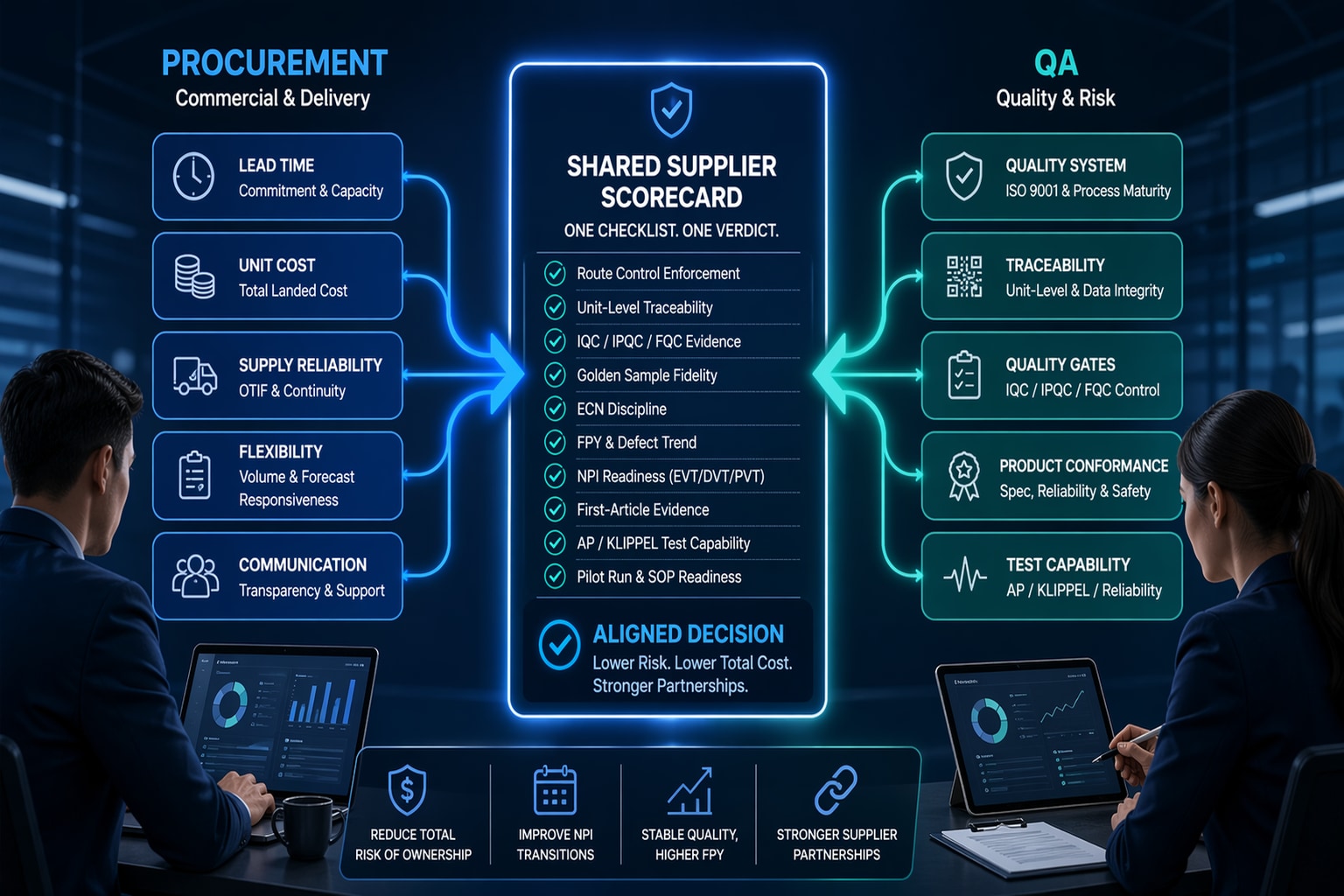
The fix isn’t more meetings. It’s a shared checklist that translates quality-gate discipline and traceability into total business risk — so both functions evaluate the same evidence against the same standard.
Why Procurement and QA Misalign
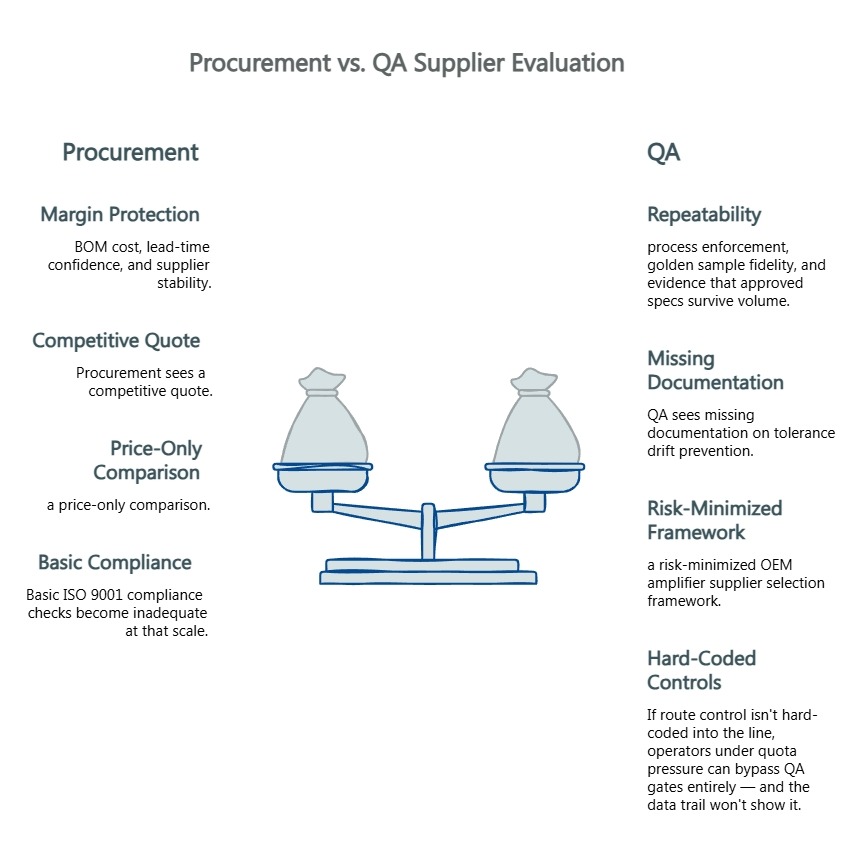
The tension is structural, not personal. Procurement optimizes for margin protection: BOM cost, lead-time confidence, and supplier stability. QA optimizes for repeatability: process enforcement, golden sample fidelity, and evidence that approved specs survive volume. Neither side is wrong. They’re evaluating two halves of the same risk stack.
The problem surfaces when each function scores suppliers independently. Procurement sees a competitive quote; QA sees missing documentation on tolerance drift prevention. Without a common framework, one function’s “approved” is the other’s “red flag.” That is why a risk-minimized OEM amplifier supplier selection framework is more useful than a price-only comparison.
This gap is especially dangerous when transitioning a flagship line or entering high-volume production where a single batch failure triggers costly field actions and brand exposure. Basic ISO 9001 compliance checks become inadequate at that scale. If route control isn’t hard-coded into the line, operators under quota pressure can bypass QA gates entirely — and the data trail won’t show it.
The Shared Standard: Total Risk of Ownership
“Lowest cost” and “best-fit supplier” are not the same thing. A 15% BOM savings can be quickly offset when field failure rates rise from 1% to 3%, once reverse logistics, replacement costs, and brand impact are factored in.
Total Risk of Ownership reframes the decision around five cost categories both functions can evaluate together: the cost of defects (rework, scrap, and field failures that erode negotiated margins), the cost of recall exposure (without unit-level traceability, a recall hits the entire batch), the cost of schedule slips (undocumented NPI transitions create late-stage surprises that delay launches), the cost of opaque change control (without strict ECN discipline requiring defined advance notification—scaled to the component’s impact on acoustics, safety, or performance—spec-drift goes undetected), and the cost of weak first-article evidence (a supplier that cannot demonstrate a stable and improving First Pass Yield (FPY), with targets defined by product complexity and validated before ramp, is transferring risk to your brand).
This framing bridges QA and Procurement language. Route control stops being a “QA thing” and becomes a recall-prevention mechanism. Traceability stops being a lab exercise and becomes a containment tool. Broadly recognized frameworks such as ISO 9001, the GS1 Global Traceability Standard: process discipline, traceability, and supplier-risk governance reduce downstream business exposure. Technical controls, viewed through this lens, are financial controls.
The Joint Evaluation Checklist
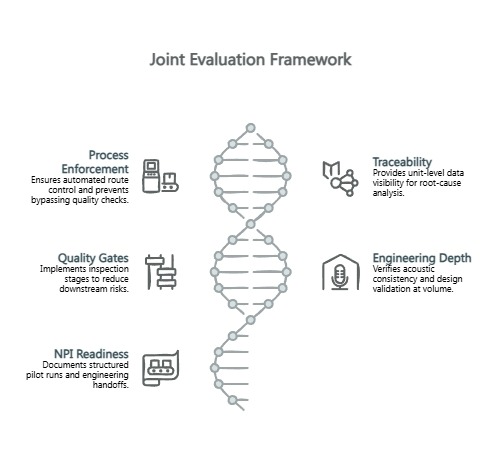
A good checklist does not ask for more words. It asks for better proof. This alignment sheet maps each QA concern to a Procurement concern and a specific evidence request.
Process enforcement and route control. System-enforced route control prevents units from advancing without a logged pass at the current station. Ask whether the factory uses barcode or QR-code gating — not optional documentation that operators can bypass under quota pressure. Procurement confirms enforcement is automated. QA confirms the route sequence matches the approved process flow.
Traceability and data visibility. Unit-level traceability ties test data to individual units, not just batches. A supplier aligned with frameworks like the GS1 Global Traceability Standard can trace a failed unit back to its component lots, test results, and operator shift. MES traceability, when properly implemented, materially reduces root-cause time. For Procurement, this turns a blind batch action into surgical containment. For QA, it proves the testing actually happened.
Quality gates: IQC, IPQC, and FQC. Three inspection stages reduce downstream risk — but only if each has documented sampling plans, reject criteria, and escalation protocols. Without that evidence, the gates are nominal. The decision for brand partners is whether to require this documentation as a qualification gate or treat it as a post-award audit item. Requiring it upfront eliminates suppliers whose quality narrative won’t survive volume pressure.
Engineering depth and sample-to-production fidelity. The core risk is spec-drift: the approved golden sample stops being representative at volume. Strong evidence includes KLIPPEL QC testing for acoustic consistency, AP (Audio Precision) measurements, simulation-backed design validation, and a sample governance process with version control. Visible amplifier-process stages — SMT, AOI inspection, aging testing, function testing, AP test, and final assembly — give auditors concrete checkpoints.
NPI and pilot-readiness evidence. Opaque NPI transitions are a top source of launch delays. Strong suppliers show documented first-article approval criteria, structured pilot runs before full ramp, clear engineering-to-production handoff documentation — covering compliance test data, safety certifications, marking specifications, and quality records — and defined escalation paths for out-of-tolerance results.
Translating Between Functions
When QA says “route control,” Procurement should hear “recall containment.” “Golden sample governance” means “warranty-rate protection.” “Unit-level traceability” means “we isolate 50 defective units instead of scrapping 5,000.”
The translation runs both directions. When Procurement says “supplier stability,” QA may hear “commercial preference.” In practice, Procurement often means fewer disruptions, cleaner change control, and a lower chance that a rushed supplier decision creates exposure the brand absorbs later.
Red Flags That Should Stall a Shortlist
Some findings during OEM amplifier supplier due diligence should stop the conversation: a factory that describes QA gates but cannot demonstrate system-enforced route control; traceability at batch level only with no unit-level data binding; golden sample language without a documented drift-prevention process; IQC, IPQC, and FQC named without sampling plans or reject-rate trends; or a fragmented engineering-to-production handoff with no clear NPI owner. Any of these signals that the supplier’s quality narrative may not survive high-volume pressure.
Running a Cross-Functional Review in One Meeting
Cross-functional alignment doesn’t require a multi-month initiative. Define three to five non-negotiables before any factory tours or RFQs go out — route enforcement, unit-level traceability, and documented QA gates are strong candidates. Score each supplier on one shared scorecard, not separate scorecards reconciled later. Separate “nice to have” from “risk blocker.” A beautiful showroom is nice. Barcode-driven route control is a risk blocker.
Require evidence, not narratives. A supplier that talks about quality without showing test-data bindings or factory evaluation checklist results is selling confidence it hasn’t earned. Decide in advance what triggers a pilot validation run before committing to a full production shift — that single agreement eliminates most of the status-quo bias that keeps teams locked on incumbents. If the discussion keeps slipping back to price alone, pair this checklist with the case for why supplier fit beats lowest BOM.
For deeper context on how quality systems translate into the supplier evidence you should be requesting, explore the amplifier production overview, or reach out to discuss your next program through supplier alignment.
Our Editorial Process
Our expert team uses AI tools to help organize and structure our initial drafts. Every piece is then extensively rewritten, fact-checked, and enriched with first-hand insights and experiences by expert humans on our Insights Team to ensure accuracy and clarity.
About the China Future Sound Insights Team
The China Future Sound Insights Team is our dedicated engine for synthesizing complex topics into clear, helpful guides. While our content is thoroughly reviewed for clarity and accuracy, it is for informational purposes and should not replace professional advice.