📌 Key Takeaways
When a product defect appears after thousands of units ship, your ability to trace each unit’s history—down to specific parts—determines whether you face a controlled fix or a costly panic.
- Track Each Unit, Not Just Batches: Barcodes linking every product to its test results and part sources let you pull only the bad units instead of destroying good inventory alongside them.
- Route Control Proves Completeness: Systems that block units from moving forward until each test passes create airtight records—no skipped steps, no missing data.
- Link Parts to Finished Products: When you can trace a failed component back to which exact units received it, you contain only what’s actually at risk.
- Verify Before You Scale: Ask suppliers to retrieve a unit’s full history in minutes, not days—if they can’t, their traceability is paperwork decoration, not real protection.
- Precision Protects Your Brand: Fast, targeted responses signal quality maturity to partners and stakeholders; broad “just in case” recalls signal uncertainty.
Real launch protection means your factory can prove exactly what happened to each unit—hope isn’t a containment strategy.
Procurement and QA leaders preparing national product launches will find concrete verification criteria here, guiding them into the supplier evaluation framework that follows.
~ ~ ~ ~ ~ ~ ~ ~ ~ ~ ~ ~ ~ ~ ~ ~ ~ ~
Twelve pallets cleared customs this morning. By noon, three warranty claims landed—different customers, same symptom.
The spreadsheet shows 2,000 units already in the field. The problem is, while failure rates suggest dozens are compromised, nobody can isolate the specific units affected. And that uncertainty is about to become very expensive.
A national launch magnifies everything. Volume scales faster than your ability to isolate problems. When a component issue surfaces after thousands of units have shipped, the question isn’t whether you’ll respond—it’s whether you can respond with precision or panic. This is where recall risk stops being a quality topic and becomes a launch-control problem. Without unit-level traceability, a single defect can force brands into blind containment, excess scrap, warranty exposure, and the kind of stakeholder conversations nobody wants to have.
The difference between a controlled incident and a brand-damaging event often comes down to one capability: can your manufacturing partner isolate defective units at the component level, or are you stuck treating the entire batch as suspect?
Why Blind Batch Containment Happens
Most quality systems look robust on paper. Incoming inspection catches obvious material defects. In-process checks flag assembly errors. Final quality control verifies that finished units meet spec. But here’s the operational gap that creates recall exposure: these gates confirm what passed, not why a failure occurred or which specific units share the root cause.
When a field failure surfaces and the factory can only confirm “this batch was produced during Week 12,” procurement and QA face an impossible choice. Contain everything from that production window—destroying sellable inventory alongside genuinely defective units—or accept the risk that more failures are waiting in the channel.
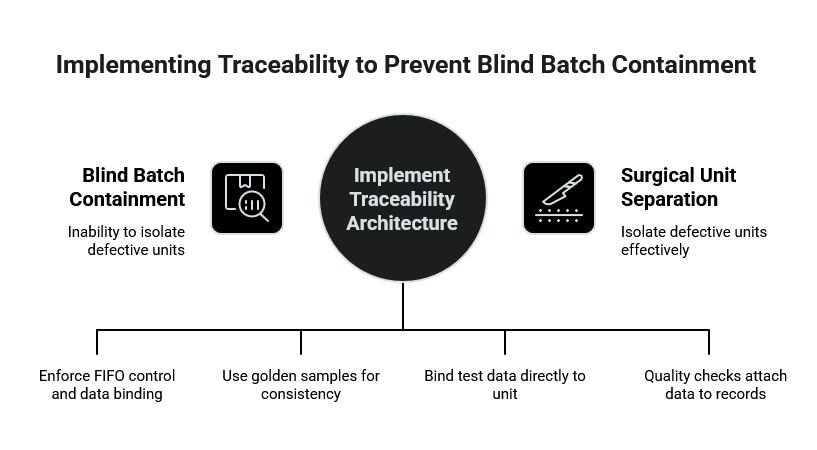
This is blind batch containment. It happens when inspection systems verify outcomes but don’t bind test data to individual units. The factory knows that units passed. They can’t prove which units passed which tests, or trace a failure back to a specific component lot, assembly station, or test result.
Robust traceability architecture requires more than inspection gates. It requires systems like ERP and WMS working together to enforce FIFO control, KLIPPEL QC testing with golden samples for consistency control, and barcode or QR-code route control that binds test data directly to the unit. Quality checks spanning IQC, IPQC, and FQC contribute data only when that data attaches to individual unit records. Without this binding, the code is decoration rather than evidence.
For private-label program owners, this gap creates a specific fear: good units getting destroyed alongside bad ones because nobody can surgically separate them.
What Component-Level Data Actually Changes
Component-level traceability transforms recall response from broad containment into targeted isolation. The mechanism works through three connected capabilities.
Test data binding. Every unit carries a barcode or QR code that links to its complete production history—component lots used, test results recorded, inspection stations passed. When a field failure occurs, that serial number unlocks a digital fingerprint showing exactly what happened during manufacturing.
Route control. The barcode system doesn’t just record data; it controls the testing path. A unit cannot proceed to the next station until the previous test is logged and passed. This prevents units from “skipping” quality gates and ensures the test history is complete, not sampled.
Lot-level correlation. When root cause analysis identifies a specific component lot as the source of failure, traceability systems can immediately query which finished units received components from that lot. Instead of containing an entire production week, you contain only the units that share the actual risk factor.
The practical difference is significant. A blind batch recall might require pulling 5,000 units because they were produced in the same timeframe. A traceable isolated recall might pinpoint the exact fraction of units that received components from the suspect lot—and clear the remaining unaffected inventory for continued sale.
That precision protects inventory, accelerates investigation, and gives stakeholders a credible answer faster.
Traceability becomes commercially valuable when it links three things without ambiguity: the unit, the route, and the test record. These capabilities only prove credible under scale pressure when backed by real engineering depth. A supplier with an R&D team spanning acoustics, electronics, structure, and software—and validation methods including finite element simulation, KLIPPEL R&D testing, short-term destructive testing, and long-term power testing—demonstrates the infrastructure to make unit-level route control meaningful at volumes exceeding 1,000 units per day.
The GS1 Global Traceability Standard provides industry frameworks for implementing these capabilities across supply chains, framing traceability around origin, processing history, and downstream location. In plain terms, that is what makes targeted containment possible instead of guesswork.
The Signals Procurement and QA Should Demand Before Scale-Up
Before committing to production scale, program owners should verify that traceability exists as an operational system, not just a line item on a capability deck. The evidence categories matter more than the specific technologies.
Route control enforcement. Can the factory demonstrate that units physically cannot bypass test stations? Look for barcode-gated workflows where scanning is required to proceed, not optional documentation added after the fact.
Test data retention and retrieval. If you provide a serial number from a unit that shipped six months ago, can the factory retrieve its complete test history within minutes? Traceability that requires days of manual research doesn’t support rapid containment decisions.
Component lot tracking. Does the system link finished units back to incoming material lots? This connection enables the correlation analysis that makes targeted recalls possible. Without it, traceability stops at the assembly level.
Golden sample governance. Production consistency depends on validated reference standards. Systems like KLIPPEL QC testing combined with golden sample management ensure that traceability is measuring against a stable baseline—not just recording drift.
Quality gate integration. Traceability should connect to the broader inspection architecture: IQC for incoming materials, IPQC during production, and FQC for finished goods. Each gate should contribute data to the unit’s traceable record.
ERP and WMS verification. Can procurement verify that ERP/WMS controls and FIFO logic support component history instead of obscuring it? These backend systems determine whether traceability data flows cleanly or gets lost in batch-level aggregation.
Suppliers operating under ISO 9001:2015 quality management systems typically have the documentation infrastructure to support these capabilities, but certification alone doesn’t guarantee operational traceability. The specific implementation matters. Cross-functional teams should review acceptance criteria before scale using documented readiness signals rather than verbal reassurance—resources like first-article approval criteria and the supplier due diligence framework provide structured approaches to these conversations.
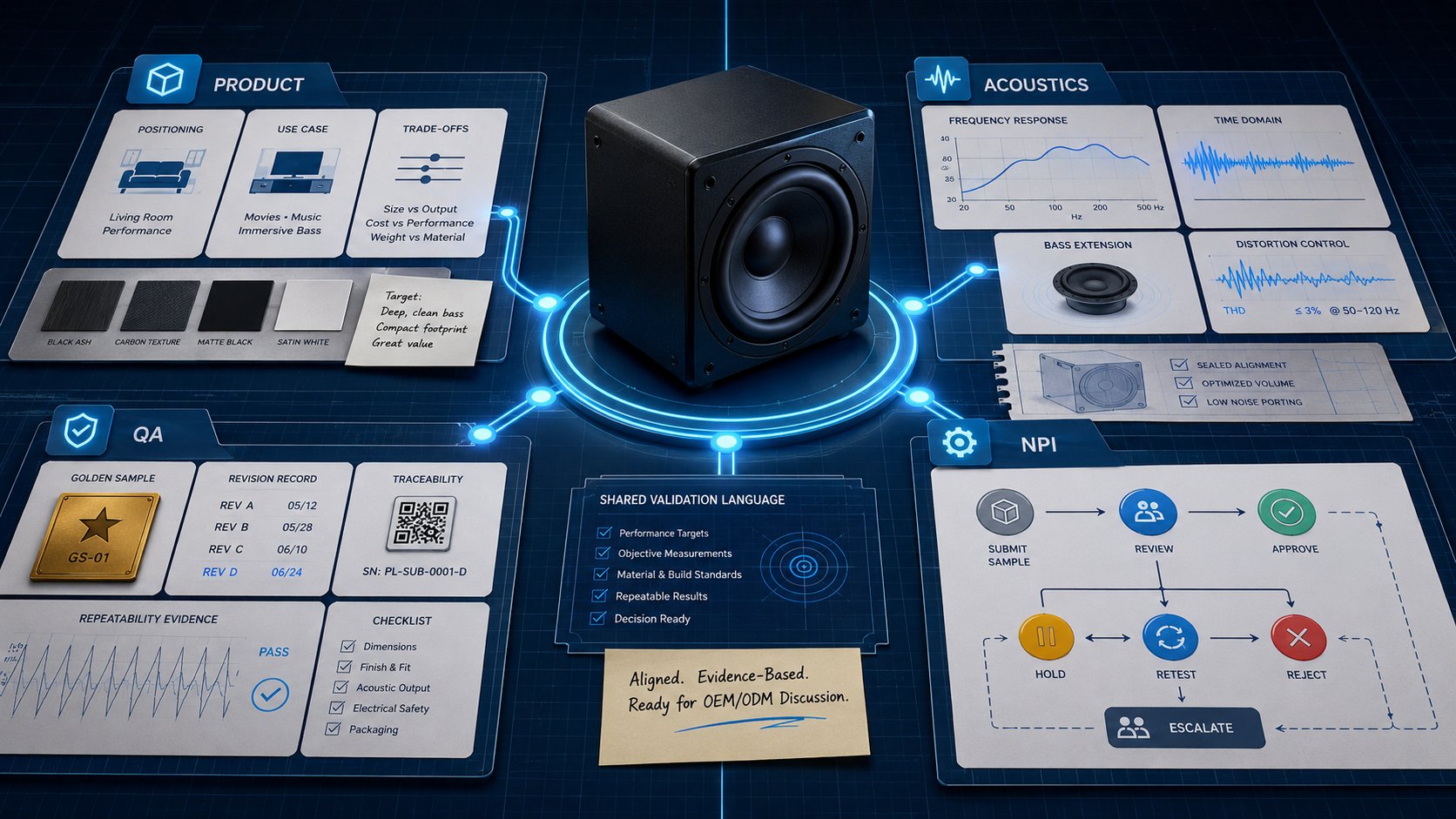
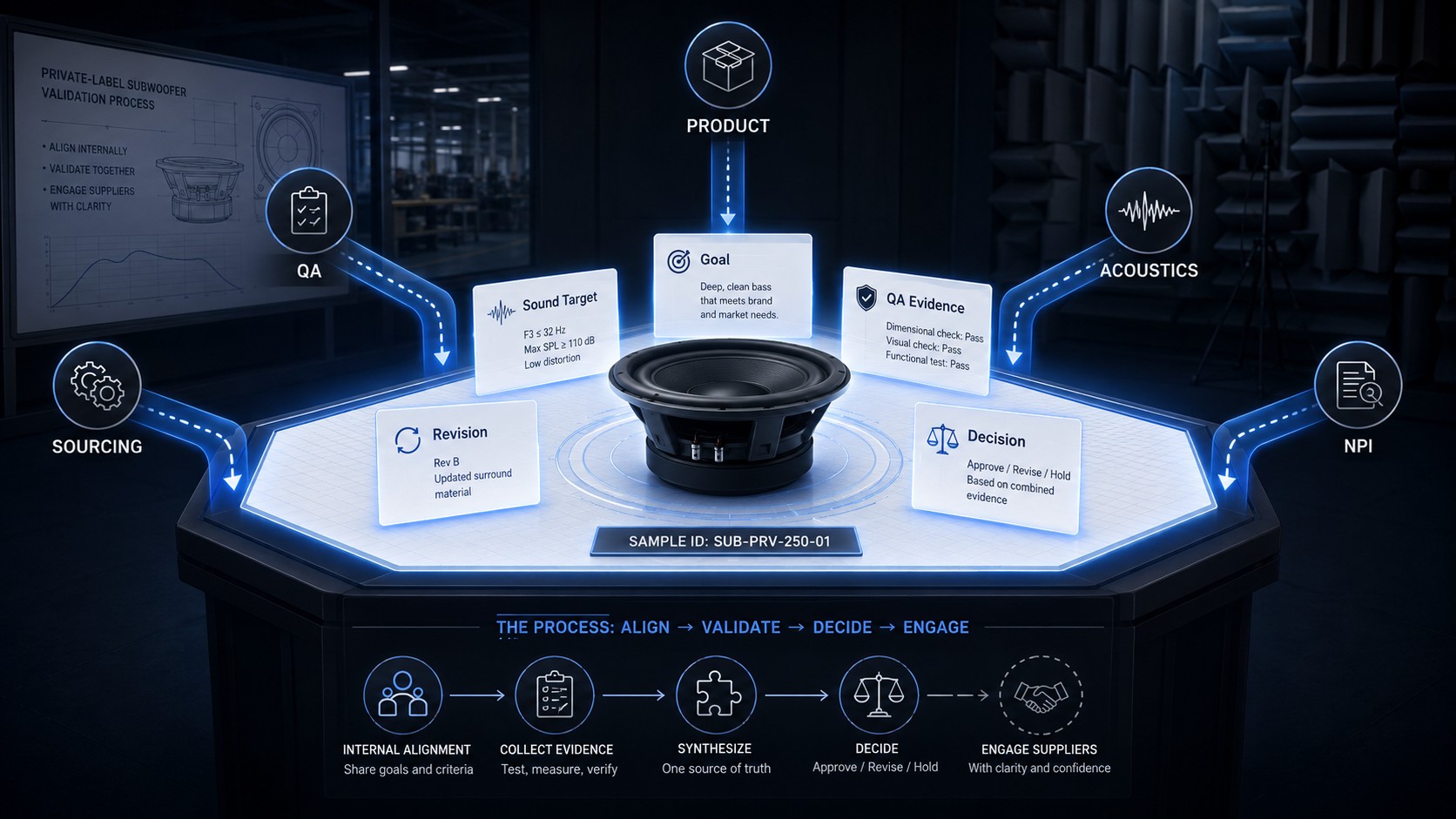
When engineering and procurement priorities drift apart, the alignment checklist for OEM/ODM amplifier programs helps stakeholders read the same signals.
How Traceability Supports Brand Protection, Not Just Factory Reporting
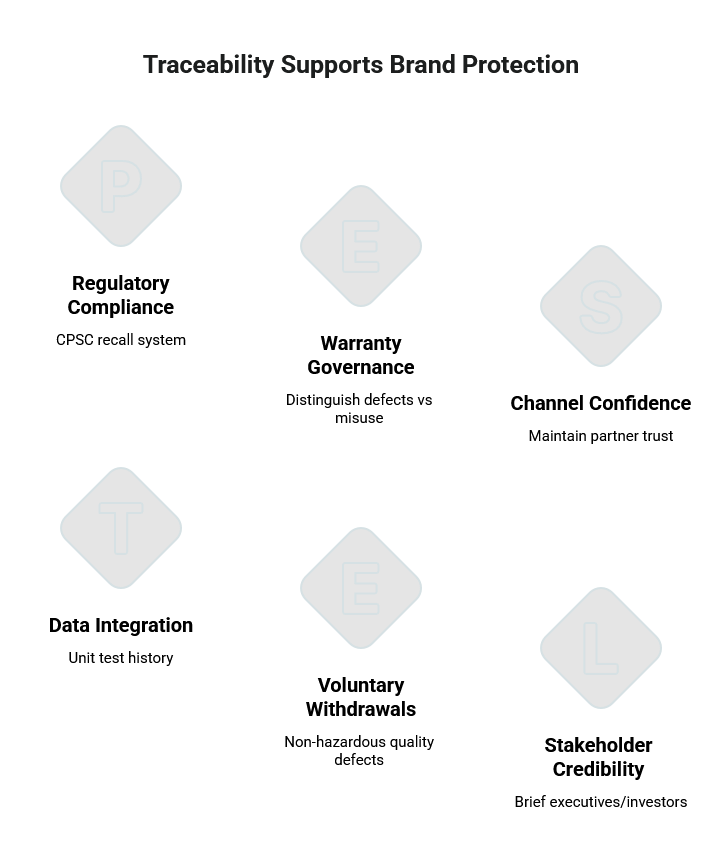
The value of component-level data extends beyond the factory floor. For brand owners managing private-label programs, traceability directly supports three commercial concerns.
Warranty governance. When warranty claims arrive, traceability provides the evidence to distinguish between manufacturing defects and misuse. The unit’s test history documents that it left the factory within spec. This data supports warranty decisions and protects against fraudulent claims.
Channel confidence. Distributors and retailers notice how brands handle quality incidents. A brand that can identify affected units precisely—and confirm that their inventory is clear—maintains channel relationships. A brand that issues broad “out of an abundance of caution” recalls signals uncertainty that erodes partner trust.
Stakeholder credibility. When product leadership needs to brief executives or investors on a quality incident, the narrative matters. ” We identified the root cause, isolated the specific impacted units, and cleared the remaining inventory for sale” tells a different story than “We’re still investigating and have contained everything produced that month as a precaution.”
The U.S. Consumer Product Safety Commission’s (CPSC) recall system reflects the seriousness and operational visibility of safety-related recall activity in the U.S. market, though non-hazardous quality defects are generally managed through voluntary commercial withdrawals. Traceability doesn’t prevent defects from occurring. It determines whether a defect becomes a contained incident or an expanding crisis.
The Batch vs. Unit Recall Logic Table
A side-by-side comparison illustrates how traceability fundamentally alters containment strategy:
| Factor | Blind Batch Recall | Traceable Isolated Recall |
|---|---|---|
| Information Available | Production date range only | Serial-level test history and component lot correlation |
| Containment Scope | All units from the time window | Only units sharing the identified risk factor |
| Sellable Inventory Impact | High—healthy units destroyed with defective | Low—unaffected units cleared for sale |
| Investigation Speed | Slow—manual sampling and inference | Fast—digital records enable immediate correlation |
| Stakeholder Communication | Uncertain—broad precautionary language | Confident—precise scope and root cause identified |
| Brand Consequence | Signals quality system gaps | Demonstrates quality system maturity |
The table reflects a general principle recognized across manufacturing sectors: unit-level traceability enables precision that batch-level systems cannot match. GS1’s standards guidance makes the same point in broader supply-chain language by tying traceability to information flow around physical products and targeted recall effectiveness.
What to Require in the Next Supplier Conversation
Component-level data isn’t a feature to request after problems emerge. It’s an architecture to verify before production scale-up begins.
The conversation with prospective or current manufacturing partners should establish whether traceability is operational—meaning it actively controls production flow and enables rapid retrieval—or cosmetic, meaning barcodes exist but don’t connect to queryable test histories.
Verification criteria worth establishing early include how quickly the supplier can retrieve a unit’s complete production history, whether route control is enforced through the barcode system or merely documented, and how component lot data connects to finished unit records.
Do not approve launch scale on sample confidence alone. Approve it on evidence that the unit can carry its own manufacturing story.
Ask whether the supplier can prove unit-level test history, route control, and component-linked traceability before volume moves. Ask whether that proof sits inside a broader system of qualification, validation, reliability testing, and documented quality gates. The DFM-to-Ramp framework for reliable launches connects ramp discipline with traceability and readiness rather than treating traceability as an isolated feature.
When that architecture is in place, component-level data stops being a factory reporting detail. It becomes launch protection. Cleaner containment. Faster answers. Stronger brand control.
If your supplier cannot prove unit-level test history and route control, you don’t have real launch protection. You have hope. And hope is not a containment strategy.
Our Editorial Process:
Our expert team uses AI tools to help organize and structure our initial drafts. Every piece is then extensively rewritten, fact-checked, and enriched with first-hand insights and experiences by expert humans on our Insights Team to ensure accuracy and clarity.
About the China Future Sound Insights Team:
The China Future Sound Insights Team is our dedicated engine for synthesizing complex topics into clear, helpful guides. While our content is thoroughly reviewed for clarity and accuracy, it is for informational purposes and should not replace professional advice.