📌 Key Takeaways
Approved subwoofer samples matter most when suppliers can prove they can repeat, protect, and control the sound.
- Proof Beats Demos: A strong sample is not enough unless test records connect it to clear sound goals.
- Set Sound Targets: Suppliers should explain the bass, power, use case, and trade-offs behind each sample.
- Control Golden Samples: Approved samples need clear ownership, version tracking, and retesting rules after meaningful changes.
- Link Tests To Production: Factory checks should protect the approved sound, not sit apart from engineering work.
- Watch Communication Quality: Clear revision notes and honest trade-off talks show whether a supplier is ready for launch.
Good sound is only useful when the supplier can repeat it.
Audio brand teams choosing private-label subwoofer manufacturers will gain a clearer way to compare suppliers, preparing them for the detailed overview that follows.
~ ~ ~ ~ ~ ~ ~ ~ ~ ~ ~ ~ ~ ~ ~ ~ ~ ~
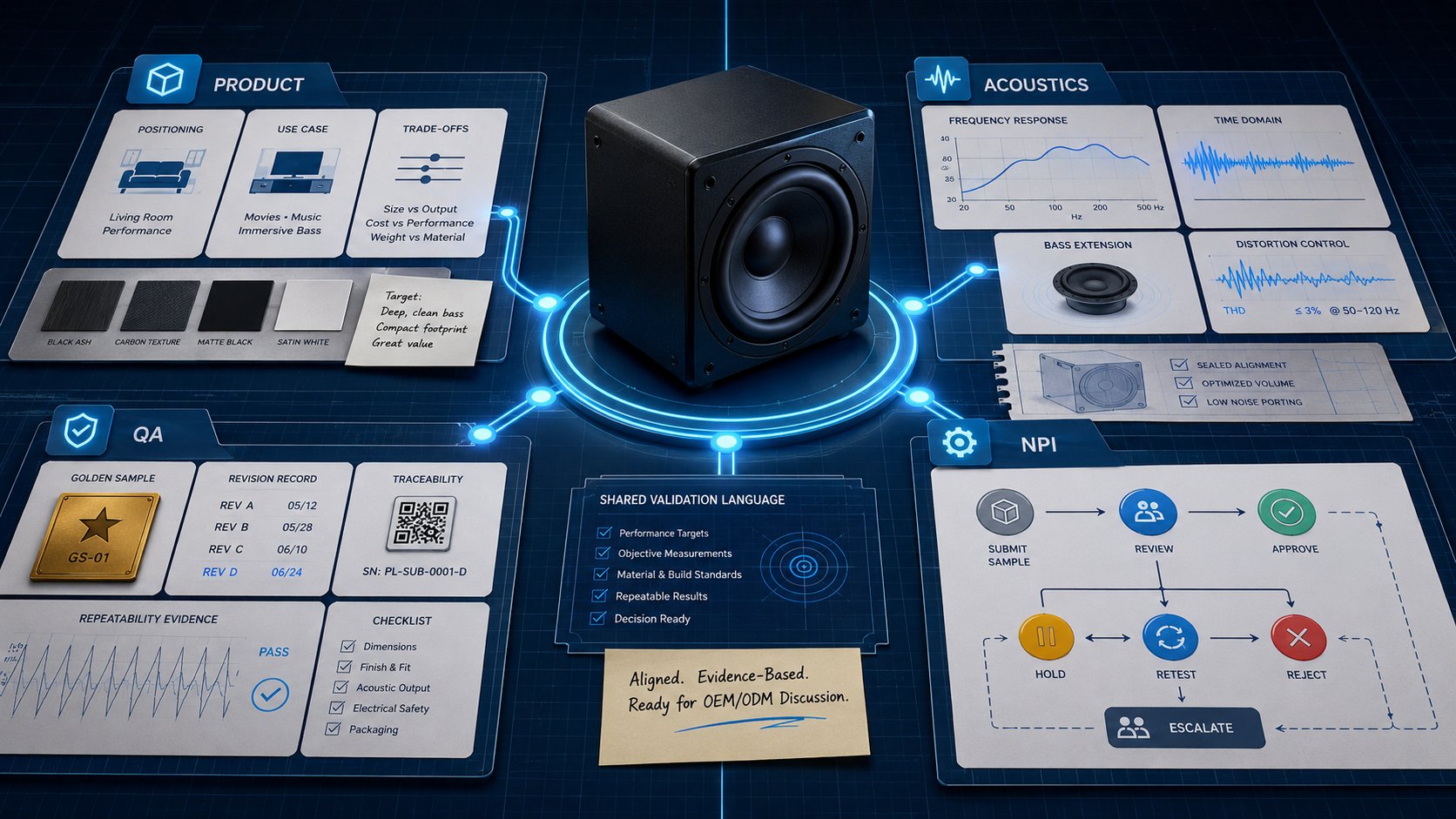
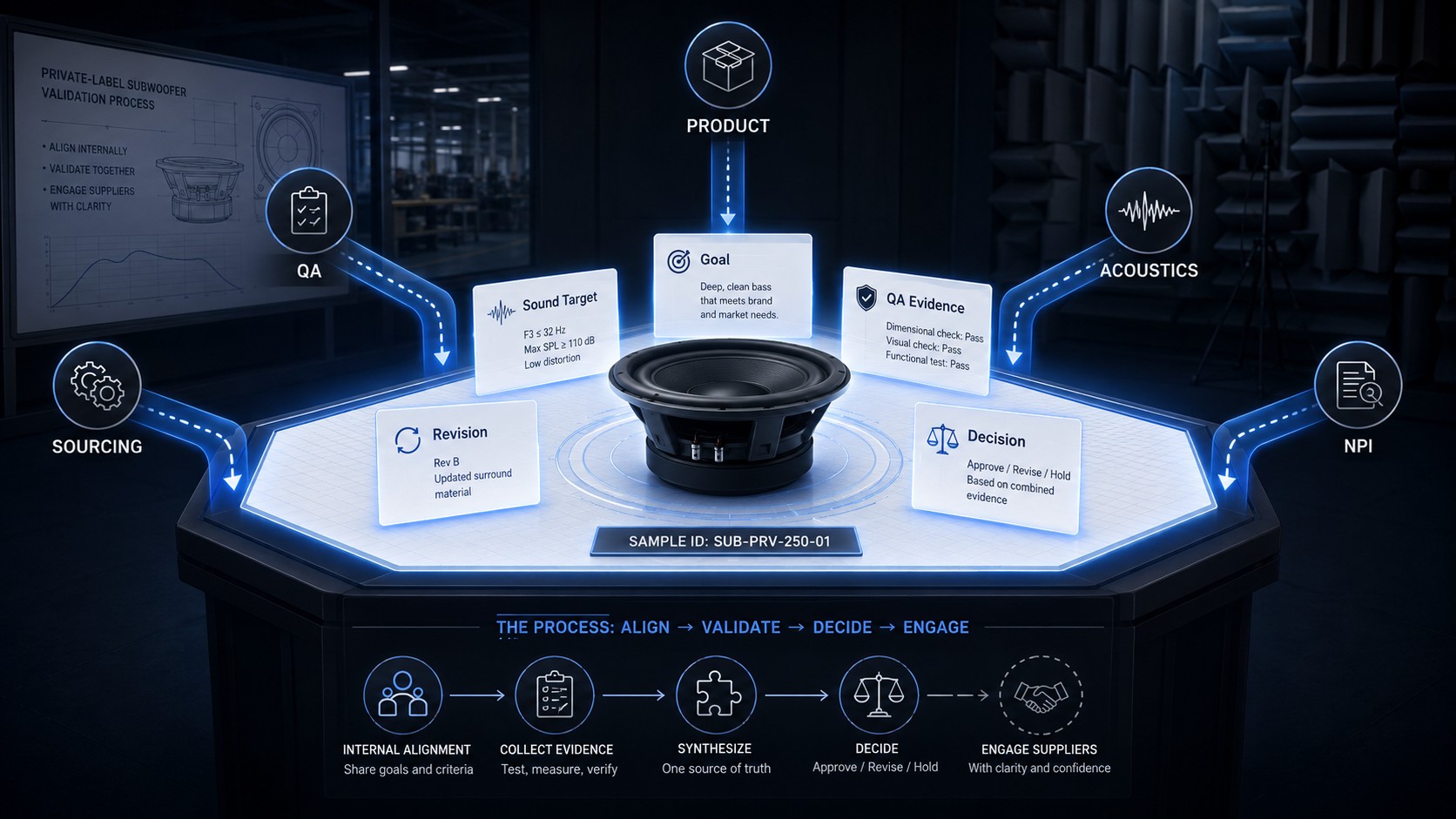
Private-label subwoofer programs often begin with a sample that sounds promising. But for an audio brand, sample approval is only one part of supplier evaluation. Before moving deeper with a manufacturer, Product, Acoustics, QA, Sourcing, and NPI teams need to know whether the supplier can define acoustic targets, test against them, protect the approved baseline, and carry that validation into production.
Supplier shortlisting often relies too heavily on subjective sample sound quality, unit price, catalog breadth, or broad manufacturing claims. However, verifying a mature acoustic validation process requires evidence that separates a capable manufacturing partner from a supplier merely providing a one-off prototype—without requiring the brand to operate an independent acoustic lab..
1. Start With Acoustic Target Alignment, Not Test Equipment
A strong sample answers one question: “Can this supplier build one unit that sounds acceptable?” Validation evidence answers a more useful program question: “Can this supplier support repeatable targets, controls, and communication after sample approval?”
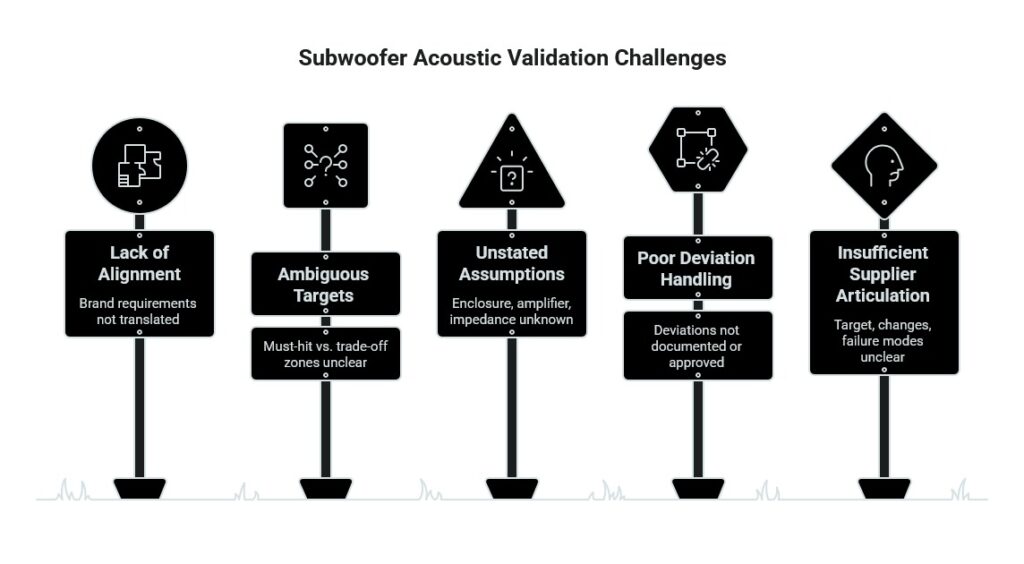
Start by asking how the supplier turns brand requirements into measurable acoustic validation criteria. For a private-label subwoofer program, this may include bass extension, SPL expectations, distortion limits, impedance assumptions, thermal or power-handling assumptions, enclosure constraints, amplifier pairing, and application context. These details can vary by program, so they should be treated as alignment points rather than universal requirements.
A short supplier-question checklist can help Product and QA teams compare manufacturers more consistently:
- What acoustic targets were used for this sample?
- Which targets are must-hit requirements, and which are trade-off zones?
- What assumptions were made about enclosure type, amplifier pairing, impedance, and use environment?
- How are deviations documented and approved?
Owning test equipment is insufficient. Capable suppliers must articulate which specific target was tested, why it matters, what changed between sample revisions, and what exact failure modes would trigger revalidation.
2. Ask for Validation Records That Connect the Sample to the Specification
A sample demo is not the same as a validation record. Listening impressions may help judge acoustic direction, but they rarely give QA, Sourcing, or NPI teams enough evidence to support a shortlist decision.
Ask the supplier to show records that connect the tested sample to the design requirement. Useful evidence can include acoustic test reports, sample test conditions, measurement setup notes, pass/fail criteria, revision history, deviation notes, and reliability or power-test summaries. As a general principle, test evidence becomes more useful when it shows the requirement, the condition, the result, and the follow-up control.
For reference, the official KLIPPEL R&D System overview describes measurement capabilities used in loudspeaker development, including acoustic tests, parameter measurement, distortion measurement, and power testing. That type of source is useful for understanding measurement-system context, but it should not be treated as proof that any specific supplier is ready. Supplier readiness depends on how measurement results are documented, governed, and linked to production decisions.
For brand teams, the key question is not simply, “Did the sample pass?” It is: “Can the supplier show which requirement it passed against, under what condition, and how that result will be protected after approval?”
3. Protect the Approved Acoustic Baseline With Golden Sample Governance
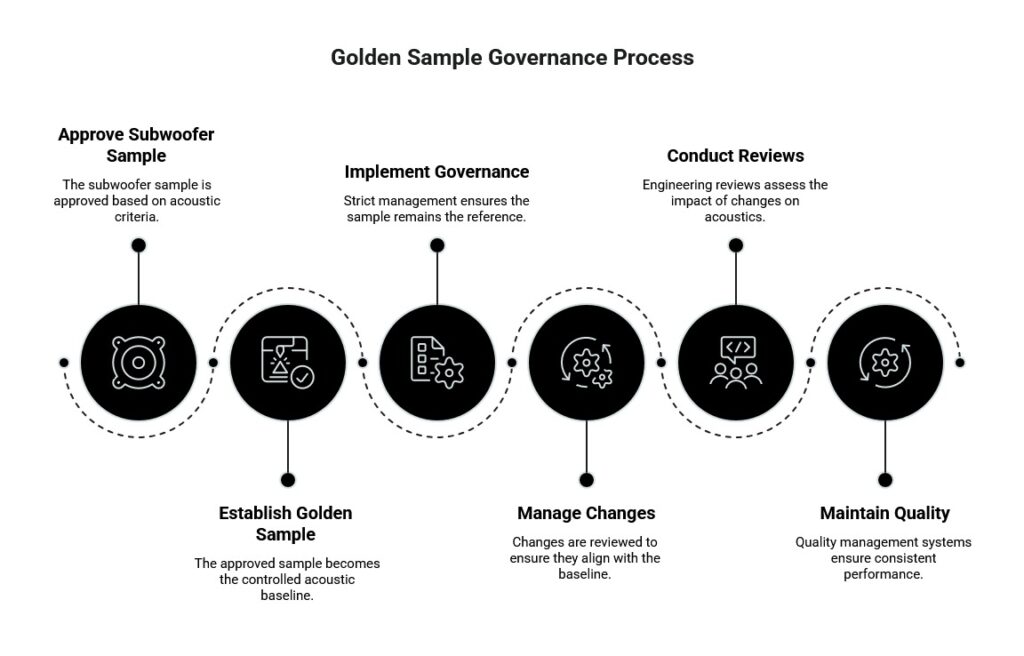
Once a subwoofer sample is approved, it should not become an informal memory. It should become a controlled acoustic baseline.
Strict golden sample management provides cross-functional stakeholders and the supplier a shared, version-controlled reference for approved performance that is tied directly to physical acceptance criteria. Without governance, teams may still disagree later about whether production has stayed aligned with the approved sample.
Subwoofer programs can be vulnerable to acoustic drift when component, material, enclosure, assembly, or process changes are not tied back to the approved baseline. A change to a cone, coil, magnet, enclosure detail, adhesive, or assembly process may look minor commercially but still affect acoustic behavior. While not every modification introduces risk, any meaningful material or process deviation requires a formalized engineering review path.
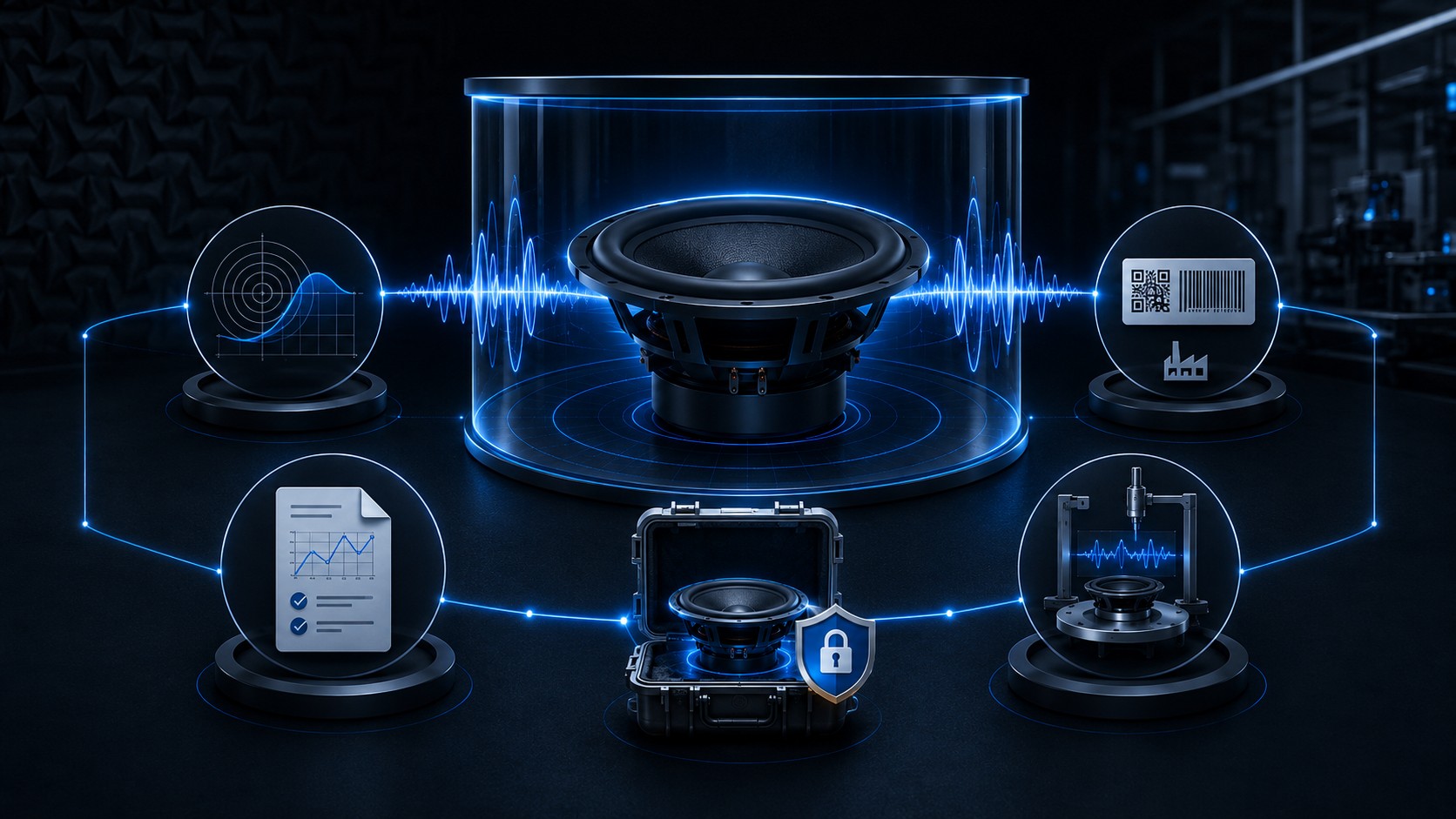
In one source-supported manufacturing example, China Future Sound’s materials describe R&D sample testing, finite element simulation for magnetic circuits and vibration systems, golden sample management, ISO9001-2015 quality management, KLIPPEL QC with golden samples, QR/barcode route control, test-data binding, IQC, IPQC, FQC, and reliability laboratory testing. These capabilities are useful evaluation signals when they are connected into a working system; they should not be read as a guarantee of performance.
4. Check Whether Acoustic Validation Carries Into Production QC
A supplier’s validation story is incomplete if it stops at engineering. Brand teams should ask how the approved acoustic baseline becomes a production control.
That means checking whether validation criteria appear in production QC limits, inspection gates, route controls, and exception records. Incoming material checks, in-process inspection, final QC, and reliability checks can support production consistency when they are linked to approved requirements. They are less useful when they exist as disconnected factory procedures.
The official ISO 9001:2015 page provides general context for quality management system requirements. For supplier evaluation, ISO 9001 can be a useful quality-system signal, but it should not replace program-specific validation evidence. A certified quality system does not, by itself, show that a subwoofer’s acoustic targets have been translated into production test limits.
Traceability also matters. Barcode testing route control and test-data binding can help brand teams investigate issues with more discipline when results are tied to units, lots, or production routes. This may support faster investigation, but it does not eliminate risk. The practical question is whether QC gates are enforced or ceremonial. If that is unclear, reviewing how suppliers manage unenforced QA gates can help teams frame better audit questions.
5. Use Communication Quality as an NPI Readiness Signal
Validation maturity is visible in how the supplier communicates. A mature supplier can explain what changed between sample revisions, why a test result matters, and what trade-offs exist between SPL, low-frequency extension, enclosure depth, thermal limits, durability assumptions, and cost.
Because cross-functional stakeholders evaluate readiness through different lenses, communication is critical. Engineering prioritizes acoustic tuning; Quality Assurance focuses on pass/fail limits; Procurement assesses warranty risk; and New Product Introduction (NPI) managers require launch schedules free of late-stage ambiguity.
Clear communication supports cross-functional decisions. Vague assurances create risk.
Green flags include target-to-test mapping, written sample revision notes, defined golden sample controls, QC linkage, traceable test data, and willingness to discuss trade-offs. Red flags include subjective sound demos only, “trust us” quality claims, no documented test conditions, no revalidation trigger after material changes, and equipment lists without reports.
For broader stakeholder alignment, brand teams can also review an OEM audio vendor selection checklist before advancing a supplier.
Subwoofer Acoustic Validation Evidence to Request Before Shortlisting
| Evaluation area | Evidence to request | What it tells your team | Risk signal if missing |
|---|---|---|---|
| Acoustic target alignment | Target list, trade-off notes, application assumptions | Whether the supplier understands the program outcome | Vague targets or equipment-first answers |
| Sample test report | Results tied to design requirements | Whether the sample maps to the specification | “Passed” with no stated requirement |
| Test conditions | Setup notes, enclosure assumptions, amplifier pairing, impedance context | Whether results are comparable | No documented test environment |
| Golden sample process | Custody, version control, retesting triggers | Whether the approved baseline can be protected | Informal sample ownership |
| Reliability/power testing | Relevant power or durability test summaries | Whether usage assumptions were considered | No link between approval and reliability checks |
| Production QC linkage | QC limits tied to approved criteria | Whether production can maintain validation intent | Engineering and factory QC are separate |
| Traceability | Unit, lot, barcode, QR-code, or test-data linkage | Whether issues can be investigated | No connection to production records |
| Supplier communication | Revision notes and deviation explanations | Whether teams can align before NPI | Vague or inconsistent answers |
Conclusion: Treat Acoustic Validation as Supplier-Selection Evidence
Choosing a private-label subwoofer manufacturer should not depend on sample impressions alone. A stronger supplier evaluation looks at how acoustic targets are defined, how samples are validated, how golden samples are controlled, how production QC protects the approved baseline, and how clearly the manufacturer communicates trade-offs.
When those pieces connect, subwoofer acoustic validation becomes a practical shortlist tool for Product, Acoustics, QA, Sourcing, and NPI teams. It supports better supplier comparison without turning brand teams into lab technicians.
To discuss target performance range, validation expectations, and sample approval criteria for an upcoming program, review China Future Sound’s private-label subwoofer manufacturing capabilities or request a validation-focused manufacturing discussion with the engineering team.
Disclaimer: This article is for general informational purposes only and does not constitute compliance, safety, technical, or professional advice. Requirements, risks, and best practices may vary by program, application, jurisdiction, system, provider, or use case. Confirm important supplier-selection and validation decisions with the appropriate qualified engineering, QA, compliance, or technical expert.
Our Editorial Process:
Our expert team uses AI tools to help organize and structure our initial drafts. Every piece is then extensively rewritten, fact-checked, and enriched with first-hand insights and experiences by expert humans on our Insights Team to ensure accuracy and clarity.
About the China Future Sound Insights Team
The China Future Sound Insights Team is our dedicated engine for synthesizing complex topics into clear, helpful guides. While our content is thoroughly reviewed for clarity and accuracy, it is for informational purposes and should not replace professional advice.