📌 Key Takeaways
Subwoofer supplier approval should depend on repeatable production evidence, not one strong sample or a low quote.
- Start With Risk: Match supplier checks to the program’s power, environment, volume, launch timing, and customization needs.
- Demand Linked Proof: A passed sample matters only when tests, limits, design intent, and revision history stay connected.
- Control Golden Samples: Golden samples should guide production checks, not sit untouched after one early approval.
- Trace Every Decision: IQC, IPQC, and FQC matter only when records connect units or batches to real quality decisions.
- Question Cheap Quotes: A 5–10% cost cut may not justify weak validation, poor traceability, or informal change control.
Evidence beats promises when warranty risk is on the line.
Enterprise audio sourcing, QA, product, and NPI teams will make safer supplier calls, using the evidence checks that follow.
~ ~ ~ ~ ~ ~ ~ ~ ~ ~ ~ ~ ~ ~ ~ ~ ~ ~
A competitive quote and a clean sample can make an original equipment manufacturer (OEM) or original design manufacturer (ODM) subwoofer partner look ready. For enterprise audio brands, that is only the beginning of supplier qualification. Unit cost, catalog fit, and available capacity matter, but they do not show whether approved performance can be repeated once the program moves into production.
The stronger evaluation question is: What evidence shows this manufacturer can repeat approved performance at scale?
That question keeps sourcing, quality assurance (QA), product, and new product introduction (NPI) teams focused on upstream warranty exposure. In this context, warranty risk is not a retail returns topic. It is a supplier-evaluation issue shaped by validation evidence, sample-to-production transfer, golden sample governance, traceable test data, enforced quality gates, and reliability testing aligned with the intended use case.
Start With Program Risk Before Reviewing the Supplier Brochure
Subwoofer manufacturer evaluation should begin with the program’s risk profile, not the factory’s sales material. Automotive, marine, pro audio, and custom OEM subwoofer programs can place different demands on power handling, environmental exposure, acoustic targets, installation assumptions, and launch timing.
As a general principle, the same manufacturer may be a suitable partner for one program and a higher-risk choice for another. That does not make the supplier “good” or “bad.” It means the evidence standard should match the program.
| Program variable | Why it changes supplier evaluation |
|---|---|
| Power handling expectations | Higher power claims usually require stronger validation and reliability evidence. |
| Use environment | Moisture, heat, vibration, and duty-cycle assumptions can change material and test expectations. |
| Brand positioning | Premium performance claims need clearer acceptance criteria and stronger sample records. |
| Volume and launch timeline | Faster ramp-up increases the importance of process control and traceability. |
| Customization level | More customization increases the need for revision control and engineering change discipline. |
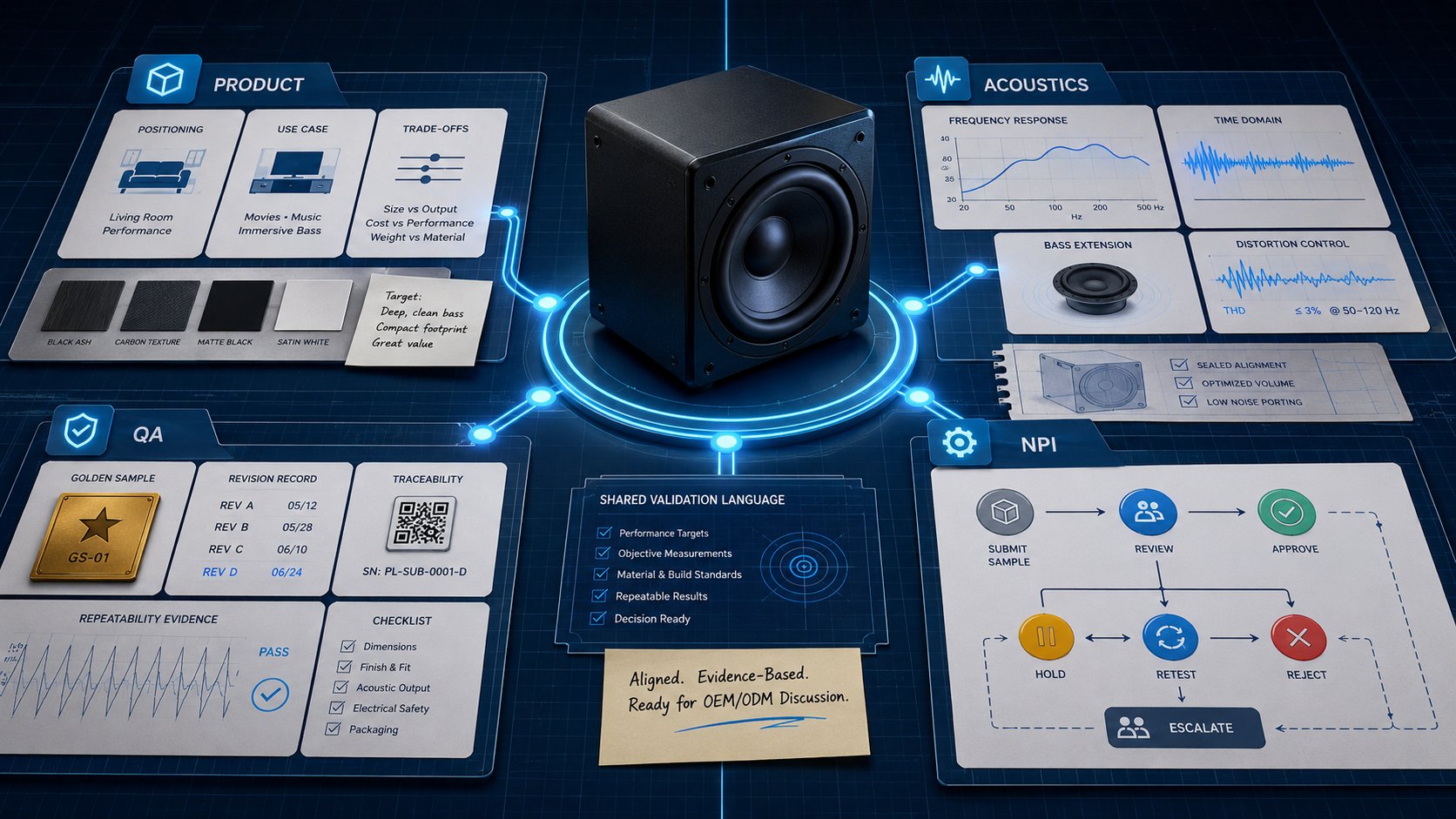
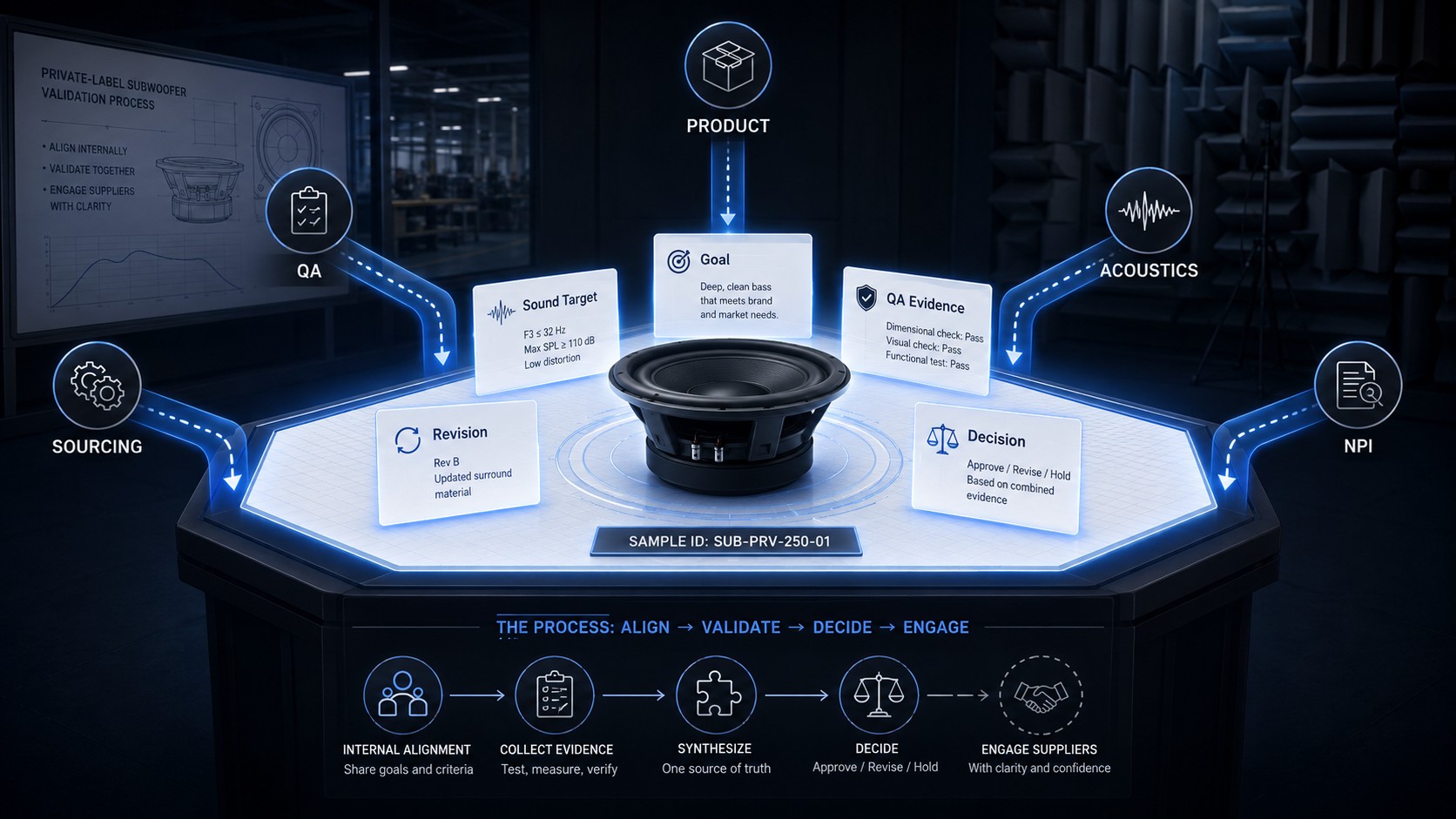
A sourcing team may be under pressure to reduce unit cost. QA may be focused on field failures and escalation risk. Product teams may worry that a strong prototype will not represent mass production. A practical evaluation process gives each team a shared evidence base instead of forcing the decision through one lens.
For programs involving marine audio programs or pro audio manufacturing programs, application assumptions should be discussed at a high level before supplier comparison begins. The goal is not to create a lab procedure. It is to clarify what kind of manufacturer readiness evidence the program needs.
Evaluate Validation Evidence, Not Sample Quality Alone
A good sample proves that a supplier can build at least one acceptable unit. It does not prove production consistency.
Stronger validation evidence connects four things: the sample identity, the test result, the design intent, and the revision history. If those items are disconnected, the team may approve a subwoofer without knowing which version was tested, which limits applied, or whether production units will be checked against the same criteria.
Useful validation evidence may include acoustic validation records, power-test summaries, prototype revision records, test limits, and failure-response notes. China Future Sound’s internal product-development documentation, for example, states that its Acoustics Team uses finite element simulation for magnetic circuit and speaker vibration-system work, KLIPPEL R&D for sample testing against designed performance requirements, as well as conducting short-term destructive power tests, long-term power tests, and golden sample management. While these methodologies illustrate critical validation categories, they function as risk-mitigation tools rather than absolute guarantees of zero warranty claims.
The practical distinction is simple. A supplier saying “the sample passed” is weaker than a supplier showing which sample was tested, what limits were used, what changed after the test, and how those limits will inform production quality control. Teams that need a deeper documentation review can also compare subwoofer validation documentation before narrowing the supplier list.
ISO 9001 provides useful quality management context, serving as a foundational standard that organizations use to improve their quality management systems and meet customer and applicable requirements. It should not be treated as product-specific proof that a subwoofer program is low risk.
Treat Golden Sample Control as Governance, Not Decoration
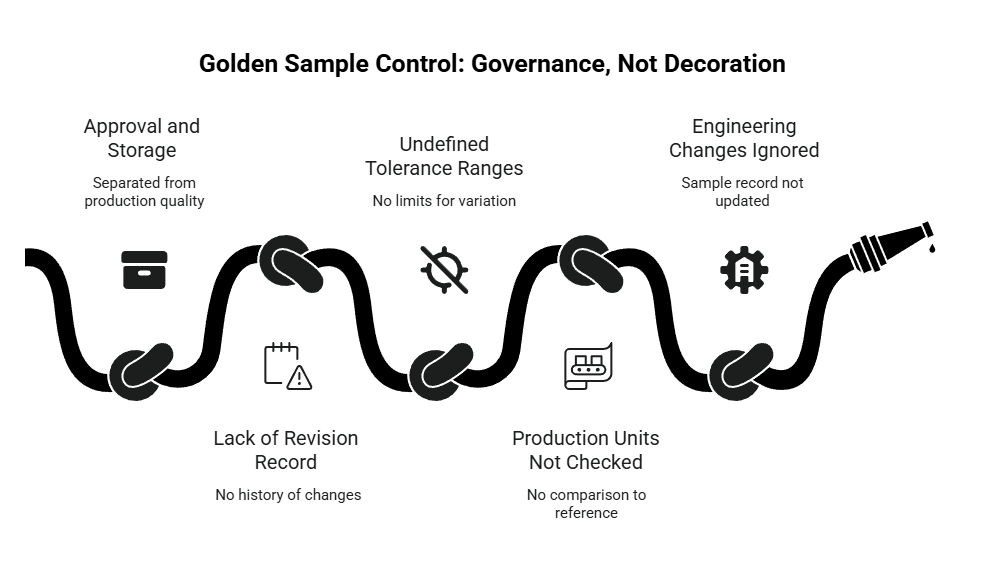
Golden samples are often discussed as if they are approved trophy units. In a mature supplier evaluation, they should be treated as governance tools.
A golden sample should help define the approved reference for performance, materials, build condition, and test comparison. The risk appears when the golden sample is approved once, stored away, and separated from production quality control. That kind of ceremonial control does little to help QA teams evaluate sample-to-production transfer.
Stronger golden sample governance answers specific decision questions. Who controls the sample? Is there a revision record? Are tolerance ranges or limit samples defined? Are production units checked against the reference? How does an engineering change affect the sample record?
At CFS, the consistency of performance parameters between mass-produced products and approved samples is maintained through strict golden sample governance. During the production process, this is directly combined with KLIPPEL QC to minimize variance and prevent specification drift at volume.
Look for Enforced QA Gates and Traceable Test Data
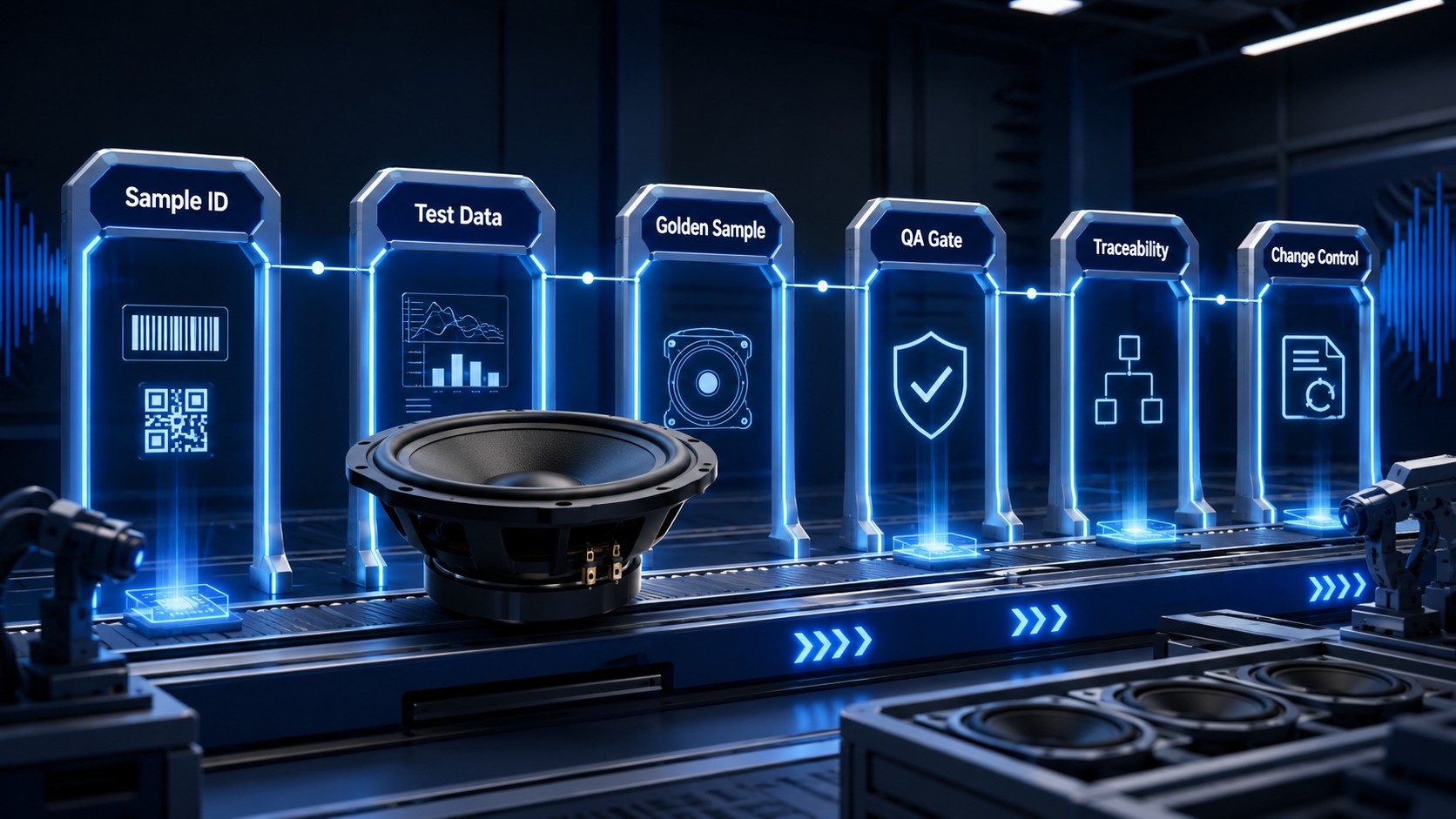
Incoming Quality Control (IQC), In-Process Quality Control (IPQC), and Final Quality Control (FQC) are useful supplier-evaluation signals only when they are enforced and documented. A factory can name the gates without proving that production decisions depend on them.
Traceability should connect units or batches to test routes, test data, inspection results, and relevant production decisions. This is a generally accepted quality-management principle: when records are tied to specific units, lots, or batches, teams have a clearer path for containment and root-cause analysis. The details may vary by supplier system, program volume, and customer requirements.
CFS utilizes integrated ERP and WMS systems for strict FIFO materials management, employing barcode and QR-code tracking to bind test data directly to specific inspection routes across IQC, IPQC, and FQC. These operational protocols serve as a necessary baseline for the process evidence an enterprise audio brand should demand from any prospective supplier.
Risk signals include manual test records that are not tied to units, production movement without recorded QC passes, weak containment rules for failed units, engineering changes that are not tied to affected batches, and final inspection presented as the whole quality system. Final inspection matters, but it is not a substitute for controlled incoming materials, in-process checks, and traceable production decisions.
For programs with formal launch gates, Advanced Product Quality Planning (APQP) can provide useful general context. AIAG’s APQP 3rd edition materials discuss product-launch planning topics such as sourcing, change management, program metrics, risk assessment mitigation plans, and gated management. Because APQP is automotive-origin, it should be used lightly and adapted carefully for audio programs rather than copied as a universal requirement.
Compare Unit Cost Against Evidence Strength
Low unit cost is not automatically a warning sign. A lower quote becomes a concern when it is paired with weak validation evidence, unclear golden sample governance, poor traceability, or quality gates that appear ceremonial.
For enterprise audio brands, the comparison should not be “lowest quote wins” or “highest-cost supplier is safest.” A better comparison is whether the quote is supported by enough evaluation evidence for the program’s risk profile.
| Supplier signal | Lower-risk interpretation | Higher-risk interpretation |
|---|---|---|
| Validation records | Linked to sample version, limits, and revision history | Polished reports disconnected from decisions |
| Golden sample control | Versioned and used in production QC | Approved once and rarely referenced |
| QA gates | IQC, IPQC, and FQC are documented and enforced | Final inspection carries most of the quality burden |
| Traceability | Unit-level or batch-level records support root-cause review | Defects cannot be connected clearly to test or production history |
| Reliability testing | Matched to intended use assumptions | Generic, undocumented, or not tied to acceptance criteria |
| Change control | Engineering Change Order (ECO) and Engineering Change Request (ECR) records include cut-in points | Substitutions and revisions are handled informally |
Sourcing teams must weigh whether a 5–10% unit cost reduction justifies assuming the liability of undocumented quality controls. That percentage should not be treated as a statistic or industry benchmark. It is only a practical way to reveal whether price is dominating the supplier discussion before QA and product evidence has been fully reviewed.
Questions to Ask Before Shortlisting a Subwoofer Manufacturer
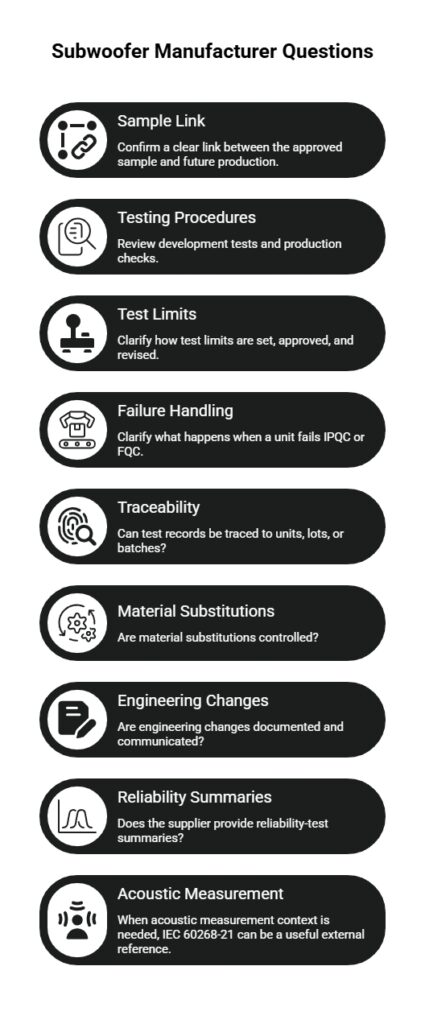
The shortlist should reflect what the supplier can prove, not only what the supplier can quote. Before RFQ, sampling, pilot run, or start of production, sourcing, QA, and product teams should align on a small set of evidence questions.
Ask whether the manufacturer can show a clear link between the approved sample and future production. Confirm which tests are used during development and which checks continue during production. Review how test limits are set, approved, and revised. Clarify what happens when a unit fails IPQC or FQC.
Traceability deserves direct attention. Can test records be traced to units, lots, or batches? Are material substitutions controlled? Are engineering changes documented and communicated before affected production moves forward? Does the supplier provide reliability-test summaries that match the intended application, without presenting generic test activity as program-specific proof?
For teams preparing an NPI handoff, questions before NPI starts can help product and QA teams align on evidence before the supplier relationship becomes harder to change.
When acoustic measurement context is needed, IEC 60268-21 can be a useful external reference because IEC describes it as an acoustical output-based measurement method for electro-acoustical transducers and passive or active sound systems, including loudspeakers, automotive sound systems, and professional equipment.
Make Supplier Approval an Evidence Decision
Subwoofer manufacturer evaluation is strongest when sourcing, QA, and product teams align around evidence rather than assumptions. While baseline metrics like pricing and production bandwidth remain necessary qualifiers, they become more useful when reviewed alongside verified process controls, rigorous documentation, and a zero-tolerance approach to unmapped variance.
A mature supplier does not need to claim that warranty risk disappears. The stronger signal is the ability to show how approved performance is transferred into production, how quality decisions are recorded, and how variation can be investigated when it appears.
Disclaimer: This article is for general informational purposes only and does not constitute compliance, safety, technical, or professional advice. Requirements, risks, and best practices may vary by context, jurisdiction, system, provider, or use case. Confirm important decisions with the appropriate qualified professional, authority, or technical expert.
Our Editorial Process:
Our expert team uses AI tools to help organize and structure our initial drafts. Every piece is then extensively rewritten, fact-checked, and enriched with first-hand insights and experiences by expert humans on our Insights Team to ensure accuracy and clarity.
About the China Future Sound Insights Team
The China Future Sound Insights Team is our dedicated engine for synthesizing complex topics into clear, helpful guides. While our content is thoroughly reviewed for clarity and accuracy, it is for informational purposes and should not replace professional advice.