📌 Key Takeaways
Subwoofer sample approval means little unless the factory can prove it can repeat the approved product in production.
- Lock The Reference: Tie the approved sample, test data, BOM, and revision record to one controlled production target.
- Measure The Sound: Turn “good bass” into clear test limits that factory QC can check the same way every time.
- Define Allowed Variation: Set material, fit, finish, acoustic, and assembly limits before normal production changes become product drift.
- Control Every Change: Require records, owners, approval triggers, and cut-in points before suppliers change materials or processes.
- Trace The QC Route: Link IQC, IPQC, FQC, acoustic tests, and unit data to the approved specification package.
Approved intent must survive production reality.
Product and QA teams managing private-label subwoofer programs will reduce launch risk, using the handoff checks that follow.
~ ~ ~ ~ ~ ~ ~ ~ ~ ~ ~ ~ ~ ~ ~ ~ ~ ~
A subwoofer sample can sound right, measure acceptably, and receive stakeholder approval. That still does not prove production readiness.
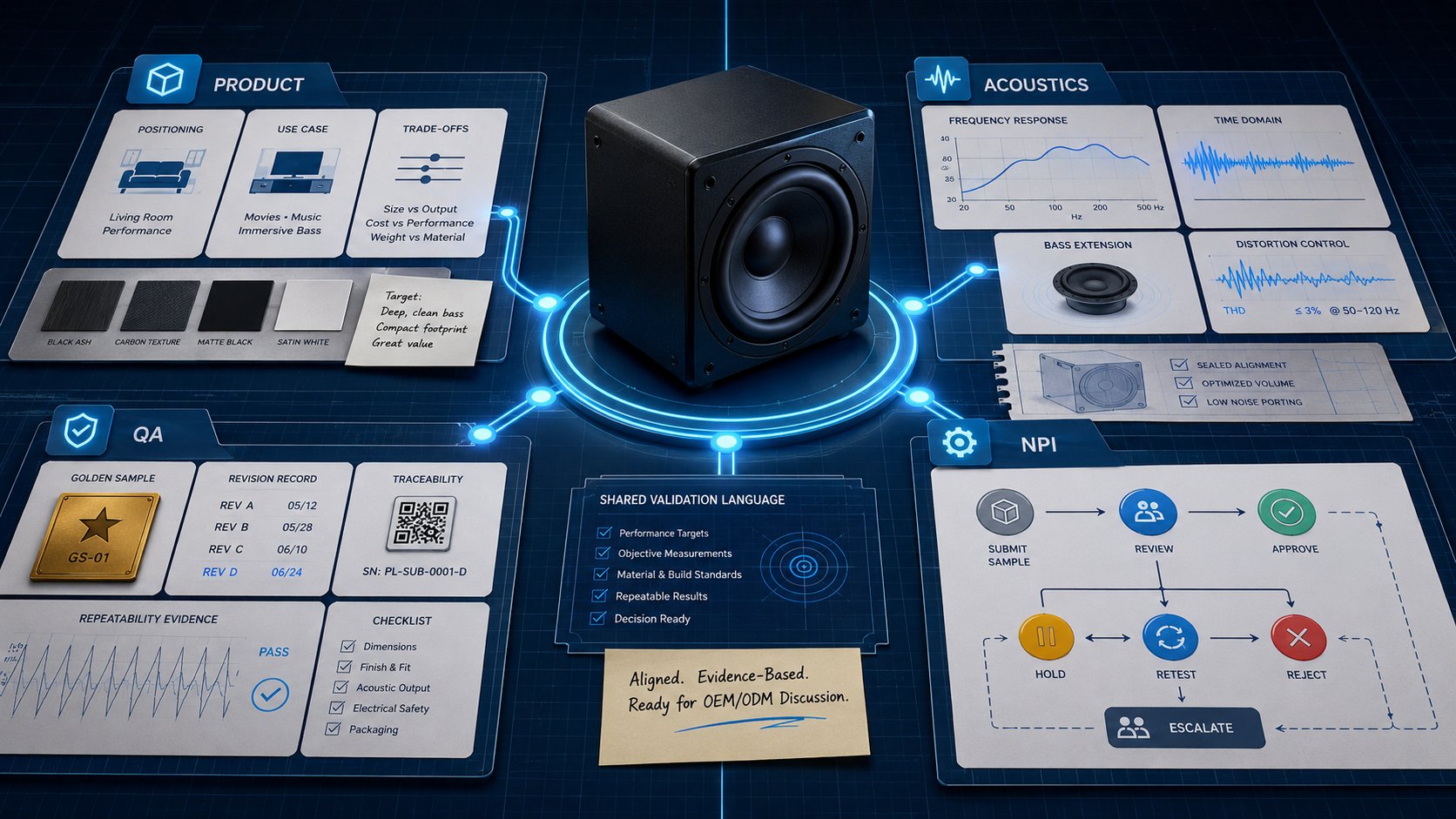
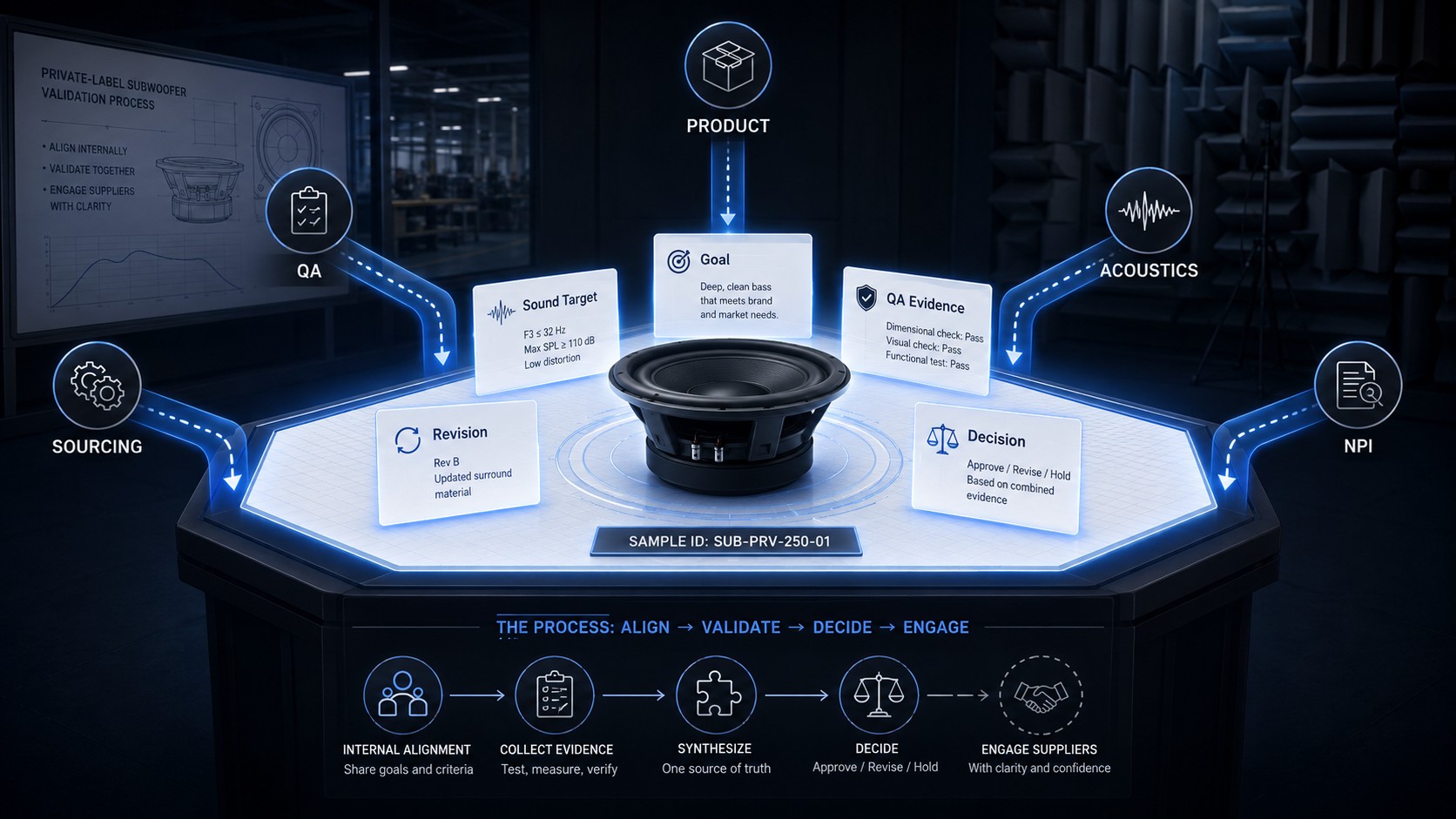
The critical risk often appears after sample approval but before SOP, when Product, QA, Acoustics, Sourcing, Operations, and the OEM/ODM partner must turn approved intent into enforceable production evidence. If the approved sample, acoustic targets, materials, tolerances, revision history, test limits, and production controls are not tied together, each team may believe it is working from the same reference while relying on different assumptions.
Quality gates should confirm more than approval status. They should confirm whether the factory can reproduce the approved intent consistently, document deviations, control changes, and provide evidence before volume production begins.
For private-label subwoofer programs, specification handoff is not a paperwork step. It is a production-readiness control point.
1. The Approved Sample Is Not Tied To A Controlled Specification Package
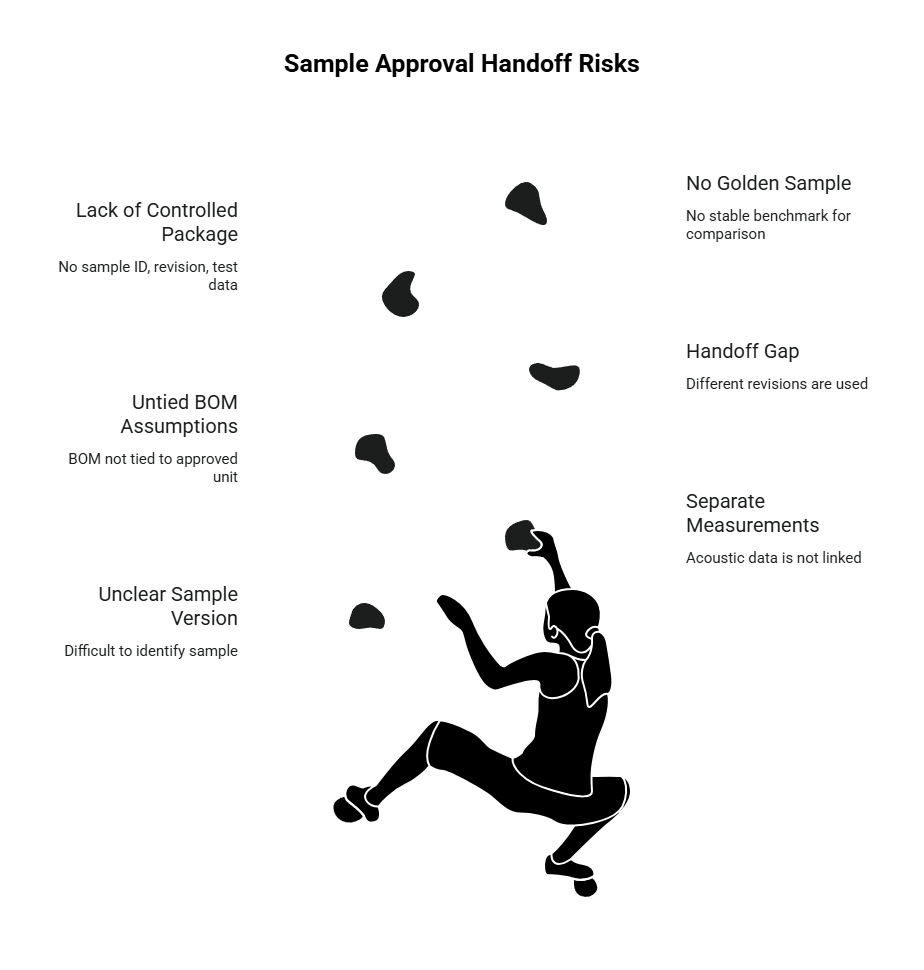
A sample only supports production readiness when everyone can identify exactly what it represents.
The risk starts when the sample version is unclear, acoustic measurements are stored separately from the physical sample identity, or BOM assumptions are not tied to the approved unit. Sub-component and material variations directly affect whether production units match the approved design intent.
A general principle in NPI control is that physical approval and documentation approval should point to the same reference. If Product approves one sample, QA reviews test data from another revision, and the supplier prepares production against a third BOM version, the program has already created a handoff gap.
The quality gate should ask for a controlled package: sample ID, revision record, test data, BOM, material notes, approval owner, and release status. Golden sample governance is important here because it turns the approved physical reference into a stable benchmark for production comparison. CFS source material states that golden sample management is used to support consistency between samples and mass-produced products, and that KLIPPEL QC is used with golden samples for production consistency control.
For further context, see CFS’s related guide on golden sample integrity.
Quality gate question: Can the supplier show which exact sample version, specification package, test data, and approval record define the production target?
2. Acoustic Targets Remain Subjective Instead Of Measurable
“Deep bass,” “clean output,” and “matches the approved sound” may be useful early in product discussion. They are not enough for production release.
Subwoofer programs need acoustic intent translated into measurable approval limits. Depending on the design and program requirements, relevant criteria may include frequency response, distortion, sensitivity, impedance, resonance, power-handling expectations, or other agreed performance checks. The exact criteria vary by product architecture, market position, use case, and validation plan.
The important production-readiness question is not whether every possible acoustic measurement has been taken. It is whether the agreed targets have defined test conditions, ownership, and pass/fail expectations that factory QC can reproduce. Without that, subjective sample approval may not scale into repeatable production checks.
CFS source material states that KLIPPEL R&D is used to test samples against designed performance requirements, while KLIPPEL QC is used in production with golden samples. KLIPPEL’s own vendor documentation describes its R&D System as supporting acoustic, parameter, distortion, life, and power testing, and its QC System as supporting manufacturing and quality-control testing.
For a related internal article, see why sample approval breaks down when acoustic targets are unclear.
Quality gate question: Are the acoustic targets documented as measurable approval limits with defined test conditions and ownership?
3. Tolerances And Material Boundaries Are Not Production-Ready
A sample shows what can be built once. A production-ready specification defines how much variation is acceptable when units are built repeatedly.
This distinction matters because normal production variation is not automatically quality drift. A program needs clear boundaries for dimensional fit, acoustic performance, cosmetic finish, assembly details, branding execution, and material substitutions. Without those boundaries, QA may struggle to distinguish an acceptable unit from a quality escape.
Material control deserves particular attention in subwoofer programs. A change in cone, surround, coil, magnet, adhesive, basket, enclosure, finish, or packaging may appear small from a purchasing or process perspective. In some designs, that change could affect acoustic behavior, durability, assembly repeatability, or customer-facing consistency. The effect depends on the specific product and production system, so the handoff should define which substitutions are allowed, which require notification, and which require retesting or re-approval.
Limit samples help when visual or tactile standards are difficult to express in text. While a general quality-control concept, not a claim that every supplier or CFS program uses a specific limit-sample process.
For more on the broader risk, see CFS’s article on mass production spec drift.
Quality gate question: Which tolerances, limit references, or acceptance criteria define the boundary between acceptable variation and production drift?
4. Change Control Does Not Define What Must Be Re-Approved
Specification handoff weakens when changes are treated as factory execution details rather than controlled engineering decisions.
For Product and QA leaders, the issue is not to block every small adjustment. The issue is to define approval triggers before production pressure begins. ECO/ECR protocols must specify exactly which tooling, material, or process deviations trigger notification, retesting, brand-side approval, or golden sample revision.
Cut-in visibility also matters. If a revised material or process enters production without a clear lot boundary, effective date, or unit identity link, later investigation becomes harder. Traceability should support production-readiness evidence and root-cause analysis, not consumer returns operations.
A mature OEM/ODM partner should be able to discuss change control in terms of records, owners, approval triggers, and production cut-in points. Verbal reassurance is not enough when the program depends on repeatable acoustic and mechanical consistency.
Quality gate question: Which changes require notification, retesting, brand approval, or a revised golden sample before production continues?
5. Factory Qc Routes Cannot Enforce The Approved Specification
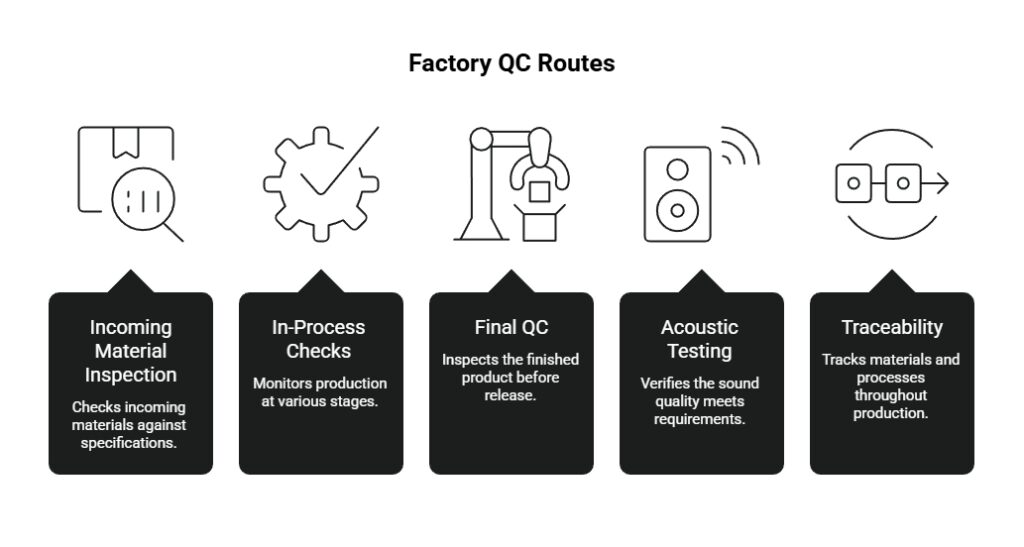
A handoff is only as strong as the QC route that enforces it.
Incoming material inspection, in-process checks, final QC, acoustic testing, and traceability should not operate as disconnected activities. They should connect to the approved specification package. If IQC, IPQC, and FQC checks are not linked to the approved BOM, tolerances, acoustic limits, golden sample rules, and change-control records, quality gates may exist on paper without controlling the actual production route.
CFS source material states that the company uses ISO9001-2015 quality management certification, ERP/WMS material control with FIFO, barcode/QR route control, barcode-linked test data, IQC, IPQC, FQC, KLIPPEL QC, and reliability laboratory testing according to design requirements.
The quality gate should focus on evidence. Can a unit’s test data be tied to its identity? Can production records show which route it followed? Can the factory identify whether a later issue relates to incoming material, process variation, final test results, or an approved change?
For documentation review guidance, see CFS’s article on how to compare subwoofer validation documentation.
Quality gate question: Can the factory show how incoming material checks, in-process inspection, final QC, and test-data traceability enforce the approved specification?
A Practical Pre-Production Handoff Checklist For Product And Qa Teams
| Handoff area | Risk if unclear | Quality gate evidence to request |
|---|---|---|
| Approved sample identity | Teams approve different references | Sample ID, revision record, test data, approval owner |
| Acoustic limits | Subjective approval cannot scale | Measurable criteria, test conditions, pass/fail limits |
| Materials and BOM | Substitutions create drift | Controlled BOM, material notes, substitution rules |
| Tolerances | Variation becomes quality escape | Dimensional, acoustic, cosmetic, and assembly limits |
| Golden sample | Factory lacks stable benchmark | Governed sample custody and comparison rules |
| ECO/ECR | Changes bypass re-approval | Change log, approval triggers, cut-in records |
| QC route | Production gates do not enforce spec | IQC/IPQC/FQC plan, test records, traceability |
This checklist is not a supplier audit template or a factory work instruction. It is a decision framework for confirming whether the partner can control specification transfer risk before production release.
The strongest handoff evidence usually answers six questions:
Which exact sample version does this production release follow?
What test limits will production units be checked against?
Which material or process changes require brand-side approval?
How will golden sample comparison be used during production?
Can unit-level test data be traced back if a later issue appears?
Who owns the decision to approve, revise, retest, or hold before SOP?
A mature manufacturer should be able to answer with records, owners, limits, routes, and change triggers. The goal is not to micromanage the factory. The goal is to confirm that the approved product intent can survive production reality.
FAQs
Is sample approval enough to start subwoofer production?
No. Sample approval is an important milestone, but production release should also require controlled specifications, measurable criteria, golden sample governance, change-control rules, and QC route readiness.
What should a subwoofer specification handoff include?
A practical handoff should include approved sample identity, revision records, acoustic targets, BOM and material notes, tolerances, test conditions, golden sample rules, ECO/ECR triggers, and QC evidence.
Why does change control matter before subwoofer production?
Even small material, component, or process changes can affect acoustic behavior, durability, or consistency. The exact effect varies by design and production system, so the handoff should define which changes require notification, retesting, or re-approval.
Treat specification handoff as a quality gate
The value of specification handoff is not more documentation for its own sake. The value is a shared, enforceable production target that connects approved sample intent to factory execution.
For private-label subwoofer programs, the quality gates that matter most are sample identity, measurable acoustic limits, production tolerances, golden sample governance, ECO/ECR control, QC route readiness, and traceable test evidence. When those controls are clear before SOP, Product and QA teams are better positioned to reduce NPI risk, protect production consistency, and hold supplier-readiness conversations with evidence instead of assumptions.
Discuss your next subwoofer program with CFS to review specification handoff, golden sample control, and production-readiness evidence before launch.
Disclaimer: This article is for general informational purposes only and does not constitute compliance, safety, technical, or professional advice. Requirements, risks, and best practices may vary by program, supplier, product design, production system, jurisdiction, and use case. Confirm important decisions with the appropriate qualified professional, authority, or technical expert.
Our Editorial Process:
Our expert team uses AI tools to help organize and structure our initial drafts. Every piece is then extensively rewritten, fact-checked, and enriched with first-hand insights and experiences by expert humans on our Insights Team to ensure accuracy and clarity.
About the China Future Sound Insights Team
The China Future Sound Insights Team is our dedicated engine for synthesizing complex topics into clear, helpful guides. While our content is thoroughly reviewed for clarity and accuracy, it is for informational purposes and should not replace professional advice.