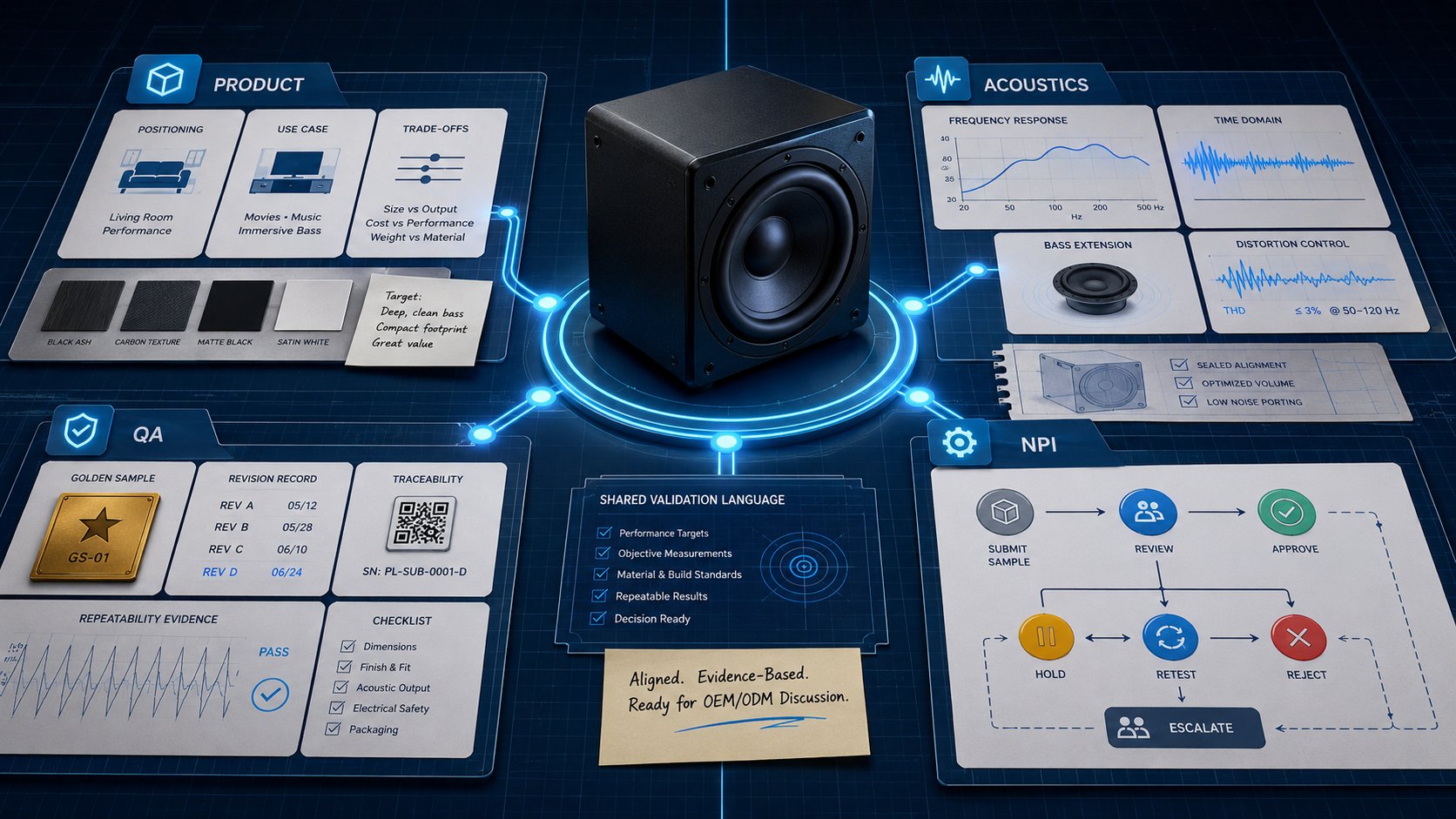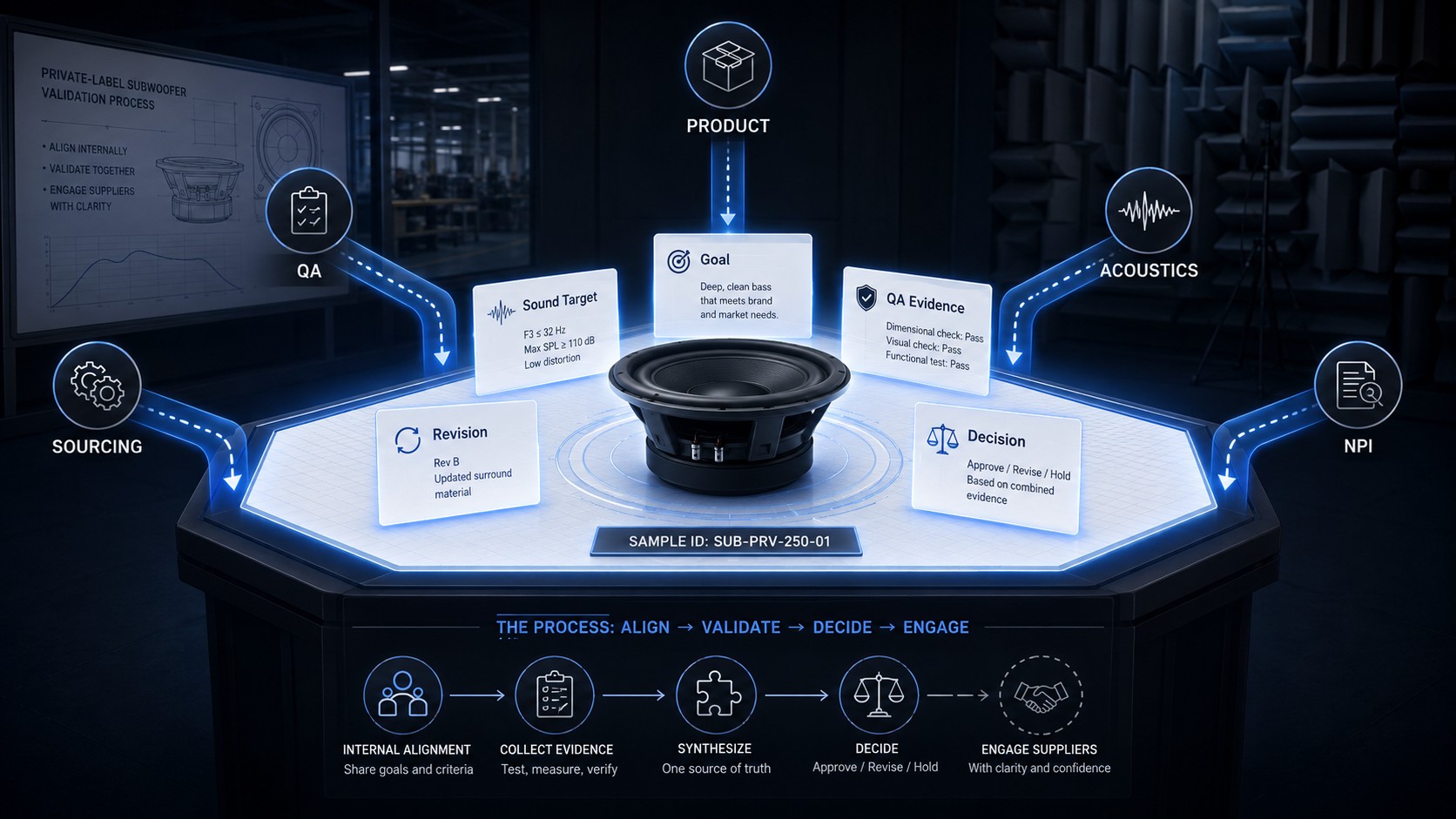
📌 Key Takeaways
Private-label subwoofer roadmaps stay controllable when every supplier change is compared, approved, introduced, and traced against one clear baseline.
- Set One Clear Baseline: Align specifications, drawings, parts lists, samples, test limits, and revision records before judging any proposed change.
- Judge Real Consequences: Classify each change by its effects on current products, shared platforms, future models, claims, evidence, and production identity.
- Demand Operating Evidence: A completed change record shows whether the supplier connects decisions, approvals, production timing, traceability, and updated documents.
- Protect Future Models: Review shared components and tools across planned variants, because an acceptable current change may quietly limit later options.
- Control the Cut-In: Identify the first affected lot or unit and remaining inventory so old and new revisions do not become mixed.
A local change can reshape the whole roadmap.
Private-label subwoofer leaders will spot supplier governance gaps and protect future products using the practical framework below.
~ ~ ~ ~ ~ ~ ~ ~ ~ ~ ~ ~ ~ ~ ~ ~ ~ ~
A supplier can deliver an acceptable first sample and still be difficult to govern across later revisions. Feature lists and sample performance show only part of partner fit; they do not show how later component, source, process, tooling, test, or documentation changes will be governed.
Change itself is normal and not automatically harmful. The risk emerges when a proposed revision cannot be compared with a controlled product reference, assessed across affected products, approved by the right owners, and tied to a clear production cut-in.
For private-label subwoofer leaders, change control is therefore a platform-continuity capability. The following framework helps Product, Engineering, QA, Sourcing, and Brand teams test that capability before detailed development or specification lock.
Change Control Becomes a Roadmap Issue When the Baseline Is Unclear
For this article, an approved baseline is the controlled combination of product intent, specifications, drawings, bill of materials (BOM), sample identity, acceptance evidence, and related documents used as the current reference for decisions.
These materials often evolve at different speeds. Product may use an approved positioning brief, Engineering the latest drawing, QA an earlier test limit, and the supplier a production BOM that already reflects a substitution. The teams may therefore compare one proposal against different product states.
The brand should establish who owns the baseline, how its revision identity is recorded, and which physical and digital references belong to it. A golden sample may be one of those controls, but it should remain aligned with drawings, specifications, acceptance criteria, and revision records. It is not a complete change-control system by itself. Further context is available in this guide to golden-sample governance.
If the model will support SQ, slim, or high-power extensions, baseline ambiguity can weaken tier logic before those variants enter detailed development.
Three opening questions expose the issue:
- What documents and physical references define the current approved revision?
- Do the BOM, drawings, test limits, and sample identity carry aligned revision status?
- Who can declare that the baseline has changed?
Classify Changes by Consequence, Not by How Small They Sound
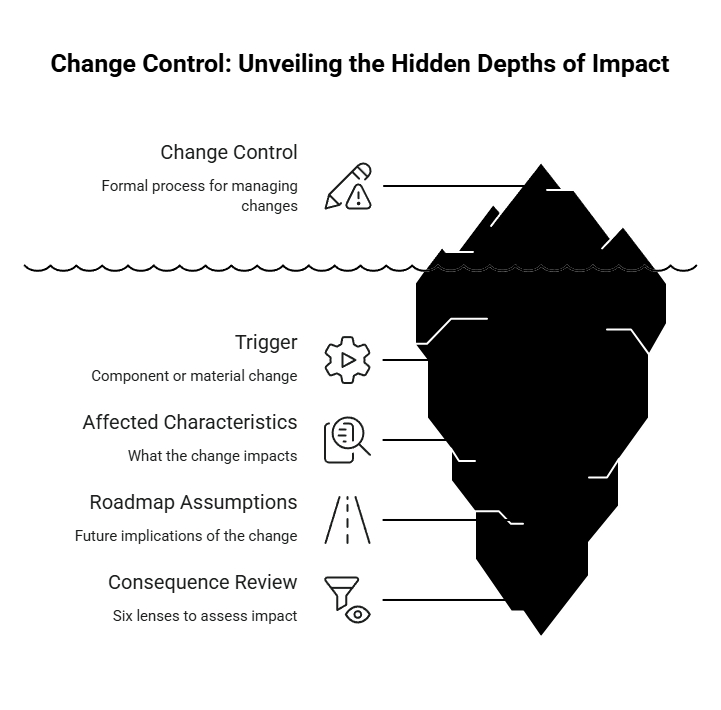
Change control is a formal method for identifying, assessing, approving, implementing, and recording a change. The exact workflow varies by organization and program. The evaluation principle is more stable: classify the proposal by what it may affect, not by labels such as “minor,” “equivalent,” or “process-only.”
Possible triggers include a component or material, sub-supplier, source, drawing, tolerance, tool, fixture, process route, assembly condition, inspection method, test limit, software element, identity document, or temporary deviation. None is automatically high-risk. The supplier should instead identify the affected characteristics, products, evidence, and roadmap assumptions.
Consider an illustrative component substitution described as equivalent. “Equivalent” might refer to fit, nominal specification, availability, or another limited comparison basis. The brand should ask which characteristics were compared, which were not, and whether the same architecture is intended for future variants. Depending on the design and application, a change that is acceptable for the active SKU may still require broader roadmap review. For example, a supplier might substitute a spider material to improve yield. While the new material passes basic frequency sweeps on the current model, it subtly shifts the suspension compliance, ultimately rendering a planned high-power variant of the same platform unbuildable without a total redesign.
A test-method or test-limit revision presented as administrative cleanup deserves similar scrutiny: does it alter comparability with earlier samples, golden-sample records, or future acceptance evidence?
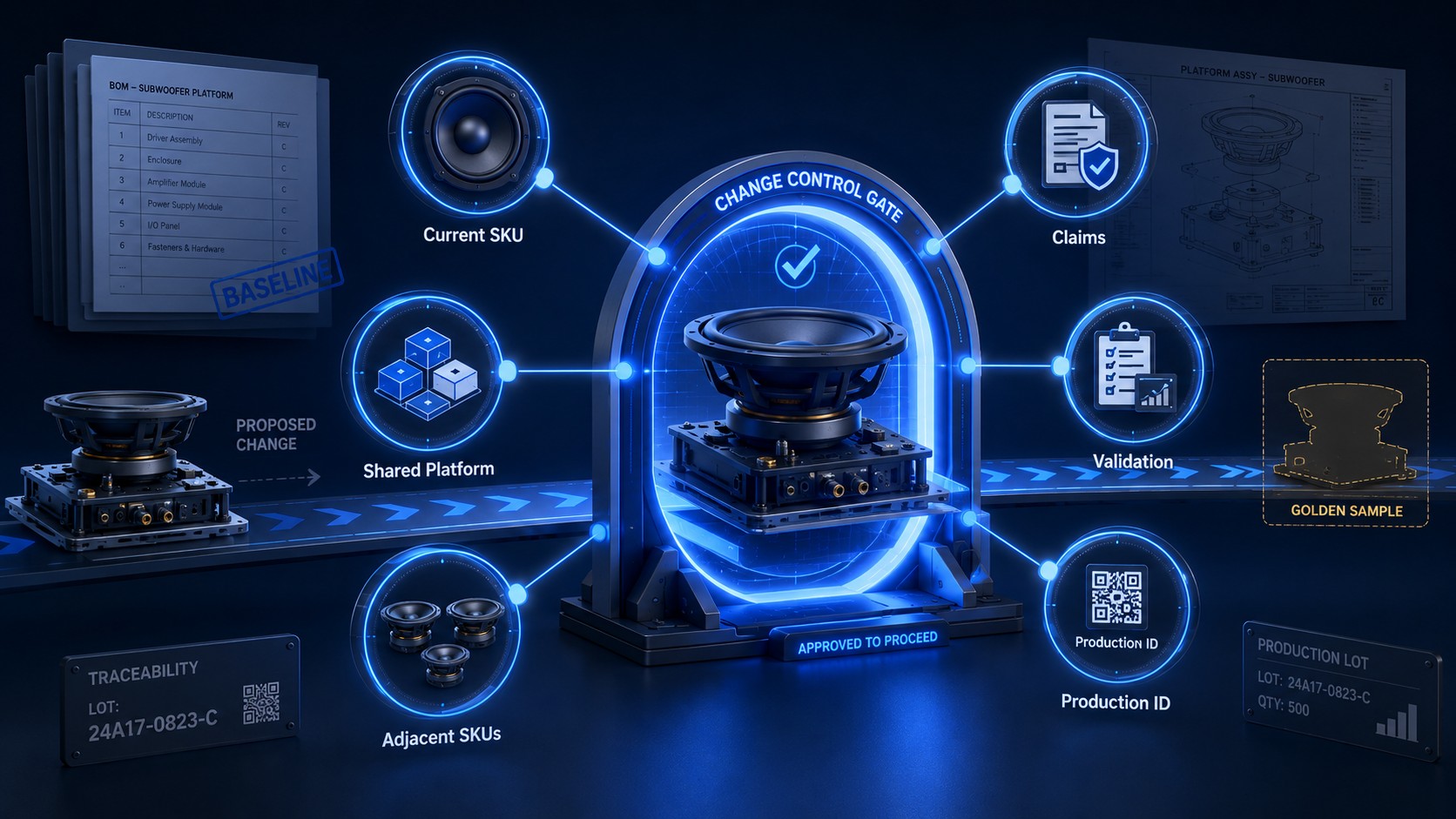
The consequence review should cover six lenses: the current SKU, the shared platform, adjacent SKUs, approved claims, validation evidence, and production identity. This prevents a narrow label from determining the review depth before the actual impact is understood.
Evaluate Operating Evidence, Not Only Policy Language
A written procedure answers whether a process has been described. A representative completed record shows whether the supplier can connect a real change to the approved baseline, affected products, evidence, reviewers, approval, cut-in, traceability, and updated documents.
During supplier screening, request one redacted example or equivalent evidence package. It will not prove future execution, but it reveals whether the stated system can produce a coherent decision trail. Guidance on reviewing supplier documentation without turning the exercise into a laboratory procedure is available in this article on comparing subwoofer validation documentation.
The following matrix is an editorial evaluation framework, not a universal technical standard. Exact evidence, validation scope, notification timing, approval thresholds, and traceability depth depend on the product and program.
| Evaluation area | Question the brand should ask | Evidence to request | Roadmap risk exposed |
|---|---|---|---|
| Approved baseline | What exact package defines the current approved revision? | Revision-aligned BOM, drawings, specification, sample identity, acceptance criteria, and approval record | No stable reference for later changes |
| Change trigger | Which component, process, tooling, source, software, test, or document changes enter formal review? | Change-classification criteria or a completed example | Important changes may be handled informally |
| Impact assessment | How are effects on product characteristics, production, and adjacent SKUs assessed? | Impact record identifying affected characteristics and products | Review may stop at one part or current SKU |
| Evidence and revalidation | How is the evidence scope tied to the reason and risk of the change? | Comparison data, sample identity, evidence plan, and review conclusion | “Retested” may not address the relevant difference |
| Approval rights | Which changes require brand approval before implementation? | Responsibility matrix or approved example | Notification may arrive after the decision |
| Revision cut-in | How is the first affected lot or unit identified? | Cut-in plan, effective lot/date/serial reference, and inventory disposition | Old and new revisions may be mixed |
| Traceability | Can the supplier identify which revision and relevant material lot apply to a unit or batch? | Traceability example and retrieval demonstration | Comparison and containment become uncertain |
| Roadmap impact | How are shared platforms, planned extensions, and adjacent SKUs included? | Affected-product list and roadmap-impact note | One change may silently narrow future options |
| Documentation closure | Which controlled documents and samples are updated after approval? | Updated revision list, drawings, BOM, test limits, and golden-sample status | Teams may continue using obsolete references |
| Exception governance | How are urgent, temporary, or supplier-initiated exceptions approved and closed? | Deviation record, owner, scope, and closure condition | Temporary exceptions may become specification drift |
Here, specification drift means movement away from the approved baseline without adequate visibility, evidence, or governance.
The record should separate advance notification, brand or technical approval, and production implementation. Notification communicates a proposal; approval records a decision; implementation establishes when the revision enters production.
Three questions provide a fast executive screen:
- Baseline: Can the supplier show exactly what is approved?
- Decision: Can the supplier show who assessed and approved a representative change?
- Cut-in: Can the supplier show which units received the approved revision?
A vague answer does not prove supplier failure. It identifies a diligence gap that may require clarification, technical review, or a hold point before the program advances. Related reading on approval and cut-in planning is available in engineering change control for OEM/ODM audio programs.
Test Whether the Review Includes Future SKUs and Shared Platforms
The active SKU is only one impact layer. Private-label roadmaps often depend on intentional reuse of components, tooling, geometry, processes, or validation evidence. A technically acceptable decision for one model may still alter the options available to later products.
Consider a hypothetical shared platform supporting an existing subwoofer and two planned variants. A common component change is proposed, and the current model remains acceptable under its defined criteria. Product and Engineering should still assess whether the revision changes assumptions behind SQ differentiation, a high-power extension, a slim packaging plan, validation reuse, common tooling, or approved product messaging.
The review should include an affected-product list, a roadmap-impact note, and a decision on whether future developments inherit the new baseline.
Platform reuse may be deliberate. The governance issue is whether it remains visible and intentional as the baseline changes.
This is where platform continuity matters: preserving the intended product role and controlled reference across revisions and line extensions. Without that continuity, a local change can become a portfolio decision without being recognized as one.
Cut-In and Traceability Show Whether an Approved Change Is Controllable
Cut-in is the point at which an approved revision begins to apply to production, inventory, or a defined lot. Approval says that a change may proceed; cut-in identifies where the new state begins.
The supplier should explain what is being replaced, how inventory and work in progress are handled, the first affected lot, date, batch, or serial range, whether revisions may overlap, and which controlled references are updated.
Traceability supports implementation visibility, but the required depth varies. Serial-level records may be appropriate in one program, while lot-level identity may be sufficient in another. The governing question is whether the supplier can retrieve the revision and relevant production evidence for a representative unit or batch.
Barcode or QR systems can support this task, but tool presence does not prove change identity is retrievable. A representative-unit demonstration should show the revision, applicable records, and effective change point.
An illustrative warning sign is an approved revision with no clear first affected lot and no explanation of remaining old inventory. That gap does not establish a technical defect. It shows that approval and implementation control are incomplete.
Align Decision Rights Before a Supplier Change Becomes Urgent
Growth-stage businesses may not have a dedicated configuration-management function, but they still need explicit decision rights.
Product should address platform role, roadmap impact, positioning, and adjacent-SKU consequences. Engineering or Acoustics should assess technical impact, evidence sufficiency, and revalidation scope. QA should address baseline integrity, production evidence, traceability, and acceptance implications. Sourcing should contribute supplier, continuity, material-availability, and commercial context. Brand or Product Marketing should review implications for differentiation and approved claims.
Not every change requires every stakeholder. The impact assessment should determine the review path. What must be clear is who can approve, reject, request more evidence, authorize a temporary deviation, or stop implementation.
Urgent exceptions should not bypass governance. A temporary deviation should have an owner, defined scope, decision basis, and closure condition. Otherwise, an exception can quietly become the new baseline.
A compact responsibility matrix can prevent urgency from turning unresolved ownership into an irreversible product decision.
Evaluate Whether the Platform Can Remain Identifiable Over Time
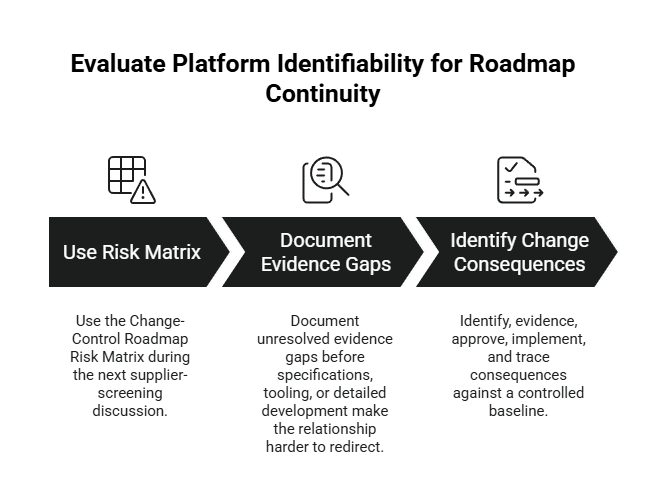
Change control is part of supplier fit when roadmap continuity matters. The central question is not whether changes will occur, but whether their consequences can be identified, evidenced, approved, implemented, and traced against a controlled baseline.
Use the Change-Control Roadmap Risk Matrix during the next supplier-screening discussion. Document unresolved evidence gaps before specifications, tooling, or detailed development make the relationship harder to redirect.
For an optional conversation about a defined private-label subwoofer program, Get in Touch!
Frequently Asked Questions
Does every component change require brand approval?
Not necessarily. Approval requirements should reflect the program, affected characteristics, platform role, and agreed decision rights. The supplier should still explain how the change was classified and why the selected review path applies.
Is change notification the same as change approval?
No. Notification communicates that a change is proposed or planned. Approval is the documented decision to accept it, reject it, request additional evidence, or control its implementation.
What evidence should accompany a supplier change request?
The package may include the affected baseline, reason for change, affected products, impact assessment, comparison data, revalidation scope, reviewer decisions, cut-in plan, traceability method, and updated documents. Exact requirements depend on the program.
Can a golden sample serve as the complete change-control baseline?
A golden sample can be an important physical reference, but it should remain aligned with controlled specifications, drawings, BOMs, acceptance criteria, sample identity, and revision records.
Disclaimer: This article provides general supplier-evaluation and product-governance information. Change-control requirements, validation scope, approval authority, and technical acceptance criteria should be confirmed for the specific product, program, contract, and engineering context.
Our Editorial Process:
Our expert team uses AI tools to help organize and structure our initial drafts. Every piece is then extensively rewritten, fact-checked, and enriched with first-hand insights and experiences by expert humans on our Insights Team to ensure accuracy and clarity.
About the China Future Sound Insights Team
The China Future Sound Insights Team is our dedicated engine for synthesizing complex topics into clear, helpful guides. While our content is thoroughly reviewed for clarity and accuracy, it is for informational purposes and should not replace professional advice.