📌 Key Takeaways
Clear subwoofer portfolios give each platform one job, one tradeoff, clear limits, and proof before teams set detailed specifications.
- Start With Roles: Teams should define each platform’s job before setting wattage, size, or price because specifications cannot create a meaningful role.
- Set Meaningful Boundaries: Teams should separate platforms by use, sound goals, packaging, operating demands, tradeoffs, and proof—not ratings alone.
- Allow Purposeful Overlap: Shared sizes or power ranges work when neighboring platforms serve different uses and require different evidence.
- Test Every Distinction: Remove names and styling; if teams cannot defend both products, the difference is probably cosmetic.
- Prevent Role Drift: Role owners should review major changes and reposition platforms that no longer pass the overlap test.
Every platform must earn its place.
Product and category leaders will build clearer subwoofer roadmaps using the role, boundary, overlap, and governance framework that follows.
~ ~ ~ ~ ~ ~ ~ ~ ~ ~ ~ ~ ~ ~ ~ ~ ~ ~
A private-label subwoofer portfolio can carry separate labels for core automotive, sound quality (SQ), slim, and high-power platforms while producing products that are difficult to distinguish. Similar driver sizes, rated-power ranges, construction choices, and positioning language can make the roadmap appear broader than the underlying architecture.
Some specification overlap is normal. Unmanaged overlap is the problem. A coherent portfolio requires each platform to have a primary job, a deliberate tradeoff, a non-goal, and a portfolio boundary that teams can explain before detailed specifications are finalized. The framework below helps product and category leaders define those roles, test whether overlap is defensible, and govern changes without imposing universal technical thresholds.
Start with a platform role, not a specification ladder
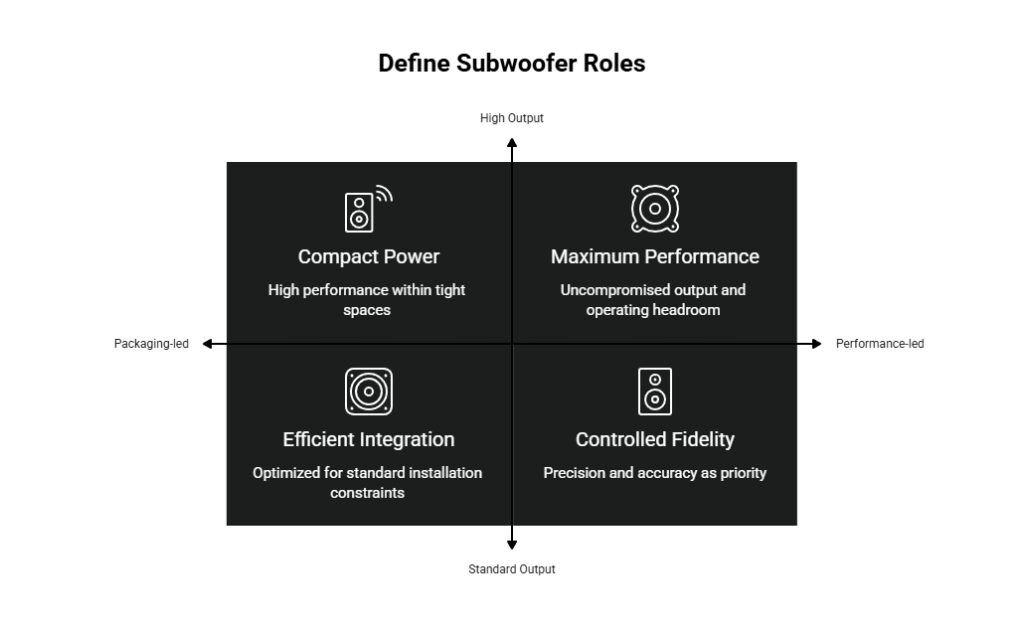
A platform role explains why a product family deserves a separate place in the roadmap. It identifies the use condition, leading priority, shaping constraint, and territory the platform should not absorb.
Specifications should express the role, not replace it. Two models with different wattage ratings may still perform the same portfolio job. Two platforms with a shared size or similar RMS range may remain distinct when they address different installation conditions, acoustic priorities, tradeoffs, or proof requirements. For example, a 10-inch, 500W RMS driver optimized for a sealed 0.5-cubic-foot enclosure (Slim/Packaging-led) and a 10-inch, 500W RMS driver optimized for maximum excursion in a ported enclosure (High-power) share the same top-line specifications but serve entirely different portfolio jobs.
A concise role charter provides a practical starting point:
This platform exists to deliver [primary outcome] for [use condition] while accepting [deliberate tradeoff]; it is not intended to [non-goal].
This is an internal decision rule, not consumer-facing copy. Product leadership defines it; engineering, marketing, sourcing, and QA translate it into requirements, promises, supplier criteria, and evidence.
Assign one primary job to each bass platform
The following role directions are general portfolio principles. They do not establish universal product specifications. Exact thresholds will vary by program, application, design, and qualified engineering review.
Core automotive: the portfolio anchor
The core automotive platform’s primary job should be broad application coverage. It provides the reference point for specialist platforms by balancing performance, conventional packaging, complexity, and scalability.
Its trade-off is breadth over specialization. Its non-goal is to expand upward into high-power, sideways into SQ, or outward until every supplier model becomes a valid extension.
The approved subwoofer platform range can help teams review available categories, but the catalog should remain an input to the roadmap rather than the source of the architecture.
SQ: controlled performance as the leading promise
A sound quality platform should lead with controlled, accurate, or low-distortion-oriented bass behavior within a defined application. Power capability may support that promise, but wattage alone should not be the principal reason the platform exists.
“Premium” is not a sufficient role. The SQ line needs defined behavior, an accepted tradeoff, and validation criteria. Its non-goal may be maximizing output at the expense of controlled performance, but that does not mean SQ products must always use less power.
Teams reviewing SQ subwoofer platform examples should therefore focus on how the intended promise would be governed, not simply where a model sits in a price or rating ladder.
Slim: packaging constraint as the architecture
A slim platform should exist because mounting or integration constraints materially shape the architecture. Packaging is the first reason for the line, not a secondary label applied to a lower-powered product.
Output and SQ attributes can vary while the packaging advantage remains material. A hypothetical slim line with increasingly demanding variants should be reviewed when those changes weaken the reason for separate ownership.
Its deliberate tradeoff should state what the program may give up to preserve space efficiency. Its non-goal is to reproduce the complete operating envelope of every conventional-depth model. Treat the slim subwoofer platform as a packaging-led architecture rather than an automatic lower tier.
High-power: output and operating headroom as the leading job
The high-power platform’s primary job should be demanding-output operation. Sustained output, thermal headroom, mechanical capability, or another approved duty requirement may lead the brief, depending on the intended application.
High power is an operating role, not merely the largest catalog number. A rating without stated conditions, intended duty, and supporting validation does not establish a defensible boundary. Sound quality still matters, but it cannot become interchangeable with SQ positioning.
The platform’s deliberate tradeoff may involve packaging flexibility, application breadth, complexity, or another program-specific constraint. Its non-goal is to function as a generic top tier whose only distinction is a larger rating.
Subwoofer platform role charter matrix
| Platform | Primary job | Target use condition | Acoustic priority | Packaging or operating constraint | Deliberate tradeoff | Non-goal | Boundary criteria | Required validation evidence | Accountable owner |
|---|---|---|---|---|---|---|---|---|---|
| Core automotive | Anchor broad application coverage | Mainstream automotive programs | Balanced coverage | Conventional program constraints | Breadth over specialization | Maximize every performance dimension | Remains distinct from specialist promises | Evidence supporting approved balanced requirements | Product or category lead |
| SQ | Lead with controlled performance | Fidelity-led application | Controlled acoustic behavior | Program-specific operating and packaging limits | Other attributes may not be maximized | Operate only as a premium label | Distinct behavior and proof standard | Evidence tied to the approved SQ promise | Product lead with acoustics |
| Slim | Protect a space-constrained architecture | Packaging-limited installation | Packaging-compatible bass performance | Mounting or integration constraint | Operating envelope may be narrower | Become a miscellaneous lower-power line | Packaging advantage remains material | Fit and performance evidence under the stated constraint | Product lead with engineering |
| High-power | Serve demanding-output operation | High-demand application | Output and operating headroom | Program-specific duty requirements | Breadth or packaging flexibility may be reduced | Act as a rating-only flagship | Distinct operating demand and proof | Evidence supporting the approved operating role | Product lead with engineering and QA |
Each organization should replace these starting directions with program-specific language before approving supplier platforms or detailed specifications.
Set boundaries across the dimensions that actually matter
A portfolio boundary shows where one platform stops being appropriate and an adjacent platform becomes more suitable. Treat this as a portfolio decision rather than a wattage decision.
| Boundary dimension | Decision question |
|---|---|
| Primary use condition | Does the platform serve broad automotive coverage, constrained installation, a fidelity-led system, or demanding-output operation? |
| Leading acoustic priority | Which behavior takes precedence when tradeoffs appear? |
| Packaging constraint | Is conventional packaging acceptable, or does available space govern the architecture? |
| Operating envelope | How demanding is the intended duty under the approved application assumptions? |
| Deliberate tradeoff | What may be reduced or constrained to protect the primary job? |
| Non-goals | Which adjacent territory must the platform avoid absorbing? |
| Validation evidence | What evidence must demonstrate that the role has been achieved? |
| Commercial role | Is the platform an anchor, specialist, differentiator, or halo without relying on price alone? |
The full role stack matters more than one specification. While Bill of Materials (BOM) cost targets and target price tiers naturally stratify these platforms, defining their acoustic and packaging roles first prevents a brand from developing two similarly priced products that cannibalize each other. A shared size can serve core and slim platforms when packaging differs. Similar RMS ranges can serve SQ and high-power when promise, tradeoff, duty, and proof remain separate.
Numerical distance can also create false differentiation when two platforms serve the same use condition and promise. Each brand must define its own technical boundaries against current product requirements. The guide to turning performance goals into validation criteria addresses that next handoff.
Use an overlap test to separate deliberate coverage from redundancy
Harmful overlap occurs when adjacent platforms converge across the factors that justify separate roadmap ownership.
| Deliberate overlap | Harmful overlap |
|---|---|
| Same driver size, different installation constraint | Same intended use condition |
| Similar RMS range, different operating or acoustic priority | Same primary promise |
| Shared components, distinct tuning, packaging, or validation | Same accepted tradeoff and non-goals |
| Broad-coverage anchor beside a specialist platform | Same validation evidence |
| Common architecture serving different approved briefs | Similar positioning with no separate ownership rationale |
Use one direct test:
If the product name and cosmetic treatment were removed, could the team still explain why both platforms must exist?
Consider a hypothetical SQ model and high-power model with the same driver size and a similar rated-power band. This overlap is defensible when the SQ platform is governed by controlled-performance evidence and the high-power platform is governed by demanding-output and operating-headroom evidence. If both products serve the same application, make the same promise, accept the same tradeoff, and require the same proof, the distinction is probably cosmetic.
A ready-made supplier model should enter the roadmap only when it fulfills an approved role or supports an explicit architectural change.
Govern the roadmap so platform roles do not drift
Architecture can erode after approval. A core line may absorb the high-power promise, or a slim line may lose its packaging advantage. Material changes should trigger a portfolio review, not an isolated specification update.
Seven governance rules keep role changes explicit:
- Require a one-sentence role charter before approving a new platform or major variant.
- Document each platform’s non-goals alongside its desired attributes.
- Assign one accountable role owner, supported by cross-functional reviewers.
- Require a written overlap rationale for adjacent variants.
- Review the boundary when specifications, packaging, positioning, or intended use materially changes.
- Translate the role into engineering requirements and validation criteria before supplier work advances.
- Merge, retire, or reposition platforms that cannot pass the overlap test.
Exceptions can be legitimate. A slim platform may support an SQ-oriented variant, or an SQ line may support substantial power. Record which boundary changed, why the role remains coherent, what evidence is required, and who approved the exception.
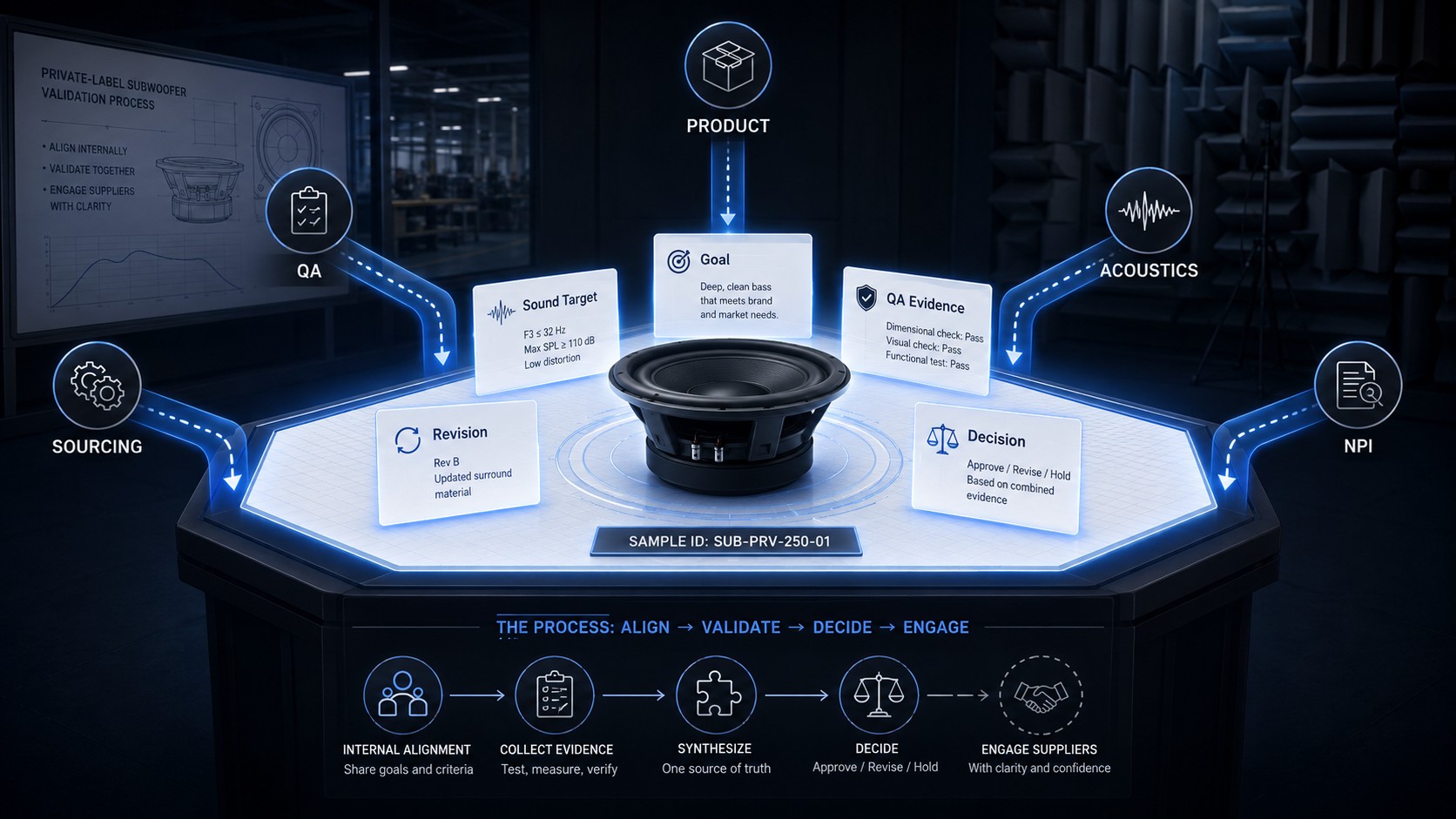
China Future Sound’s product-development documentation states that its process includes acoustic simulation, KLIPPEL R&D sample testing, power testing, and golden-sample management. This vendor-specific example illustrates a general principle: portfolio intent eventually needs measurable development and production evidence. It does not establish a universal process.
A concise governance check keeps the discussion focused:
- Why does this platform exist?
- What must it not become?
- What evidence proves that it still performs its assigned role?
Make every platform earn its place
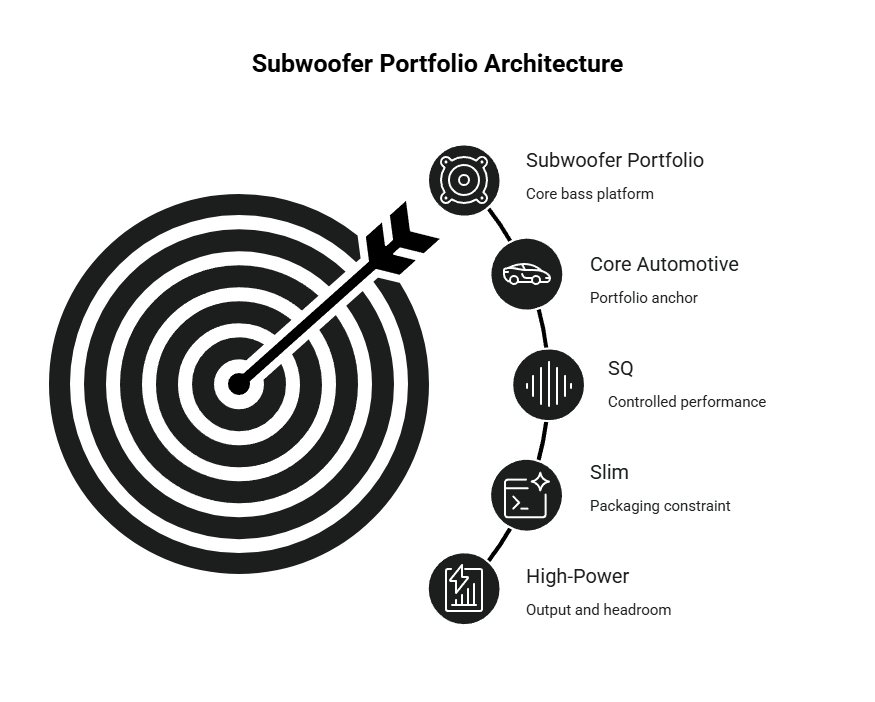
Clear subwoofer portfolio architecture does not eliminate all overlap. It makes overlap intentional, documented, and explainable. Core automotive, SQ, slim, and high-power platforms can coexist when each has a distinct job, tradeoff, non-goal, boundary, and proof requirement.
Specifications should follow that logic rather than create it. Before the next roadmap or OEM/ODM platform discussion, complete a one-sentence role charter for every planned bass platform and test each one against its nearest neighbor.
Frequently asked questions
Can SQ and high-power subwoofers share the same size or RMS rating?
Yes. Shared specifications do not automatically make the lines redundant. They remain distinct when they serve different use conditions, lead with different promises, accept different tradeoffs, and require different validation evidence.
Should slim subwoofers be a separate tier or a packaging variant?
Treat slim as a distinct platform when the packaging constraint materially shapes its architecture, tradeoffs, validation, and roadmap role. If the distinction is mainly cosmetic or does not require separate governance, it may be better managed as a variant.
How much specification overlap is acceptable?
No universal percentage applies. Overlap is acceptable while each platform retains a distinct job, boundary, tradeoff, and proof requirement. It becomes harmful when those elements converge and the team cannot justify separate roadmap ownership.
Disclaimer: This article provides general product-portfolio and OEM/ODM planning information. Technical targets and platform boundaries should be validated against the intended application, approved product requirements, and qualified engineering review.
Our Editorial Process:
Our expert team uses AI tools to help organize and structure our initial drafts. Every piece is then extensively rewritten, fact-checked, and enriched with first-hand insights and experiences by expert humans on our Insights Team to ensure accuracy and clarity.
About the China Future Sound Insights Team
The China Future Sound Insights Team is our dedicated engine for synthesizing complex topics into clear, helpful guides. While our content is thoroughly reviewed for clarity and accuracy, it is for informational purposes and should not replace professional advice.