📌 Key Takeaways
Subwoofer teams can spot manufacturing drift early by connecting batch trends, component changes, test records, and unresolved exceptions.
- Look Beyond Passing Results: Passing final inspection does not rule out gradual movement from the approved production state.
- Compare Connected Records: Link references, batches, component lots, revisions, test routes, and exceptions to reveal patterns hidden within separate quality gates.
- Control Every Change: Teams should record each change, its reason, approval, start date, and affected batches.
- Treat Signals As Patterns: A recurring signal linked to another evidence gap deserves investigation, while one explained event may only need monitoring.
- Close Every Exception: Teams must assign owners, document decisions, define affected scope, and preserve closure records for future review.
Connected evidence exposes drift before passing batches hide it.
Enterprise QA and Operations teams will improve production oversight by applying the signal matrix and governance steps that follow.
~ ~ ~ ~ ~ ~ ~ ~ ~ ~ ~ ~ ~ ~ ~ ~ ~ ~
A subwoofer production batch can meet final release criteria while still generating evidence that the program may be moving away from its approved state. Passing inspection and remaining consistent over time are related questions, but they are not identical.
For enterprise QA and Operations teams, the strongest early signals are rarely isolated failures. More useful evidence may come from repeated movement relative to an approved reference, changing batch patterns, undocumented component changes, incomplete test-route records, contradictions across quality gates, and recurring exceptions without closure.
None of these signals proves that manufacturing drift has occurred. Each should be reviewed in context. Their value lies in showing where a structured, cross-functional investigation may be justified before uncertainty spreads across additional batches, revisions, or supplier decisions.
What Manufacturing Drift Looks Like After a Subwoofer Program Enters Production
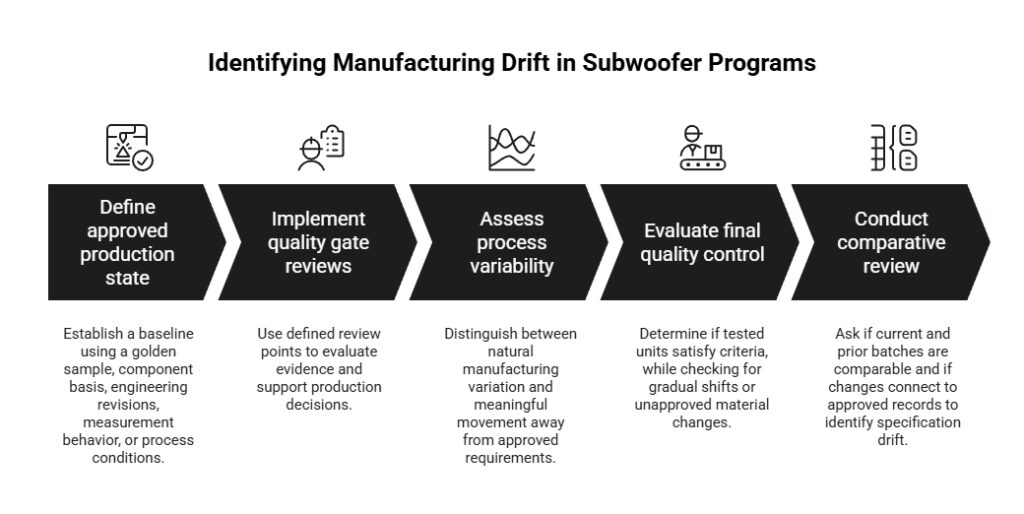
Manufacturing drift is a pattern of movement away from an approved production state. That state may be defined by a golden sample, an approved component basis, engineering revisions, expected measurement behavior, process conditions, or a combination of these controls.
A quality gate is a defined review point at which evidence is used to support a production decision. Its existence does not automatically establish that the underlying records are complete, comparable, or useful for identifying movement over time.
Variation is present in manufacturing and measurement processes, so not every difference is meaningful. The National Institute of Standards and Technology’s discussion of process variability explains that manufacturing and measurement outputs naturally vary rather than producing identical values. The practical issue is whether the observed movement remains consistent with the program’s approved requirements and whether any change can be explained through controlled records.
Final quality control primarily answers a release question: did the tested units satisfy the applicable criteria at that point? It may not show whether results have shifted gradually across several batches, whether rechecks are increasing, or whether a material change entered production without aligned approval.
A useful review begins with three questions:
- What is the current approved reference?
- Can current and prior batches be compared on the same basis?
- Can every relevant change be connected to an approved record?
These questions help distinguish ordinary variation from possible mass-production specification drift.
Six Quality-Gate Signals That Deserve Attention
1. Repeated Movement From the Approved Reference
An approved reference, often called a golden sample, provides a physical or documented benchmark for production comparison. It is useful only when teams know which version governs production and can confirm its approval status, custody history, and relationship to the current product revision.
Repeated or directional differences from that reference may indicate that the product or process is moving. The concern is not necessarily one unusual reading. It is a recurring pattern that cannot be reconciled with known test conditions, approved changes, or expected variation.
Reference integrity matters as much as reference existence. When Engineering, QA, and the supplier use different versions, the comparison basis becomes uncertain. Effective golden-sample integrity therefore depends on clear governance around the reference.
2. Batch-to-Batch Movement Hidden Inside Passing Results
Pass/fail summaries can conceal changes in the underlying data. Several batches may remain within approved limits while measurements move in one direction, result spread increases, or rechecks and overrides become more frequent.
For instance, a gradual upward shift in resonant frequency (Fs) or total Q (Qts) across consecutive batches—even if still passing the wider final ±15% tolerance window—could signal unrecorded changes in spider compliance, cone mass, or magnet strength.
That pattern does not prove that the batches are defective. It can surface a change in production behavior that warrants investigation.
The American Society for Quality distinguishes ordinary process variation from changes associated with identifiable circumstances. Its broader guidance emphasizes that variation must be interpreted rather than treated as automatically harmful. ASQ’s overview of variation provides useful background for this distinction.
Trend visibility requires comparable measurement records. A gate that retains only the final disposition may support release administration while providing limited evidence about movement over time.
3. Component or Material Changes Without Aligned Approval Records
A component substitution is not automatically manufacturing drift. Approved changes are a normal part of many OEM/ODM programs.
Concern increases when teams cannot reconcile the component lot, supplier, material, revision, production cut-in point, and approval record. A nominally similar component may still require program review because its suitability depends on the approved design, test basis, and application.
Component change control is the process of documenting, reviewing, approving, and tracing a change as it enters production. A useful record should show what changed, why it changed, who approved it, when the change took effect, and which units or batches were affected.
This distinction protects supplier accountability without assuming misconduct. An approved engineering change and an unexplained production variation should not be interpreted in the same way.
4. Missing or Incomplete Test-Route Records
Traceability is the ability to connect a product or batch with the records needed to reconstruct its production history. In this context, useful test-route records connect identity, time, station, reference version, result, and exception disposition.
An exception disposition is the documented decision explaining how an unusual result or process deviation was evaluated and resolved.
A missing record does not prove a product defect. It reduces confidence in the evidence supporting the release decision and makes later scoping more difficult. Warning signs include records that cannot be linked to a unit or batch, unclear station identity, incomplete routes, overwritten rechecks, or results tied to an unknown reference version.
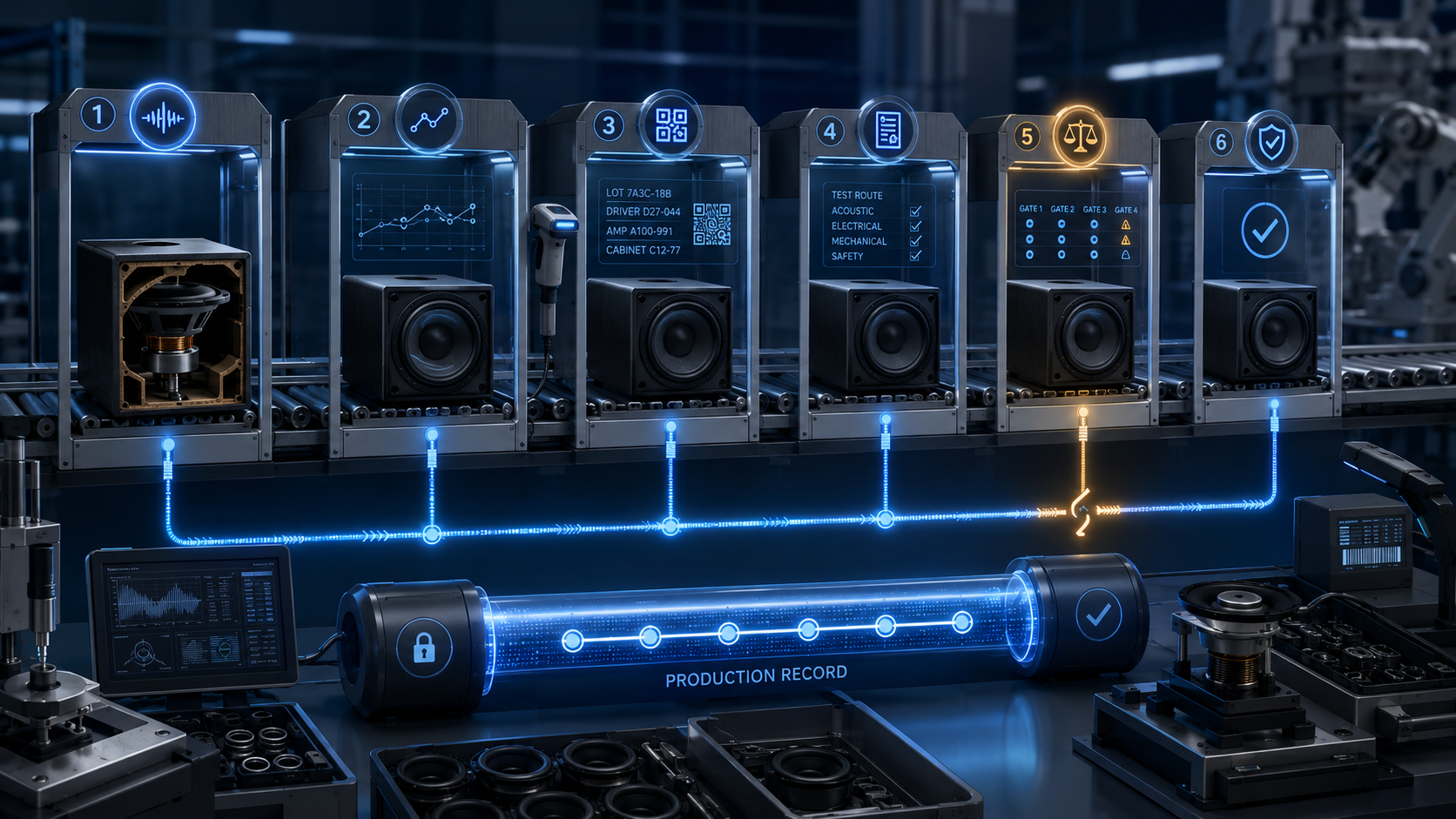
China Future Sound states in its supplied documentation that it uses barcode or QR identities to control production test routes and bind test data to product identity. This is a supplier-stated example of testing-route control, rather than independent proof that every record gap or drift condition will be detected.
5. Contradictions Across Quality Gates
Incoming quality control, in-process quality control, final quality control, and reliability reviews may each show only part of the production picture. Their governance value increases when the records share identifiers and can be reconciled across the same component lots, batches, revisions, and time periods.
For example, a recurring incoming-material exception may appear manageable on its own. Later measurement movement may also be inconclusive in isolation. When both relate to the same component lot or production window, the combined evidence is more decision-useful.
The question is not which gate is “correct.” The question is whether the organization can explain why the records differ and identify the affected scope.
6. Recurring Exceptions Without Closure or Ownership
Waivers, rechecks, overrides, and deviations can occur in complex manufacturing programs. The stronger governance signal is what happens afterward.
An exception that repeatedly returns without a documented cause, approved decision, affected scope, responsible owner, or closure record may indicate that the system is recording symptoms without resolving the underlying governance issue.
Escalation quality is itself a signal. A mature evidence trail should allow later teams to determine what was known, who evaluated it, what decision was made, which production was affected, and whether the condition recurred.
Read Signals as Connected Patterns, Not Isolated Events
One unusual result can attract disproportionate attention. It may be a useful prompt for review, but it should be interpreted against the approved reference, prior batches, component history, test conditions, traceability, and related exceptions.
A stronger investigation trigger usually combines more than one evidence category. Consider three illustrative combinations:
- Measurements move in the same direction after a component-lot change that has no aligned approval record.
- The final pass rate remains stable, but rechecks, overrides, or conditional dispositions become more frequent.
- A reliability exception appears, but the affected units cannot be connected to component lots, revisions, or test-route history.
These are general examples, not descriptions of actual customer incidents.
In the first hypothetical case, a batch remains within final limits, but several measurements begin moving in the same direction after an undocumented component-lot change. The appropriate conclusion is not that the batch is defective or that the supplier caused a failure. The connected evidence warrants investigation.
The response posture should remain proportional:
Monitor when a signal is isolated, records remain complete, and the result can be reconciled with approved conditions.
Investigate when the signal recurs, connects to another evidence category, or weakens confidence in the approved production state.
Escalate for program-specific review when technical significance, affected scope, ownership, or disposition cannot be resolved through routine cross-functional review.
The boundary among these responses depends on the approved specification and program controls. Generic numerical thresholds should not be copied across different subwoofer architectures, applications, measurements, or quality plans.
Quality-Gate Signal Interpretation Matrix
| Signal family | What the record may show | Why it matters | What to verify next | Escalation posture |
|---|---|---|---|---|
| Approved-reference movement | Recurring difference from the current approved benchmark | May indicate movement in the product, process, or comparison basis | Are the results tied to the same approved reference, revision, and test conditions? | Cross-check, then investigate |
| Batch-pattern movement | Directional change across several batches despite passing results | Can surface movement hidden by binary release status | Are the records comparable across batches, stations, and measurement conditions? | Monitor or investigate |
| Undocumented component change | New supplier, lot, material, or revision without aligned approval | Makes the cause, timing, and affected scope unclear | Can the change record, cut-in point, affected batches, and approval be reconciled? | Investigate |
| Test-route evidence gap | Missing, skipped, overwritten, or disconnected records | Reduces confidence in release and traceability evidence | Can each result be tied to identity, time, station, reference, and disposition? | Cross-check evidence |
| Cross-gate contradiction | Incoming, in-process, final, or reliability records do not reconcile | May reveal a control, communication, or record-linkage gap | Do the records share identifiers, timing, lots, and revision information? | Cross-functional review |
| Unclosed recurring exception | Rechecks, overrides, or waivers repeat without closure | May indicate weak exception and escalation governance | Is there an owner, cause assessment, affected scope, approval, and closure record? | Escalate for program-specific review |
This matrix is an editorial decision-support tool. It is not a factory audit, a defect-detection guarantee, or a replacement for approved specifications, control plans, quality agreements, and qualified technical judgment.
What Strong Governance Does After a Signal Appears
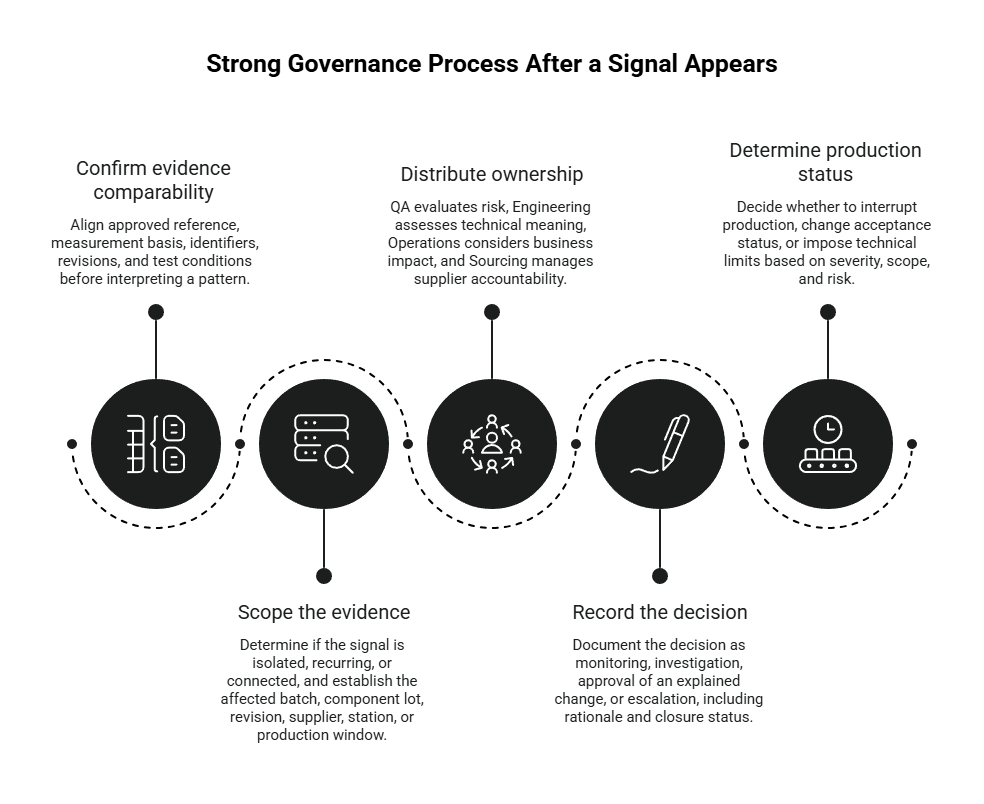
Strong governance begins by confirming that the evidence is genuinely comparable. The approved reference, measurement basis, identifiers, revisions, and test conditions should align before teams interpret a pattern.
The next question is whether the signal is isolated, recurring, or connected to another change. Where the records permit, the team should establish the affected batch, component lot, revision, supplier, station, or production window. This is evidence scoping, not a presumption that every associated unit is defective.
Ownership is normally distributed. QA evaluates evidence sufficiency and risk. Engineering determines whether observed movement is technically meaningful. Operations considers continuity and business impact. Sourcing and Supplier Quality manage change visibility and supplier accountability. Program management coordinates decisions, while the supplier’s designated quality or engineering representative may need to provide records or clarify the production history.
The decision should be recorded as monitoring, investigation, approval of an explained change, or escalation. The underlying evidence, rationale, participants, known uncertainties, affected scope, and closure status should also be preserved so that later teams can reconstruct what was known and decided.
This does not require indiscriminate document volume. ISO’s guidance on documented information stresses that organizations should determine the amount of documentation needed to support effective process planning, operation, and control rather than building a “system of documents.” Connected, decision-relevant records are more valuable than disconnected paperwork.
A supplier may already operate under formal quality procedures, but that alone does not answer whether a specific program’s references, batches, component changes, test results, exceptions, and escalation decisions can be connected. Teams evaluating that evidence can also compare subwoofer validation documentation without turning the review into a laboratory exercise.
Any decision to interrupt production, change acceptance status, or impose technical limits depends on severity, affected scope, customer risk, approved program criteria, and qualified professional judgment.
Frequently Asked Questions
Can a subwoofer batch pass final inspection and still show possible manufacturing drift?
Yes. Final inspection can confirm conformance with defined release criteria while other records show directional movement, undocumented change, recurring exceptions, or declining evidence quality. Those records may indicate a need for investigation, but they do not prove drift by themselves.
Is a golden sample sufficient to control production consistency?
No. A golden sample is useful only when its version, approval status, custody, condition, and relationship to the current production revision are controlled. The records used to compare production against it must also remain consistent and traceable.
Does a component substitution prove that the supplier caused a defect?
No. A substitution does not automatically establish drift, a defect, supplier causation, negligence, or customer impact. The change should be reviewed in context and reconciled with its supplier, lot, revision, cut-in point, approval, and affected production.
Which team should own the response to a drift signal?
Ownership is usually shared. QA may coordinate the evidence review, while Engineering assesses technical meaning, Operations evaluates continuity, Sourcing and Supplier Quality address accountability, program management coordinates decisions, and the supplier contributes records or technical clarification according to the governance model.
Better Visibility Comes From Connected Evidence
Enterprise audio teams do not gain meaningful drift visibility merely because a supplier reports that IQC, IPQC, FQC, testing, or reliability gates exist. The records must allow the organization to compare approved references, measurement patterns, component lots, revisions, test routes, exceptions, and escalation outcomes.
A signal does not prove manufacturing drift. It provides a reason to ask a more precise question, connect previously separate evidence, and determine whether monitoring, investigation, or program-specific escalation is appropriate.
Review one recent production batch against the matrix. Examine its reference records, measurement history, component and change records, traceability links, exception dispositions, ownership, escalation decisions, and preserved evidence trail.
Disclaimer: This article is for general informational purposes only and does not constitute compliance, safety, technical, quality-assurance, or professional advice. Requirements, risks, specifications, and appropriate responses vary by product, program, supplier, application, and jurisdiction. Program-specific decisions should be reviewed by appropriately qualified QA, engineering, acoustics, manufacturing, supplier-quality, legal, or other relevant professionals.
Our Editorial Process:
Our expert team uses AI tools to help organize and structure our initial drafts. Every piece is then extensively rewritten, fact-checked, and enriched with first-hand insights and experiences by expert humans on our Insights Team to ensure accuracy and clarity.
About the China Future Sound Insights Team
The China Future Sound Insights Team is our dedicated engine for synthesizing complex topics into clear, helpful guides. While our content is thoroughly reviewed for clarity and accuracy, it is for informational purposes and should not replace professional advice.