📌 Key Takeaways
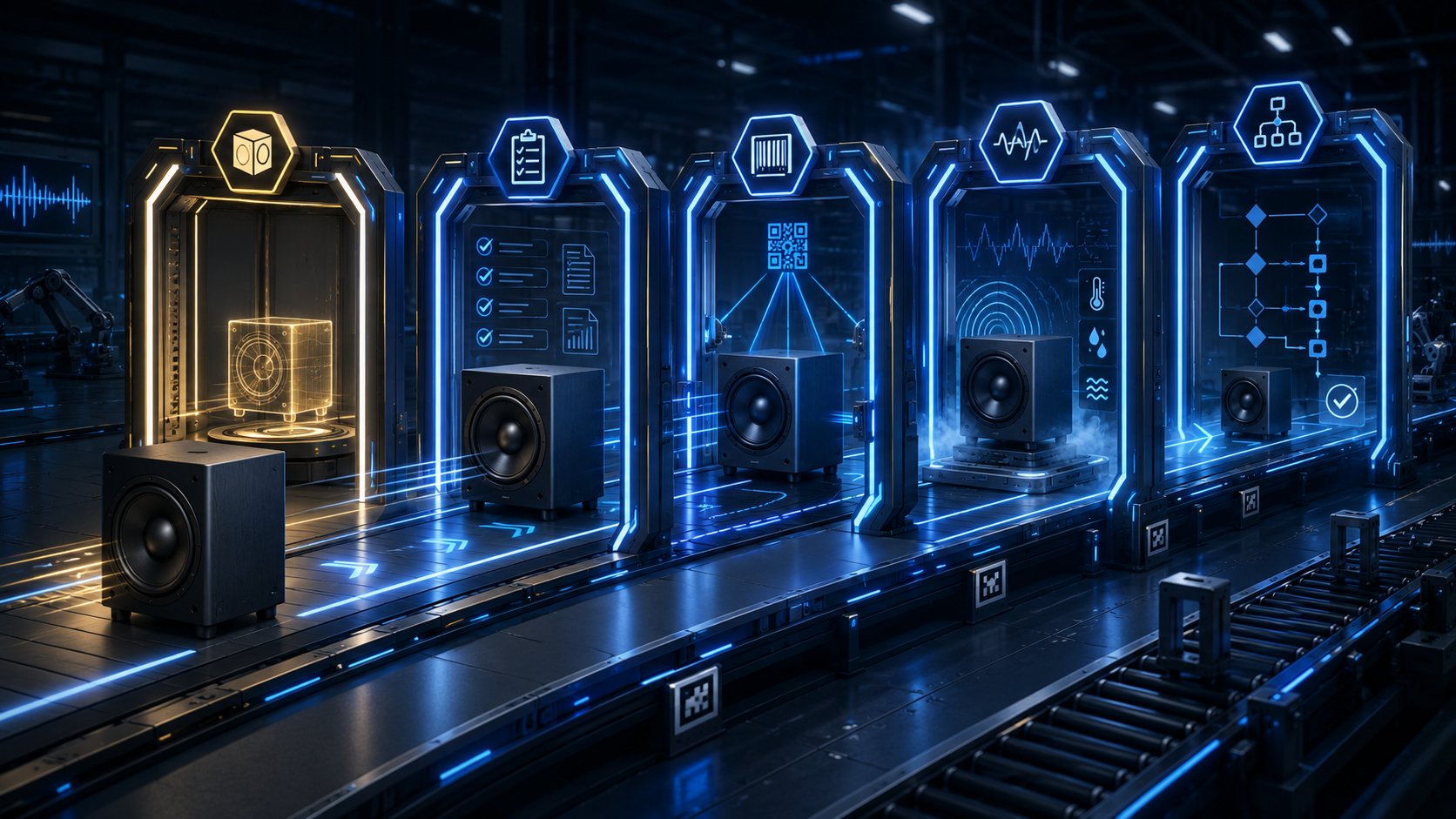
Brand warranty risk drops when supplier approval checks the production process, not just the sample, quote, or slide deck.
- Control the Sample: A strong sample only helps when the supplier tracks its identity, version, limits, and production comparisons.
- Demand Real Records: Quality gates matter only when IQC, IPQC, and FQC records show clear checks, failures, and fixes.
- Trace Each Unit: Unit-level test history helps teams find root causes faster when field problems appear later.
- Match Real Use: Reliability tests should reflect the subwoofer’s actual environment, power demands, mounting, and long-term stress.
- Control Every Change: Formal change review helps brands see when materials, tooling, process, or acoustic details affect production.
A good sample is not a quality system.
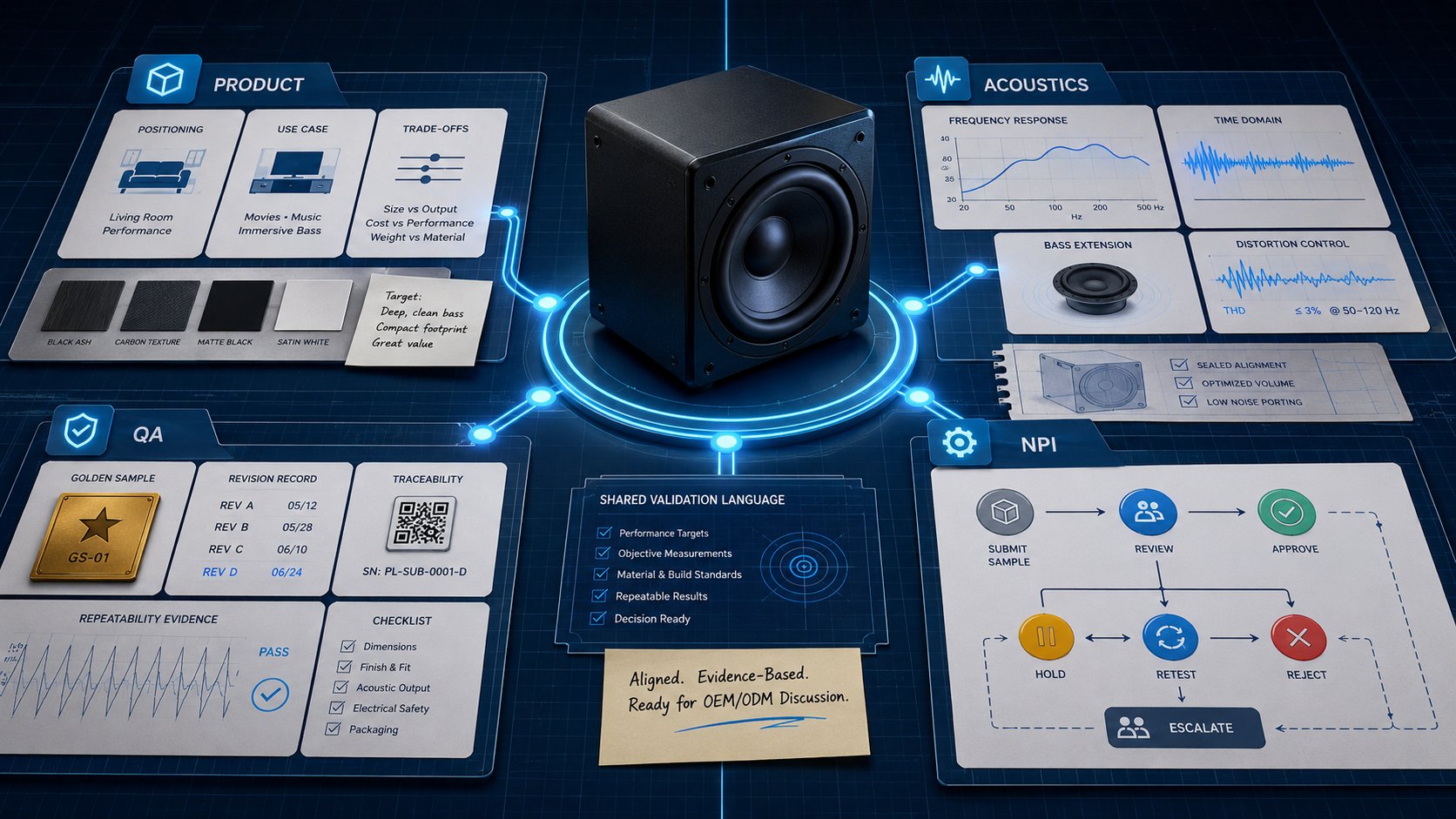
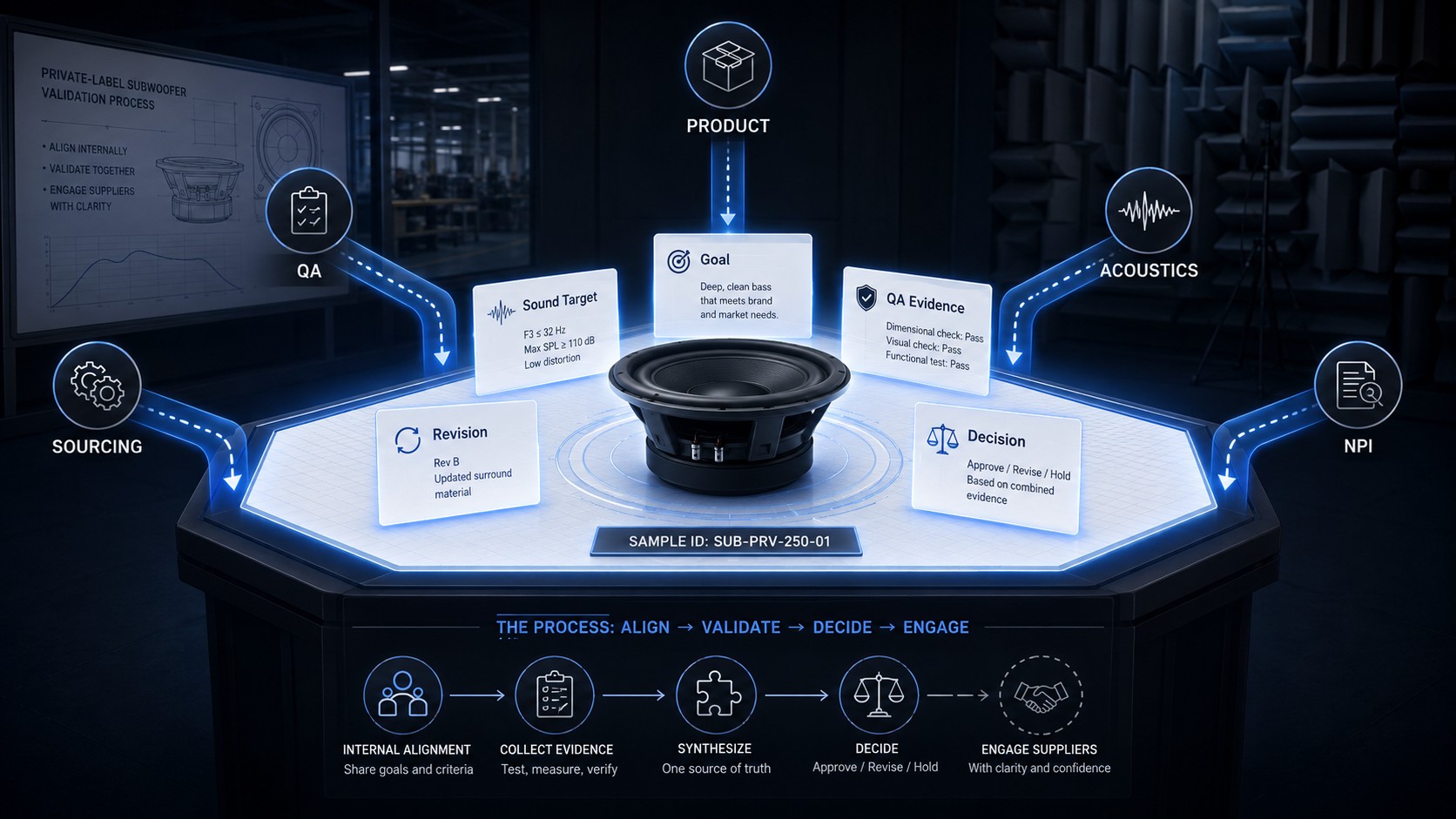
Sourcing, QA, operations, product, and acoustics teams will spot supplier risk faster, using the warning signs below.
~ ~ ~ ~ ~ ~ ~ ~ ~ ~ ~ ~ ~ ~ ~ ~ ~ ~
Subwoofer warranty exposure often begins before a unit reaches the field. It can start when a brand approves an OEM/ODM partner based on sample sound, quoted unit cost, or general quality claims without confirming whether the supplier’s process can hold the approved performance at production scale.
For sourcing, QA, operations, product, and acoustics teams, the risk is rarely one isolated document. A supplier may show an acceptable sample, a clean slide deck, and a familiar list of quality gates. That still may not prove production repeatability.
The practical question is sharper: can the supplier integrate sample approval, validation evidence, traceability, reliability testing, and change control into a repeatable OEM/ODM quality process?
1. The Approved Sample Is Treated As Proof, Not A Controlled Reference
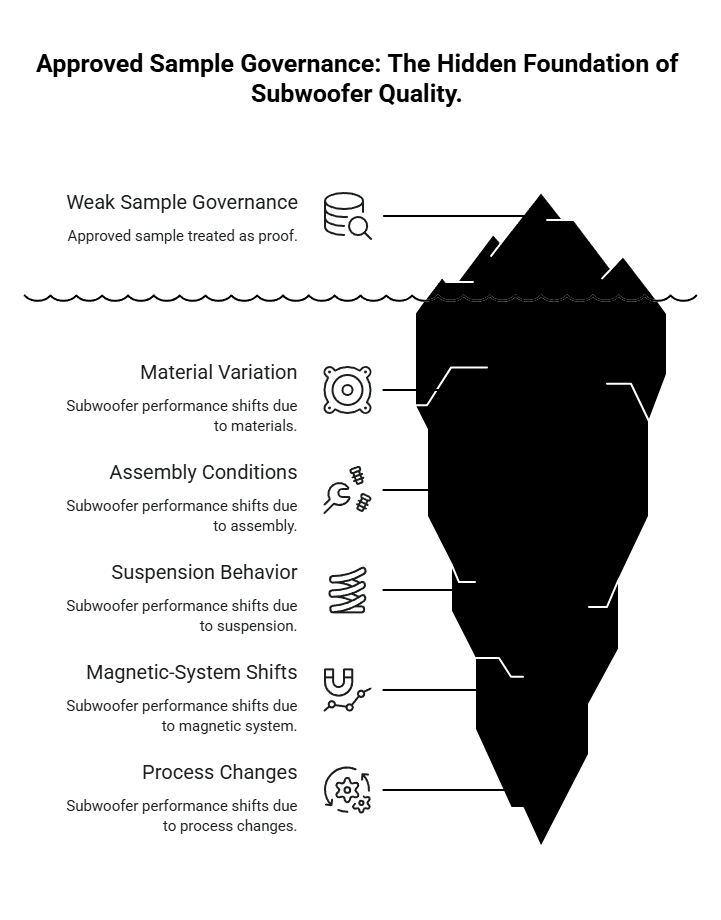
A strong sample can prove capability once. A controlled process helps show repeatability.
The warning sign is weak golden sample governance. If the supplier cannot show sample identity, custody, version history, approved limits, and production comparison rules, the approved sample becomes an informal benchmark rather than a controlled reference.
That matters because subwoofer performance can shift through material variation, assembly conditions, suspension behavior, magnetic-system shifts, or process changes. The concern is not that variation always causes warranty claims. The concern is that unmanaged variation can make it harder for the brand to know whether mass production still reflects the approved intent.
For deeper context, brand teams can review how golden sample integrity supports long-term production consistency.
Ask before commitment: How do you prevent mass-production units from drifting away from the approved subwoofer sample?
2. Quality Gates Exist, But Usable Evidence Is Thin
IQC, IPQC, and FQC labels are common in supplier quality plans. The risk is not the absence of a test label; it is the absence of usable evidence.
A serious supplier should be able to show what each gate checks, what criteria define pass or fail, how nonconforming units are contained, and how failures feed back into engineering or process control. General quality-management principles, including ISO’s public guidance on quality management systems, supports the idea that process control depends on documented planning, operation, review, and improvement. In supplier evaluation, that principle should translate into records that sourcing and QA teams can actually inspect.
Warning signs include gate names that appear only in presentations, unclear incoming-material criteria, in-process checks without escalation logic, finished-goods inspection based heavily on visual checks, or listening impressions that are not supported by objective validation evidence.
Teams that need a broader review method can also compare subwoofer validation documentation without turning the process into a lab-manual exercise.
Ask before commitment: What records prove that quality gates are enforced on production units, not just described in the quality plan?
| Warning Sign | Why It Matters | What to Ask |
|---|---|---|
| Sample approval is not tied to golden sample control | Production may drift from approved performance | How is the approved sample governed during mass production? |
| Quality gates lack records | Gate language may not reflect real enforcement | Can example IQC, IPQC, and FQC records be reviewed? |
| Traceability is not linked to test data | Root-cause review may be slower or less precise | Can unit test history be reconstructed? |
| Reliability testing is generic | Tests may miss use-case-specific stress | What assumptions shaped the reliability plan? |
| ECO/ECR control is informal | Changes may reach production without brand visibility | How are changes reviewed, approved, and cut in? |
3. Traceability Stops At Batch Level Or Is Not Tied To Test Data
Traceability should help brand teams understand what was built, tested, released, and contained if a concern appears later. Batch-level tracking may be useful, but it can be too broad when a program needs precise review.
The warning sign is traceability that ends at the carton, shipment, or batch level without a unit-level link to test station results, process route, material lots, or exception handling. If a concern appears later, the team may struggle to determine whether the issue relates to material variation, process conditions, testing decisions, or change timing.
As a general quality principle, root-cause review depends on identifying the underlying causes of nonconformities rather than treating symptoms. ASQ’s overview of root cause analysis is a useful external reference for that concept. In subwoofer manufacturing, traceability gives that analysis a stronger factual base.
Barcode/QR-linked test-route control is one way to make traceability more actionable when it is tied to real production data. The label itself is not the control. The control is the ability to reconstruct the unit’s quality route and test status.
Ask before commitment: Can each production unit’s quality route and test status be reconstructed if a concern appears later?
4. Reliability Testing Does Not Match The Program’s Use Case
“We do reliability testing” is not enough. The reliability plan should reflect the subwoofer program’s actual use-case assumptions.
An automotive program may raise concerns around vibration, heat, electrical environment, mounting constraints, and long-term installation conditions. A marine program may involve moisture exposure, material durability, and environmental stress. A pro audio program may place more pressure on duty cycle, sustained output, and thermal behavior. A custom enclosure or application can introduce constraints that do not fit a generic test plan.
A generic reliability summary that remains identical across vastly different environmental and thermal profiles is a critical red flag. If the supplier cannot explain what failure modes the test is intended to reveal, how power testing reflects sustained-use assumptions, or how results connect to production controls, the evidence may be weaker than the document suggests.
For acoustic-specific review, teams can align subwoofer validation before NPI so the first supplier conversations are tied to program intent, not generic test claims.
Ask before commitment: Which use-case assumptions shaped the reliability plan for this subwoofer program?
5. Engineering Change Control Is Informal Or Poorly Documented
Even a solid validation process can weaken if material, tooling, process, structural, electrical, or acoustic-relevant changes are handled informally.
Warning signs include no formal ECO/ECR workflow, component substitutions without brand review, unclear cut-in timing, or records that do not show which units were built before and after a change. In subwoofer programs, a change that looks minor commercially may still affect repeatability. Adhesives, suspension parts, magnet assemblies, voice coil components, fixtures, enclosure-related tolerances, or test limits can all influence consistency depending on the design.
The issue is not that every change is unacceptable. Mature programs require changes. The question is whether the supplier can show how changes are reviewed, approved, communicated, and connected to production records.
Ask before commitment: How will the brand team know when a material, tooling, process, or acoustic-relevant change affects the program?
6. The Quote Does Not Explain The Trade-Off Between Unit Cost And Quality Controls
Lower unit cost can be commercially useful. It becomes a warning sign when the supplier cannot explain what controls are included, reduced, optional, or excluded at that cost level.
Procurement may prioritize price. QA may prioritize evidence. Product and acoustics teams may prioritize launch confidence. Without a shared standard for what “quality-ready” means, the program can be approved on commercial terms that do not match the expected risk profile.
If reliability testing, traceability, quality-gate documentation, acoustic validation, or golden sample control improves only after the brand asks for it, the first quote may not represent the program the brand actually needs. This should prompt deeper review, not automatic rejection.
Ask before commitment: Which quality controls are included in this quote, and which would change if cost targets were adjusted?
Look For Process Evidence Before Supplier Commitment
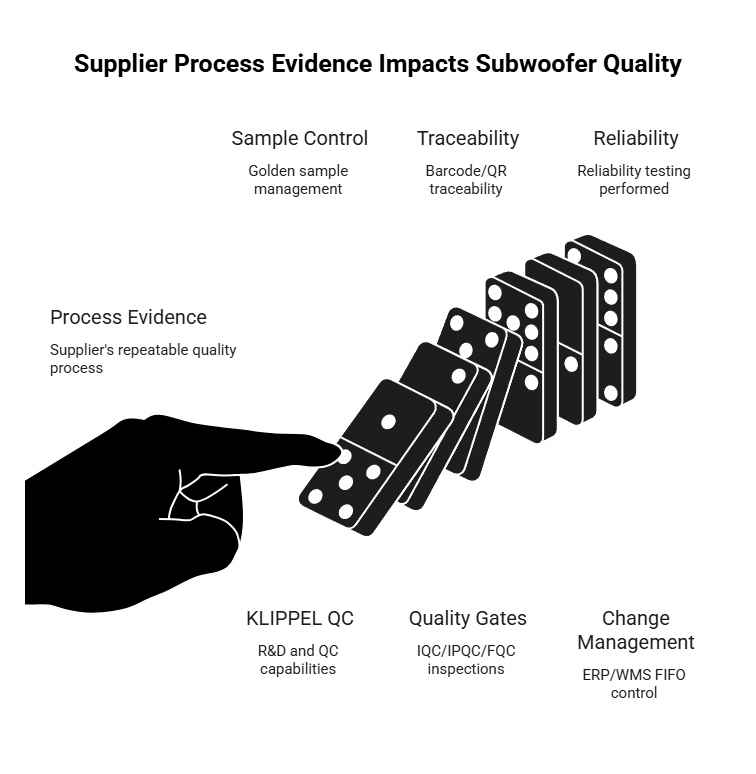
Supplier evaluation should not stop at sample approval, quoted cost, or generic quality claims. For subwoofer programs, sourcing and QA teams should look for evidence that the supplier can connect sample control, quality gates, traceability, reliability testing, and change management into a repeatable process.
External references such as ISO’s quality-management resources, ASQ’s quality tools, and technical audio-QC references such as KLIPPEL QC can help frame the general principles. Program-specific decisions still need supplier-specific evidence.
China Future Sound supports subwoofer OEM programs with source-supported capabilities including golden sample management, KLIPPEL-based R&D and QC, barcode/QR traceability, IQC/IPQC/FQC, reliability testing, ERP/WMS FIFO control, and cross-functional engineering review. These capabilities should be discussed as part of the broader quality-gate conversation, not treated as a substitute for program-specific evaluation.
Disclaimer: This article is for general informational purposes only and does not constitute compliance, safety, technical, or professional advice. Requirements, risks, and best practices may vary by program, supplier, product design, application, jurisdiction, and use case. Confirm important sourcing, QA, and production decisions with the appropriate qualified professional, authority, or technical expert.
Our Editorial Process:
Our expert team uses AI tools to help organize and structure our initial drafts. Every piece is then extensively rewritten, fact-checked, and enriched with first-hand insights and experiences by expert humans on our Insights Team to ensure accuracy and clarity.
About the China Future Sound Insights Team
The China Future Sound Insights Team is our dedicated engine for synthesizing complex topics into clear, helpful guides. While our content is thoroughly reviewed for clarity and accuracy, it is for informational purposes and should not replace professional advice.