📌 Key Takeaways
Choose a subwoofer OEM/ODM partner by testing whether their quality gates protect approved performance during production.
- Evidence Beats Samples: A good sample means little unless the factory can keep that same performance across production lots.
- Gates Need Records: Strong gates show what teams checked, who checked it, and what happened when results failed.
- Traceability Reduces Risk: Unit or batch records help QA teams find drift before weak products leave the factory.
- Reliability Must Match: Test evidence should fit the subwoofer design, use case, and risk level.
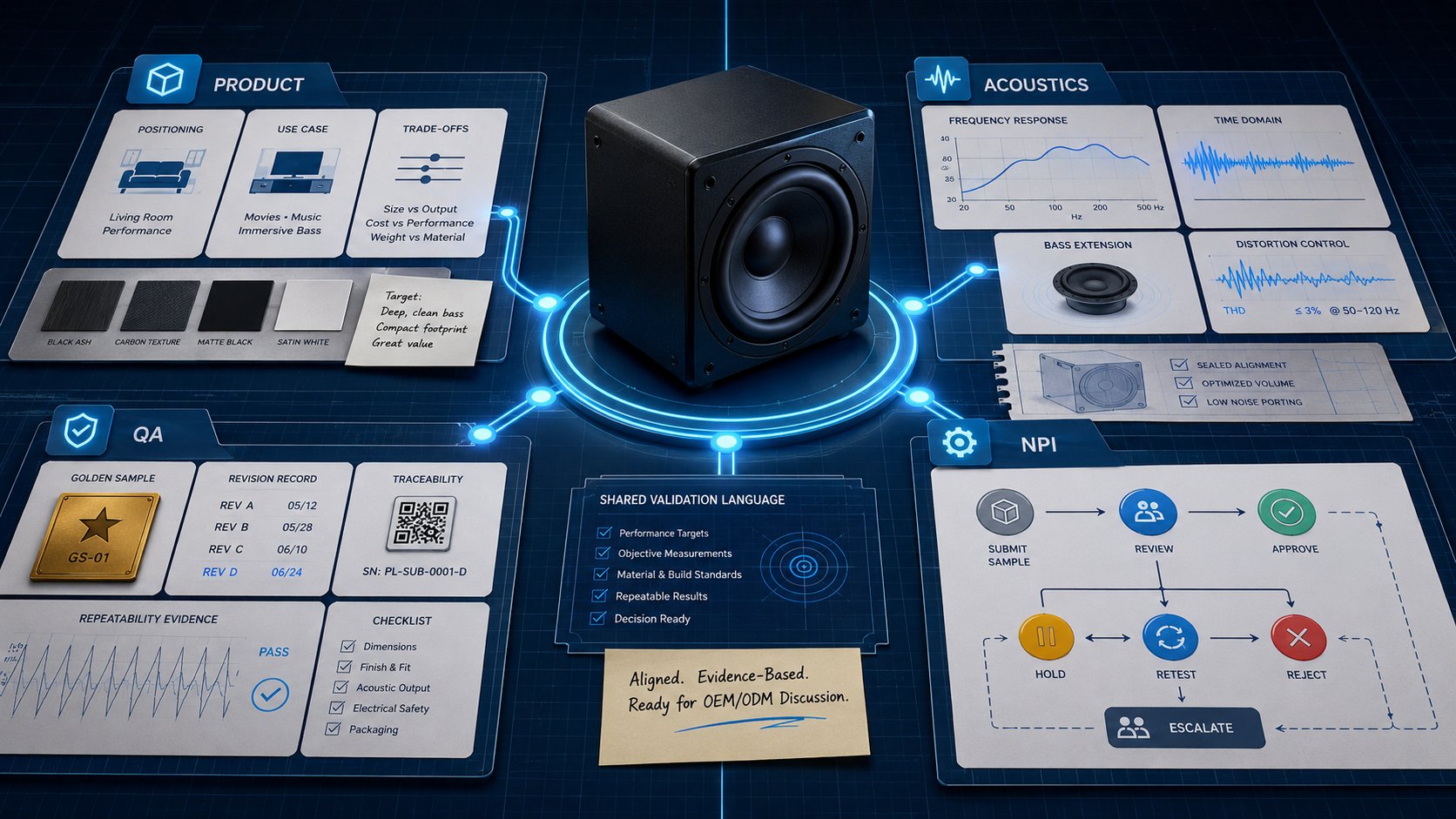
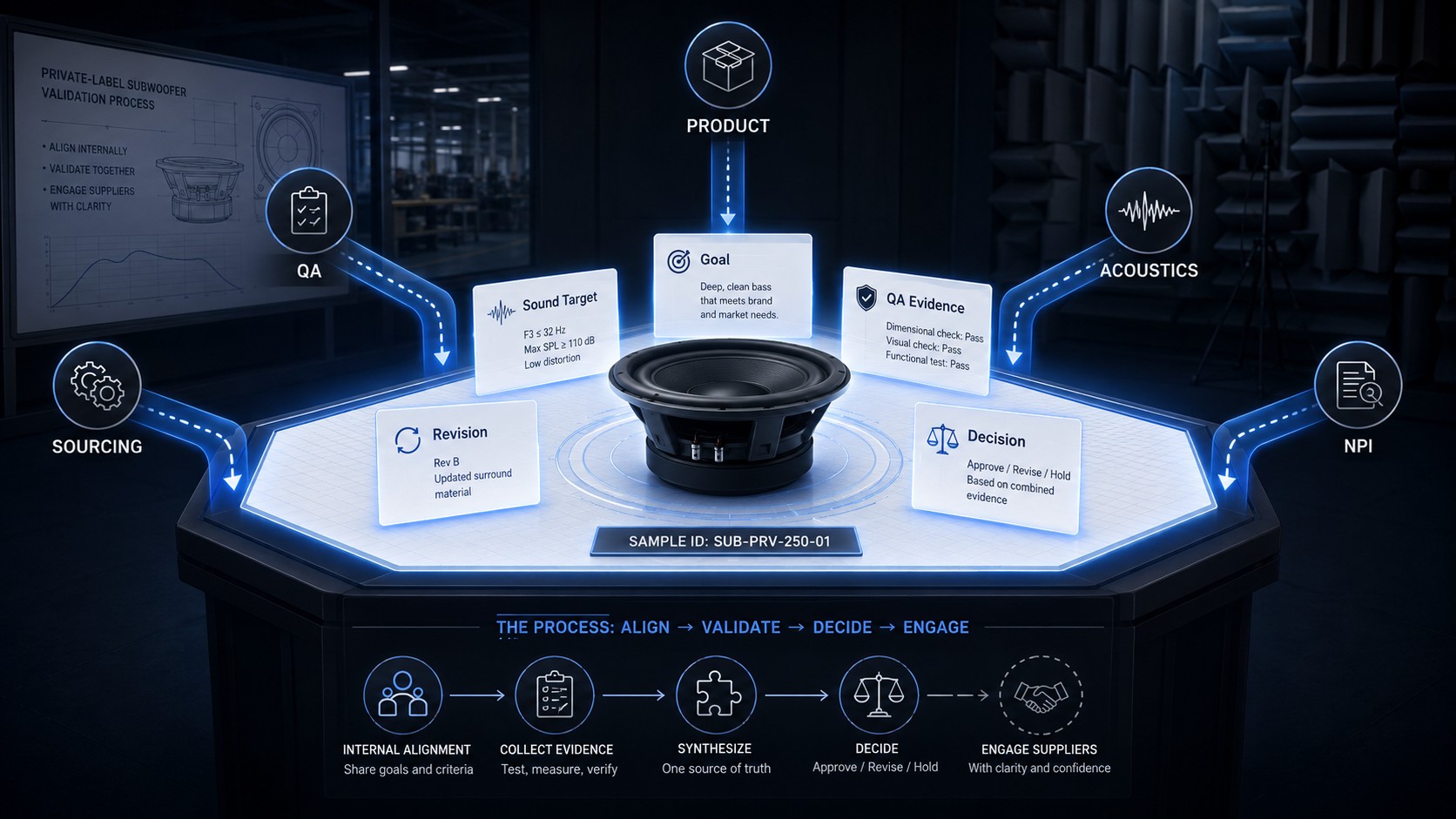
- Shared Questions Help: Sourcing, QA, product, acoustics, and NPI teams should review the same gate evidence together.
Strong gates protect sound after approval.
Audio brand teams will compare subwoofer suppliers with less guesswork, using the quality-gate review that follows.
~ ~ ~ ~ ~ ~ ~ ~ ~ ~ ~ ~ ~ ~ ~ ~ ~ ~
Before an audio brand chooses a subwoofer OEM/ODM partner, the question is not only whether the sample performs well. The harder question is whether the manufacturer has quality gates that can keep that performance stable once the program moves into production.
Sample sound, quoted price, and capacity can all look acceptable during supplier selection. They do not, by themselves, prove that approved acoustic, mechanical, and reliability expectations will hold across production lots. For sourcing, QA, product, acoustics, and NPI teams, subwoofer quality gate design should become part of supplier diligence before RFQ finalization or partner approval.
A strong quality gate system connects approved samples, production controls, test records, traceability, and escalation rules. It should prove that the supplier can protect design intent at scale, not just pass a one-time sample review.
What “Quality Gate Design” Means in a Subwoofer Program
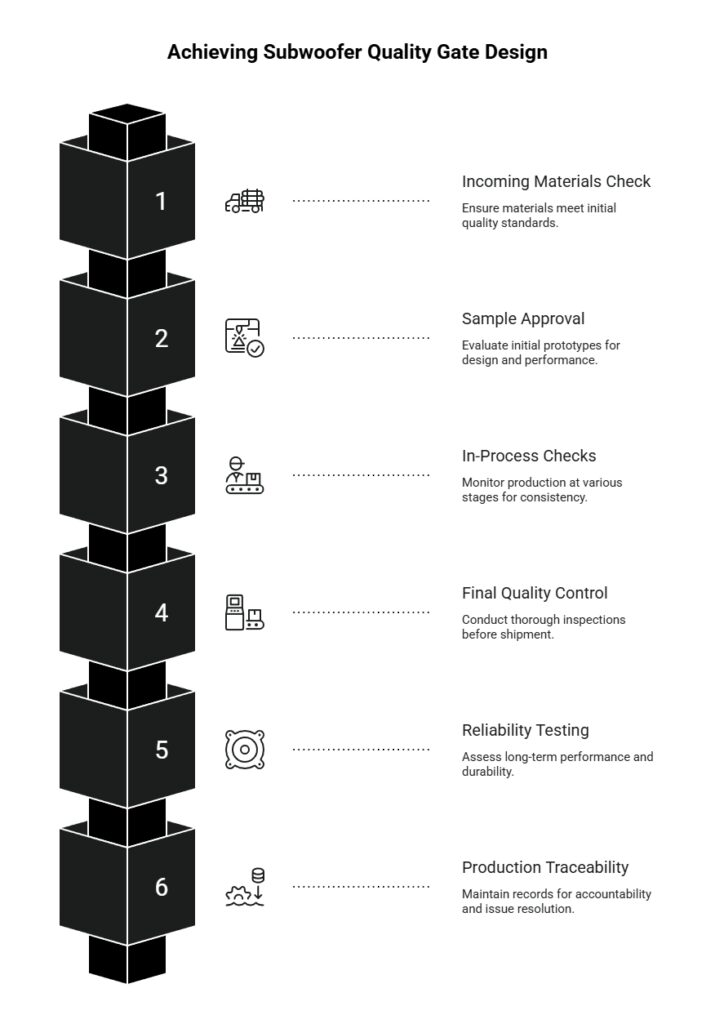
A quality gate is a defined decision point with criteria, evidence, ownership, and escalation rules. In a subwoofer OEM/ODM program, gates may apply to incoming materials, sample approval, in-process checks, final quality control, reliability testing, and production traceability.
The purpose is not to create more inspection paperwork. A quality gate should create decision evidence.
For subwoofers, that evidence may relate to magnet structure consistency, voice coil and suspension consistency, acoustic parameter stability, power-handling assumptions, thermal or reliability expectations, golden sample comparison, and unit-level test records. The exact criteria should vary by product design, use case, brand requirement, and program risk.
The difference between a gate that exists on paper and a gate that is enforced appears in the records. A documented gate may show a checklist. An enforced gate should show what was checked, against what criteria, by whom, with what result, and what happened when the result did not meet expectation.
For broader quality-management context, ISO 9001 is a quality management systems standard. It can support confidence in process discipline, but certification alone should not be treated as proof that a specific subwoofer program is production-ready. Brand teams still need program-specific evidence.
Where Warranty Exposure Starts Before the First Production Run
Warranty exposure can begin before mass production when sample criteria, test limits, gate ownership, and escalation rules are unclear. The issue is not only whether a product fails later. The issue is whether the brand and supplier have enough evidence to prevent, detect, and investigate production drift before units leave the factory.
A sample can sound acceptable during review while still leaving unanswered questions. Are the acoustic targets clearly defined? Is the approved sample governed as a production reference? Are IQC, IPQC, and FQC records tied to subwoofer-specific risk areas? Can test data be traced to unit or batch identity?
When weak gates allow drift between the approved sample and shipped units, QA teams may face a root-cause burden without a reliable evidence trail. Sourcing may believe the supplier was approved because the sample and audit looked acceptable. Product and acoustics teams may later find that production did not preserve the performance attributes they signed off.
A useful supplier question is: “What failure modes is each gate designed to catch before product leaves the factory?” The answer should connect the supplier’s inspection system to real subwoofer program risks, not just generic quality-control language.
The Four Evidence Layers Brands Should Ask Suppliers to Show
Audio brands should evaluate four evidence layers before choosing a subwoofer manufacturer: sample-to-production control, process gate evidence, test-data traceability, and reliability evidence. These layers help sourcing and QA teams distinguish real process control from cosmetic inspection claims.
First, sample-to-production control should show how the approved sample remains active during production. Golden sample governance is most useful when the sample is version-controlled, protected by custody rules, linked to test records, and compared against production output. For further operational context, CFS’s guide on golden sample integrity details this methodology.
Second, process gate evidence should explain what happens at IQC, IPQC, and FQC. IQC, or Incoming Quality Control, evaluates incoming materials. IPQC, or In-Process Quality Control, reviews production-stage conformity. FQC, or Final Quality Control, checks finished goods before release. These gates are stronger when they are tied to acceptance criteria and escalation logic.
Third, test-data traceability should show how results connect to unit or batch identity. Barcode or QR route control can help if test data is bound to the product record and cannot be bypassed without review. CFS’s framework on barcode testing route control further explains this concept in an audio OEM context.
Fourth, reliability evidence should connect testing to design requirements. CFS enforces quality control through short-term destructive power tests, long-term power tests, reliability laboratory testing, KLIPPEL QC with golden samples, and strict IQC/IPQC/FQC protocols. These are useful capability examples, but they should not be treated as guarantees. Each brand should confirm whether the supplier’s evidence matches the specific subwoofer platform, use case, and acceptance criteria.
For acoustic measurement context, IEC 60268-21 covers acoustical output-based measurements for sound system equipment. If a supplier references standardized measurement methods, brand teams should ask how those methods apply to the specific program rather than assuming every test claim has the same meaning.
Warning Signs That a Quality Gate System Is Too Weak
Weak quality gates are not always obvious. Some suppliers can describe inspection steps fluently while still failing to show how the gates are enforced.
Risk signals include a golden sample that exists but is not version-controlled, acoustic test evidence that is discussed generically without sample identity, or IQC/IPQC/FQC records that are not tied to subwoofer-specific failure modes. Another concern is route control that can be bypassed without escalation.
Reliability claims also deserve careful review. A vague “aging test” statement gives limited insight unless the supplier can connect the test to design requirements, sample basis, and decision use. Rather than demanding a universal test plan, brands must recognize that program requirements naturally vary by application, market, and product architecture. The objective is to ensure the supplier’s evidence is strictly calibrated to support the specific risk profile of the program.
Inconsistent answers across functions are another warning sign. If sourcing, QA, product, and acoustics teams receive different explanations of the same gate, the supplier may lack a shared quality language internally.
Merely citing systems like KLIPPEL QC is insufficient. While vendor-owned documentation provides valuable technical context, it does not serve as independent proof that a supplier’s specific, on-site implementation is fully realized.
For further guidance, brand teams can review CFS’s related article on how to compare subwoofer validation documentation when supplier records look polished but need closer evaluation.
How to Turn Quality Gate Review Into a Supplier Evaluation Conversation
Quality gate review works best when every function asks a different part of the same question.
Sourcing should look beyond commercial fit and ask for proof of gate enforcement. QA should ask for gate evidence, test records, traceability, and escalation logic. Product and acoustics teams should confirm whether the gates protect the performance attributes the brand cares about. NPI and program teams should ask when gate criteria are locked and how Engineering Change Order (ECO) and Engineering Change Request (ECR) processes are controlled.
ASQ describes supplier quality management as a proactive and collaborative approach to ensuring suppliers meet customer needs and pre-established requirements. That framing fits OEM/ODM evaluation well: the goal is not to inspect a supplier from a distance, but to establish whether the brand and supplier can make evidence-based decisions together.
Use the matrix below as a practical evaluation aid during supplier diligence.
| Evaluation area | Question to ask | Stronger evidence | Risk signal |
|---|---|---|---|
| Golden sample control | How is the approved sample governed during production? | Version-controlled sample, custody rules, comparison records | “We keep a reference sample” with no record system |
| Process gates | What happens at IQC, IPQC, and FQC? | Gate-specific records tied to acceptance criteria | Generic inspection checklist |
| Test traceability | Can test records be tied to unit or batch identity? | Barcode/QR-linked test data | Manual records that cannot be traced |
| Reliability | How are long-term use risks simulated? | Design-linked reliability tests | Vague “aging test” claims |
| Escalation | What happens when a gate fails? | Hold, review, corrective action, retest logic | Unclear rework or bypass rules |
This matrix should not replace supplier audits, engineering review, or program-specific qualification. It gives brand teams a common language for comparing supplier readiness before a commercial commitment is made.
Choose the Partner Whose Gates Produce Decision Evidence
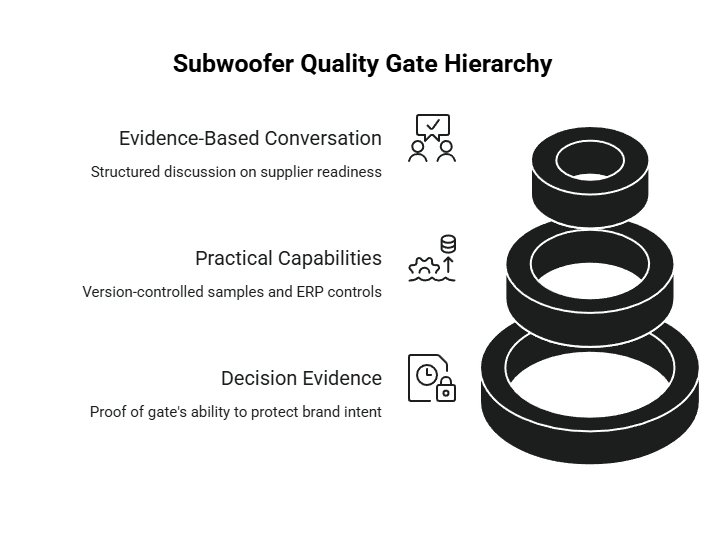
Subwoofer quality gate design belongs in supplier selection because it shows whether a manufacturer can protect brand intent through production. The best conversation is not “Do you inspect?” It is “What evidence proves the gate protects this program?”
For audio brands, that shift matters. Sourcing can compare suppliers with more than price and capacity. QA can evaluate whether records will support investigation. Product and acoustics teams can confirm whether approved performance expectations have a path to repeatable production.
Leveraging these concrete capabilities—from version-controlled golden samples to ERP-driven FIFO controls—allows brand teams to structure a highly practical, evidence-based supplier readiness conversation.
Disclaimer: This article is for general informational purposes only and does not constitute compliance, safety, technical, or professional advice. Quality requirements, test methods, and supplier-evaluation criteria may vary by product design, application, market, and program requirements. Confirm important decisions with qualified engineering, QA, compliance, and supplier-management professionals.
Our Editorial Process:
Our expert team uses AI tools to help organize and structure our initial drafts. Every piece is then extensively rewritten, fact-checked, and enriched with first-hand insights and experiences by expert humans on our Insights Team to ensure accuracy and clarity.
About the China Future Sound Insights Team
The China Future Sound Insights Team is our dedicated engine for synthesizing complex topics into clear, helpful guides. While our content is thoroughly reviewed for clarity and accuracy, it is for informational purposes and should not replace professional advice.