📌 Key Takeaways
Award a subwoofer supplier only after its quality gates prove repeatable production readiness with clear, traceable evidence.
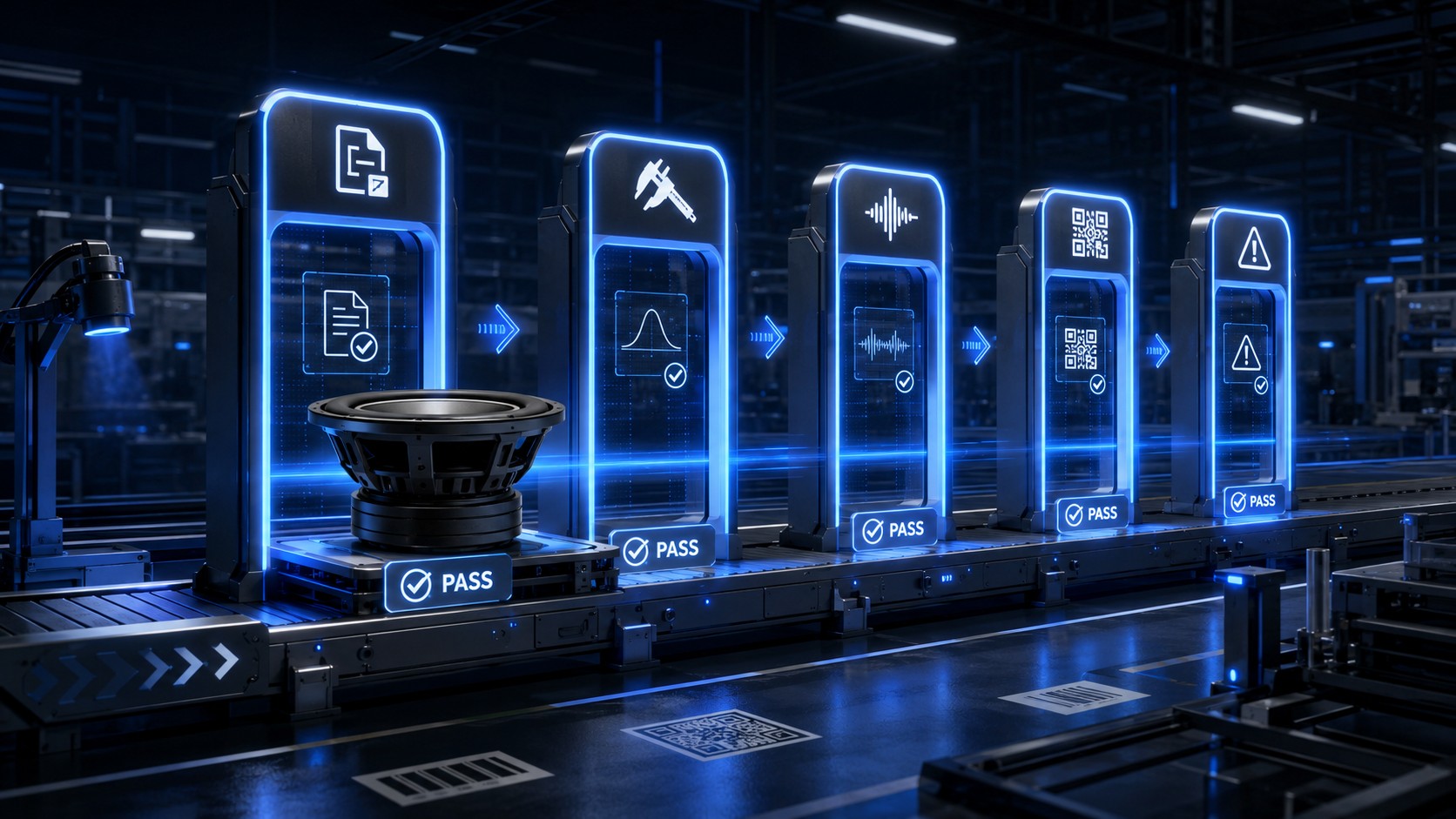
- Make Gates Visible: Quality gates must show when a program can continue, pause, revise, or escalate.
- Tie Samples To Production: Approved samples only matter when suppliers control versions and compare production units against them.
- Catch Variation Early: Strong suppliers use IQC, IPQC, and FQC to find drift before finished goods pile up.
- Trace Every Result: Test data should link to each unit, batch, or route so teams can investigate issues fast.
- Demand Failure Rules: Failed gates need owners, records, hold rules, and clear communication before problems spread.
Visible gates beat vague quality promises.
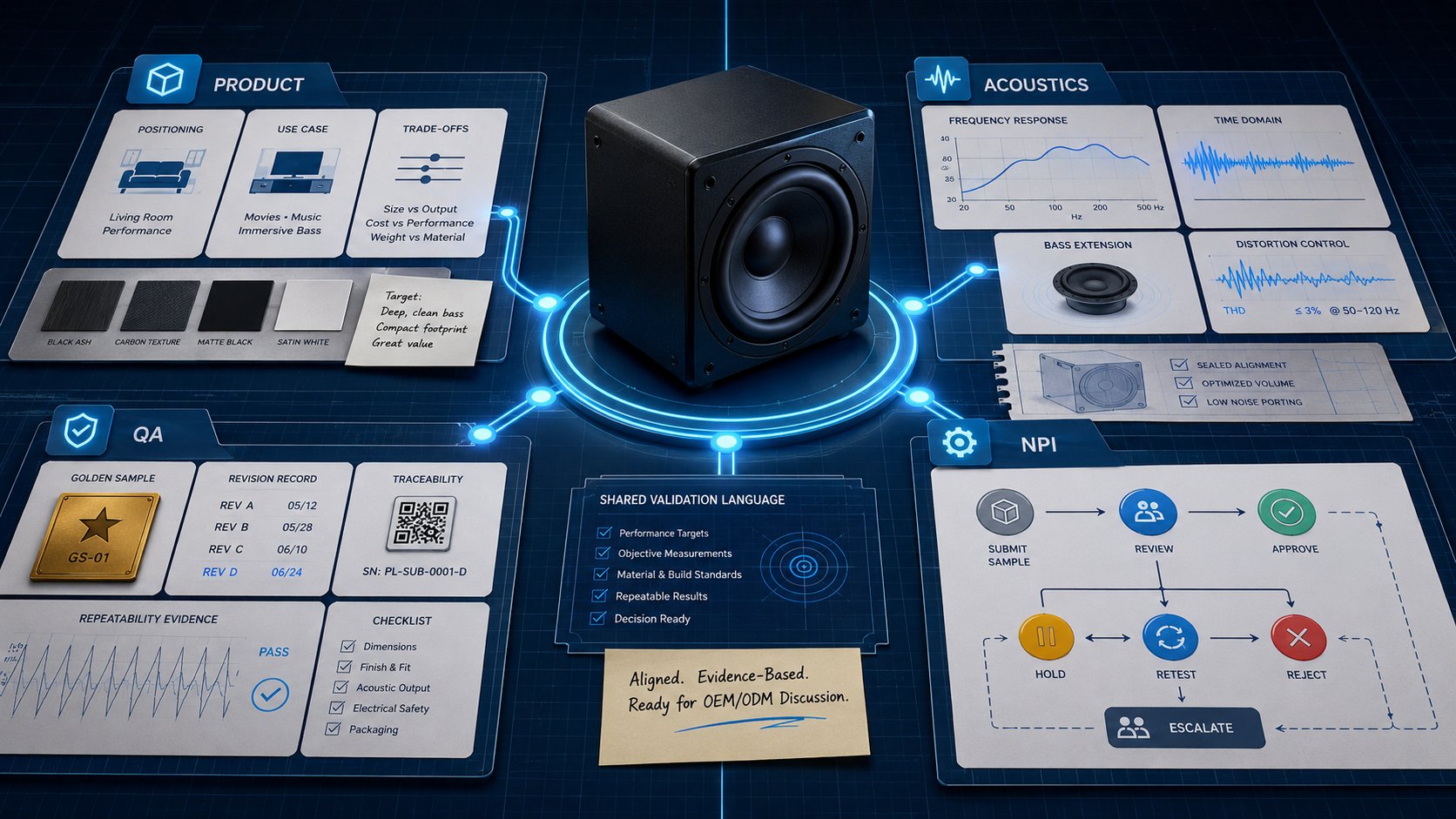
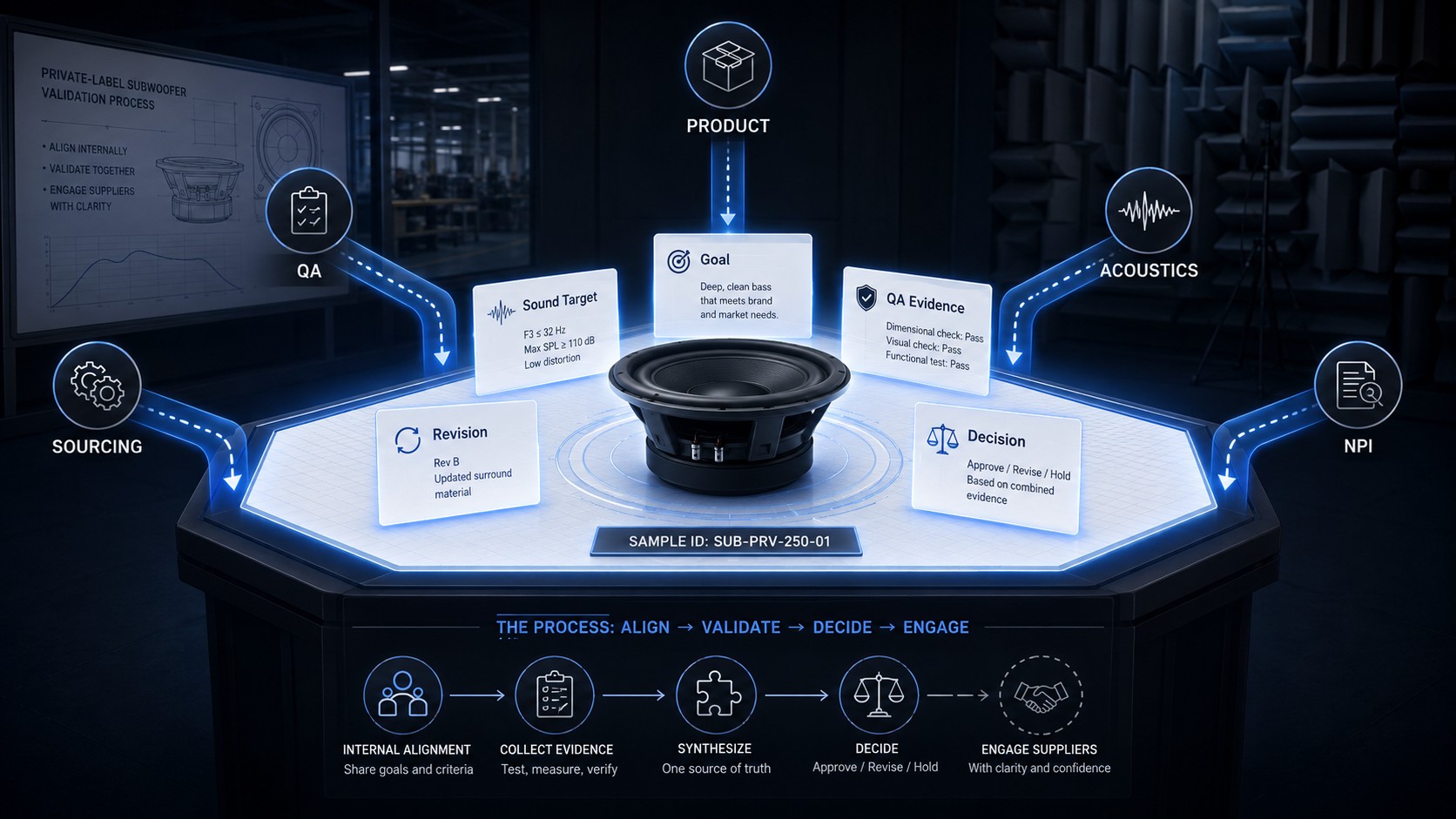
Sourcing, QA, product, acoustics, and NPI teams will make cleaner supplier decisions, using the quality-gate questions that follow.
~ ~ ~ ~ ~ ~ ~ ~ ~ ~ ~ ~ ~ ~ ~ ~ ~ ~
By the time a subwoofer warranty issue appears in the field, the underlying risk usually began much earlier: during sample approval, supplier award, or production gate definition.
Sourcing teams often compare subwoofer manufacturers by price, capacity, timeline, and sample performance. Those factors matter, but they do not fully answer a harder question: can this supplier keep the approved subwoofer stable after the program moves from sample review to repeatable production?
That is where quality gates become useful. Rather than treating a quality gate as a mere factory checklist or lab procedure, sourcing teams must leverage it as a critical decision point: a place where evidence should show whether a subwoofer program can continue, pause, revise, or escalate before risk becomes harder to control.
For brand teams evaluating an OEM/ODM or private-label subwoofer manufacturer, the goal is not to demand one universal procedure. It is to ask sharper pre-award questions about sample control, production variation, acoustic evidence, traceability, and failed-gate escalation.
What a Quality Gate Should Prove in a Subwoofer Program
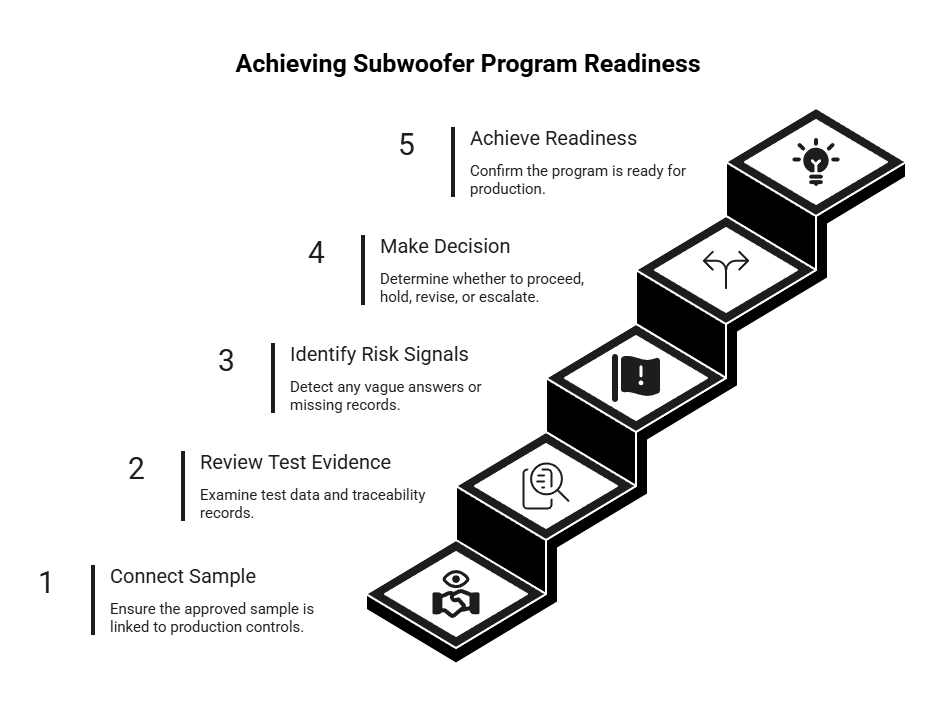
A quality gate should prove that the supplier can connect the approved sample, production controls, test evidence, and traceability records in a way that sourcing and QA teams can review.
Three terms matter:
| Term | What sourcing and QA should look for |
|---|---|
| Gate | A decision point where the supplier continues, holds, revises, or escalates. |
| Evidence | Records, test data, approved samples, traceability, responsible owner, and acceptance logic. |
| Risk signal | A vague answer, missing record, by passable gate, unclear owner, or no escalation path. |
While stronger gates do not guarantee zero defects, they serve as a foundational supplier-quality principle. They make risk visible earlier. They also help sourcing, QA, acoustics, product, and NPI stakeholders use the same definition of “ready.”
External quality frameworks can be useful reference points. For example, ISO 9001:2015 addresses quality management system requirements, while ASQ’s supplier quality guidance frames supplier quality as a proactive and collaborative management discipline. These references do not replace program-specific engineering review, and ISO certification alone should not be treated as proof that a specific subwoofer program is production-ready.
Five Pre-Award Quality-Gate Questions to Ask
1. How do you connect approved samples to production limits?
A strong sample proves that a supplier can build at least one promising unit. It does not automatically prove that future production will stay aligned with that unit.
Sourcing teams should ask how the approved sample becomes a controlled production reference. The answer should address golden sample custody, sample version control, build records, acceptance basis, and production comparison.
At industry-leading facilities like CFS, performance-parameter consistency between mass-produced products and samples is supported through strict golden sample management—an ideal benchmark sourcing teams can use when evaluating supplier controls.
A strong answer should show version-controlled sample records, defined golden sample ownership, comparison between production units and the approved reference, and clear handling of deviations.
A weak answer may sound simple: “The sample passed.” That response leaves open several risks: which sample passed, under what build condition, against what requirement, and how future units will be compared.
For related context, see CFS’s article on golden sample integrity and production consistency.
2. Which gates catch variation before finished goods?
Finished-goods inspection matters, but it should not be the first meaningful point where variation is discovered. Subwoofer programs may be affected by incoming material variation, assembly consistency, magnetic circuit behavior, cone/suspension behavior, acoustic output, and reliability expectations.
Sourcing teams should ask how incoming quality control, in-process quality control, and final quality control connect to the program’s requirements. The supplier does not need to expose every factory SOP during early evaluation, but the quality system should show owners, evidence records, acceptance logic, and escalation rules.
For instance, robust quality-control approaches utilize IQC, IPQC, FQC, ERP/WMS FIFO controls, and regular reliability testing. Sourcing teams must frame these as documented capability categories rather than vague guarantees of a specific outcome.
A strong answer ties each gate to a decision. For example, incoming checks should relate to material readiness, in-process gates should relate to production stability, and final checks should confirm that finished goods meet defined requirements.
A weak answer focuses only on visual inspection or general “QC checks.” That may not reveal whether the supplier can catch production drift before finished goods accumulate.
3. What acoustic or reliability evidence supports the sample?
Equipment lists are not the same as validation evidence. A supplier may mention acoustic tools, simulation software, or reliability equipment, but sourcing and QA teams should ask what evidence is tied to the actual sample, revision, and intended use case.
As a general principle, the evidence should match the program. Automotive subwoofer programs may require attention to vibration, thermal conditions, and fit constraints. Marine programs may place more emphasis on moisture or humidity exposure. Pro audio programs may require closer review of sustained power and reliability evidence. These examples are illustrative; actual requirements vary by product, market, and engineering specification.
Advanced validation requires proper tooling; leading acoustics teams utilize finite element simulation for magnetic circuits and speaker vibration systems, alongside KLIPPEL R&D sample testing, short- and long-term destructive power tests, and custom reliability testing based on design requirements. Industry-standard platforms like the KLIPPEL R&D System facilitate these validations by supporting advanced acoustic tests, parameter and distortion measurements, and comprehensive power testing. The official KLIPPEL QC System page describes QC applications for production-line and repetitive testing.
For external technical reference, IEC 60268-21:2018 covers acoustical output-based measurements for sound-system equipment, including loudspeakers and related audio systems. Whether a particular standard applies depends on the program, market, and buyer requirements.
A strong answer identifies the sample revision, the performance requirement, the evidence record, and who reviewed it. A weak answer says “we test everything” without showing what was tested, why it mattered, or which sample the evidence belongs to.
For a deeper internal reference, see CFS’s article on subwoofer acoustic validation before choosing a private-label manufacturer.
4. Can test data be traced to the unit, batch, or process route?
Traceability should not be treated as an after-sales topic. Before award, it helps sourcing and QA teams understand whether gate evidence can be connected to actual production units, batches, or process routes.
The question is simple: if a quality issue appears later, can the supplier identify which units or lots are involved, which gates they passed, and where abnormal evidence appeared?
Best-in-class operations employ barcode or QR code systems to strictly control the production testing route, seamlessly binding individual test data to these codes to ensure comprehensive traceability.
A strong answer may include unit or lot identity, barcode/QR route control, linked test records, and a way to confirm whether a unit passed, failed, was reworked, or was held. A weak answer relies on disconnected manual logs or broad batch claims that cannot be tied to test evidence.
Traceability is especially useful when sourcing and QA need root-cause visibility. It should not be framed as a consumer returns process or reverse-logistics playbook.
For additional internal reading, see CFS’s article on how to compare subwoofer validation documentation without turning it into a lab procedure.
5. What happens when a gate fails?
A quality gate is only meaningful if a failed gate changes the decision. Sourcing teams should ask what happens when incoming material, in-process evidence, acoustic validation, reliability checks, or finished goods do not meet the program requirement.
The answer should explain hold logic, retest rules, disposition ownership, corrective action responsibility, and stakeholder communication. The purpose is not to request a full corrective-action template during the first discussion. The purpose is to confirm that exceptions are controlled.
A strong answer makes escalation visible. A weak answer uses informal language such as “engineering will handle it” or “production will adjust.” Those statements may be sincere, but they do not show who owns the decision, what record is created, or when the brand is informed.
For automotive-style supplier planning references, AIAG’s APQP manual page describes advanced product quality planning with topics such as sourcing, change management, risk assessment, and gated management. AIAG’s PPAP manual page describes production part approval documentation expectations. These can be useful reference concepts, but they should not be treated as mandatory for every subwoofer program unless the buyer, market, or contract requires them.
Pre-Award Quality-Gate Question Table
| Gate area | Question to ask | Evidence to request | Strong answer | Warning sign |
|---|---|---|---|---|
| Sample control | How do you connect approved samples to production limits? | Golden sample records, version history, acceptance basis | Approved reference units are controlled and tied to production comparison | “The sample passed” with no production correlation |
| Production variation | Which gates catch variation before finished goods? | IQC, IPQC, FQC records, gate ownership, hold rules | Gates connect to program requirements and escalation logic | Inspections are described only as visual or generic |
| Acoustic and reliability evidence | What evidence supports the sample? | Sample test records, revision identity, reliability evidence | Evidence matches the intended use case and is reviewable by QA/product teams | Equipment list without records or sample identity |
| Traceability | Can test data be traced to unit, batch, or route? | Barcode/QR records, route control, linked test data | Unit or lot identity connects to gate results | Manual logs with no link between unit and test evidence |
| Escalation | What happens when a gate fails? | Hold rules, disposition owner, retest logic, communication path | Failed gates trigger documented review or corrective action | Informal fixes with no owner or exception record |
How Sourcing and QA Should Use the Answers
These questions should not become a 50-question audit exercise. They should help the team decide which supplier answers are acceptable, which need clarification, and which should block award until resolved.
A practical way to use the framework is to separate responses into three categories: clear evidence, clarification required, and award risk. Missing sample version control, by passable gates, or no traceable test data may deserve stronger concern than a documentation format that simply needs cleanup.
Consider a hypothetical comparison. Supplier A shares a polished sample report but cannot explain how production gates, traceability, and failed-gate escalation connect to the approved sample. Supplier B gives a less polished presentation but shows how golden sample control, IQC/IPQC/FQC evidence, barcode-linked test data, and escalation ownership fit the program. Before commercial negotiation, Supplier B gives sourcing and QA a stronger basis for risk discussion.
The timing matters. If QA is brought in only after a commercial shortlist is already favored, vague quality answers may become harder to challenge. Before award, sourcing, QA, product, acoustics, and NPI teams should agree which quality-gate answers are required, which are negotiable, and which need documented follow-up.
For a broader supplier-selection companion piece, see CFS’s OEM audio vendor selection checklist.
FAQ
What is a quality gate in a subwoofer manufacturing program?
A quality gate is a decision point where evidence determines whether the program, sample, material, process, or finished unit can continue, pause, revise, or escalate. In supplier evaluation, the gate matters because it shows whether quality control is documented and enforceable.
Is a golden sample enough to control subwoofer quality?
No. A golden sample is useful only when it is version-controlled, protected, tied to acceptance criteria, and used for production comparison. A single approved unit does not prove repeatability by itself.
Should sourcing teams ask technical quality questions before award?
Yes, but at decision-maker altitude. Sourcing does not need to run the lab review, but it should ask whether QA, acoustics, and product teams can review the supplier’s evidence before the commercial award decision becomes difficult to reverse.
How does traceability reduce warranty exposure?
Traceability does not eliminate warranty risk. It can help teams investigate which units, lots, test routes, or process stages may be involved when an issue appears. That makes root-cause review more precise.
What is a weak quality-gate answer from a subwoofer supplier?
A weak answer is vague, record-light, or disconnected from program requirements. Examples include “we inspect everything,” “the sample passed,” “engineering will fix it,” or “we have test equipment” without sample identity, records, owners, or escalation logic.
Award the Program Only After the Gates Are Visible
Subwoofer quality gates should help sourcing teams see whether a manufacturer can connect approved samples, production controls, acoustic and reliability evidence, traceability, and escalation logic.
Ultimately, these criteria strip away vague quality assurances, forcing the supplier to defend their production readiness with hard, traceable evidence.
When evaluating subwoofer manufacturers, ask for evidence before award momentum narrows the decision. The strongest supplier conversations are built around visible gates, clear owners, reviewable records, and shared expectations between sourcing, QA, product, acoustics, and NPI teams.
Disclaimer:
This article is for general informational purposes only. It is not a substitute for advice from a qualified professional, provider, or official source relevant to your situation. Always verify important sourcing, quality, technical, and compliance decisions with the appropriate expert, authority, or service provider.
Our Editorial Process:
Our expert team uses AI tools to help organize and structure our initial drafts. Every piece is then extensively rewritten, fact-checked, and enriched with first-hand insights and experiences by expert humans on our Insights Team to ensure accuracy and clarity.
About the China Future Sound Insights Team
The China Future Sound Insights Team is our dedicated engine for synthesizing complex topics into clear, helpful guides. While our content is thoroughly reviewed for clarity and accuracy, it is for informational purposes and should not replace professional advice.