📌 Key Takeaways
Unit cost matters, but QA should compare suppliers by proof that approved subwoofer performance can repeat at scale.
- Price Is Partial: A low quote only works when the supplier also proves strong controls after launch.
- Proof Beats Samples: Approved samples need test records, target limits, version history, and rules for production use.
- Quality Gates Matter: IQC, IPQC, and FQC only help when suppliers record clear pass and fail decisions.
- Traceability Reduces Guesswork: Barcode or QR-linked test data helps teams investigate field issues with real evidence.
- Change Control Protects: Clear ECO and ECR records reduce hidden changes across lots, revisions, and production runs.
The best supplier choice is evidence-weighted, not price-blind.
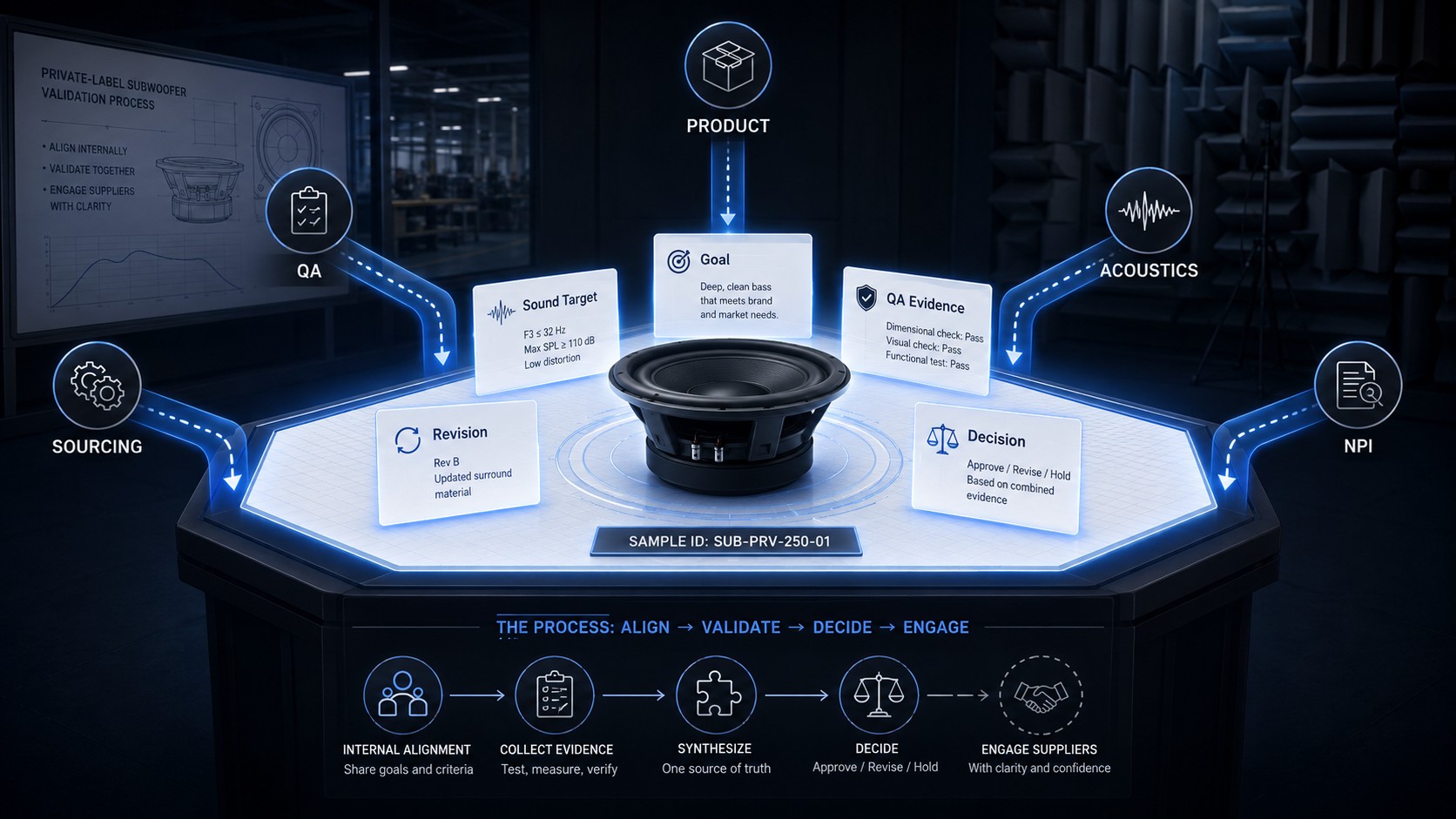
QA Directors and sourcing teams will compare subwoofer suppliers more clearly, using the evidence-based checklist that follows.
~ ~ ~ ~ ~ ~ ~ ~ ~ ~ ~ ~ ~ ~ ~ ~ ~ ~
Unit cost belongs in every supplier discussion. For enterprise private-label subwoofer programs, sourcing teams need competitive quotes, stable commercial terms, and partners that can support the program’s business case. QA Directors, however, are responsible for a different risk window: what happens after sample approval, production launch, and field exposure.
A practical comparison should ask whether each supplier can reproduce approved performance at scale, control process variation, document quality gates, trace units and test results, and manage engineering changes. That means QA should compare subwoofer manufacturers by validation evidence, quality gates, traceability, golden sample discipline, reliability testing, and change-control maturity alongside unit cost.
This is not an argument against cost reduction. It is a way to make cost review more complete.
Reframe Unit Cost as Part of Total Program Exposure
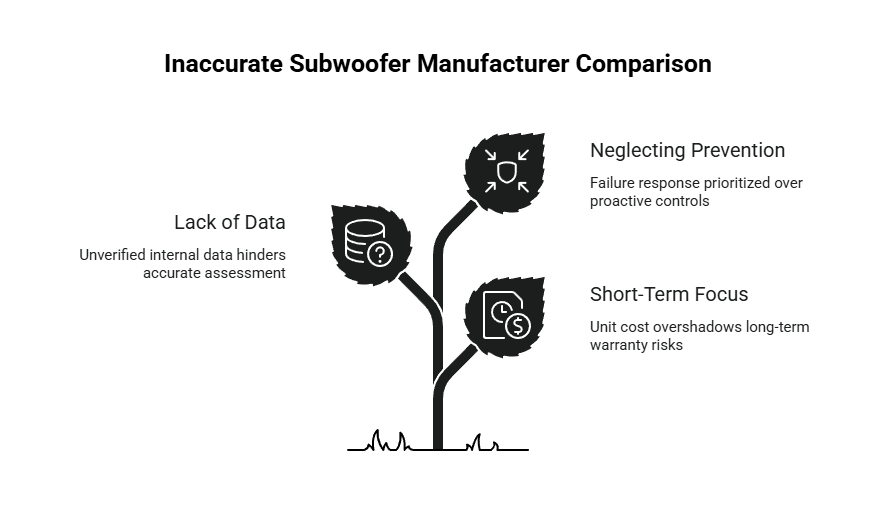
Unit cost is visible early. Warranty-risk exposure may appear later through inconsistent production, retesting, engineering escalation, containment work, or brand-support burden. The exact impact varies by program, product architecture, supplier maturity, and field conditions, so it should not be quantified without verified internal data.
A lower quote remains a strong choice if the supplier proves disciplined controls, whereas a higher quote is not automatically safer if the evidence is thin. QA’s mandate is to bridge the gap between initial quotes and lifecycle validation by demanding verifiable process controls?
ASQ’s quality-cost framework distinguishes prevention, appraisal, internal failure, and external failure costs. In supplier comparison, this is useful as a general principle: prevention and appraisal evidence should be reviewed before the program depends on failure response.
Compare Sample Validation Evidence, Not Sample Appearance
A sample that sounds acceptable or visually matches expectations is not enough by itself. QA teams should ask whether the sample is tied to documented test conditions, revision history, acoustic targets, and approval limits.
Strong acoustic validation evidence shows which sample version was approved, what performance target it met, what limits define pass or retest, and how that reference will be protected during production. This is where subwoofer validation documentation matters more than presentation polish.
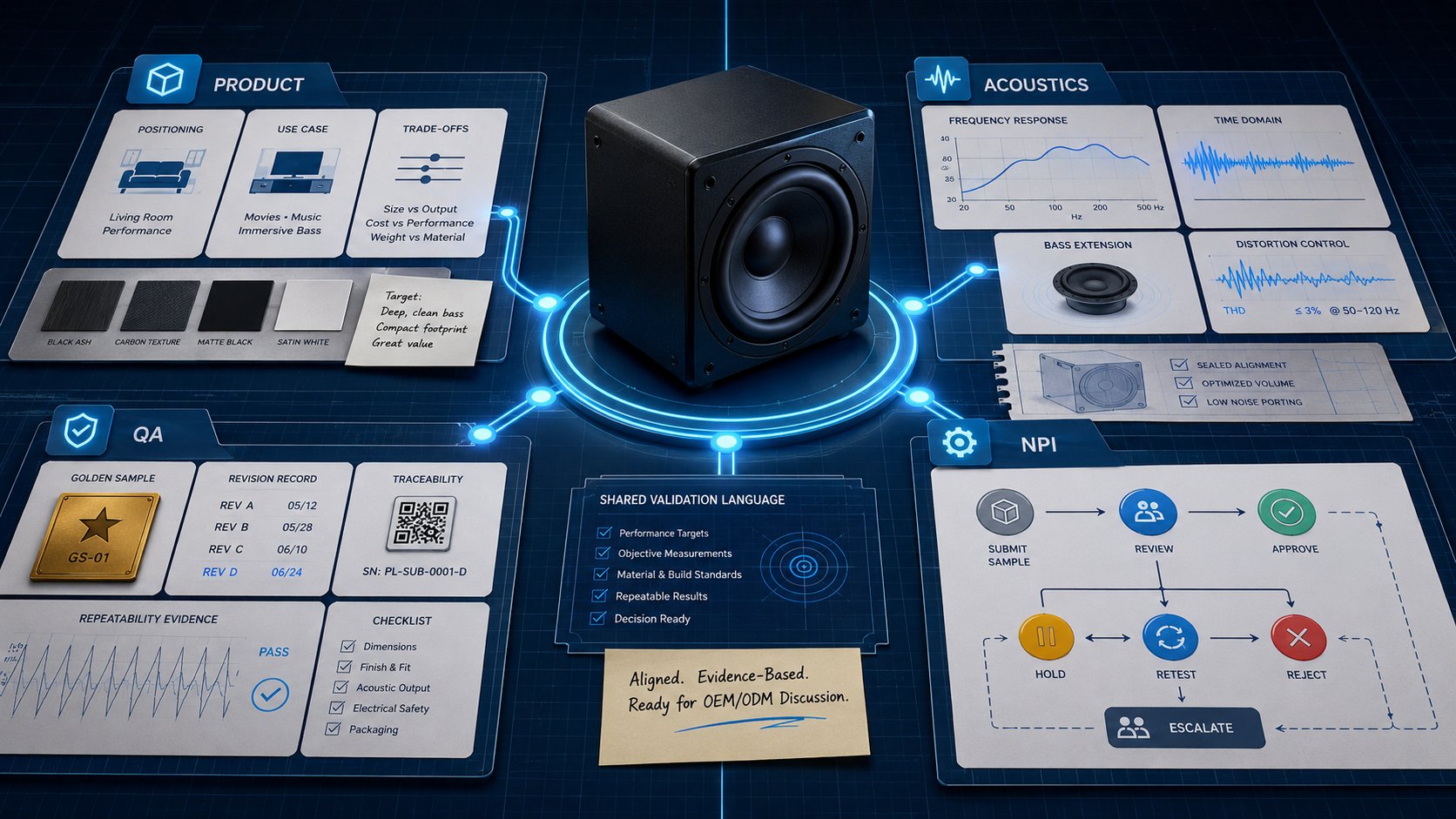
For example, the acoustics engineering team at CFS utilizes finite element simulation, KLIPPEL R&D sample testing, and short- and long-term destructive power testing to establish baseline golden sample governance. The decision point is not the equipment list alone. The stronger signal is whether the manufacturer can connect sample approval to repeatable production evidence.
Check Whether Quality Gates Are Enforced in Production
Supplier documents can look complete while still leaving QA with limited proof. The useful question is whether quality gates are enforced, recorded, and tied to decisions.
For subwoofer programs, QA should review how incoming materials are inspected, what in-process checks prevent drift, what final test evidence is linked to finished units, and what happens when a unit fails. IQC, IPQC, and FQC terminology are only meaningful when supported by pass/fail criteria, exception handling, and records that brand teams can interpret.
CFS source materials identify ISO9001-2015 certification, ERP/WMS/FIFO material control, KLIPPEL QC with golden samples, IQC/IPQC/FQC, and reliability laboratory testing as part of its mass-production quality-control system. ISO 9001 can indicate a quality management framework for consistent products and applicable requirements, but it should not be treated as proof that a specific subwoofer program is low risk. QA still needs supplier-specific production records.
Treat Traceability as a Warranty-Risk Signal
Traceability is not just an operational detail. For QA Directors, it signals whether a manufacturer can support containment, root-cause analysis, and controlled investigation if issues appear.
A stronger supplier-readiness signal includes barcode or QR-based identity, test-route control, test data tied to serial or barcode records, and a clear connection between production batch, inspection status, and test results. CFS source materials state that barcodes and QR codes are used to control the testing route and bind test data with the barcode system for traceability.
In general QA practice, traceable test data does not eliminate warranty risk. It improves the team’s ability to investigate with evidence instead of broad assumptions.
Use a Shared QA-Sourcing Scorecard
A useful scorecard helps QA and sourcing compare manufacturer maturity without turning the discussion into a price dispute. It should keep the focus on evidence of production consistency.
Manufacturer Comparison Signals QA Should Review Beyond Unit Cost
| Evaluation area | What to ask for | Strong evidence looks like | Warranty-risk signal | Weak signal to watch for |
|---|---|---|---|---|
| Sample validation | Test records, revision history, acoustic targets | Evidence tied to defined targets and versions | Shows whether approval is repeatable | “Approved sample” with little data |
| Golden sample control | Custody rules and comparison process | Production checks benchmarked against the approved sample | Helps detect production drift | Golden sample stored but not used |
| Production gates | IQC/IPQC/FQC records | Gate evidence with pass/fail criteria | Shows process control discipline | Generic inspection checklist |
| Traceability | Unit or batch test linkage | Test data tied to barcode/QR identity | Supports containment and investigation | No link between failures and history |
| Reliability testing | Program-relevant test plan | Tests mapped to use-case assumptions | Shows risk review before SOP | Reliability stated only as a claim |
| Change control | ECO/ECR records and cut-in logic | Changes tied to affected lots or revisions | Reduces undocumented variation | Informal changes with unclear ownership |
This framework supports procurement and QA alignment by making supplier comparison evidence-weighted, not price-blind. If two manufacturers submit similar quotes, QA can compare which one provides clearer validation records, stronger golden sample governance, enforced production gates, and traceable test data. The answer may vary by program, but the comparison becomes more defensible.
Before shortlisting, QA and sourcing should align on five questions: what evidence supports the approved sample, how production consistency is verified, what traceability exists, how changes are controlled, and which missing records would create unacceptable uncertainty.
The Best Comparison Is Evidence-Weighted
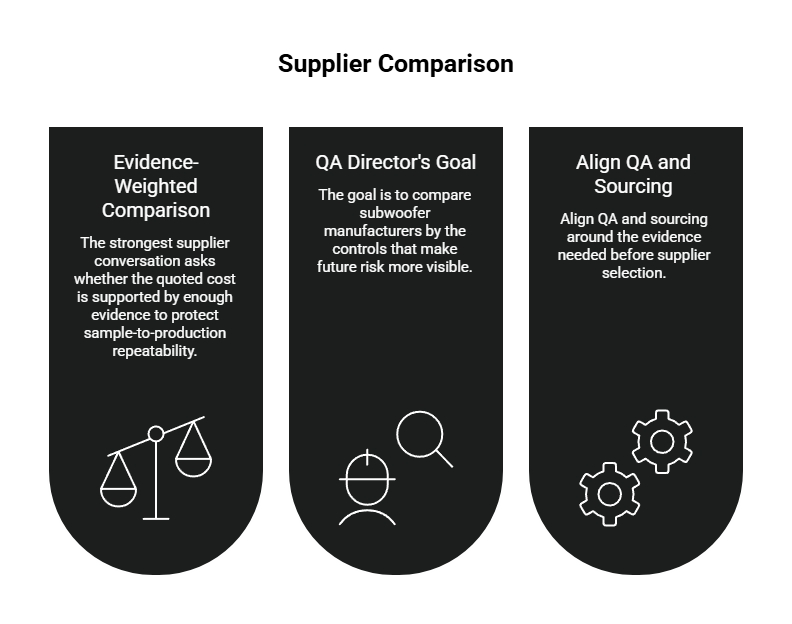
The strongest supplier conversation does not dismiss unit cost. It asks whether the quoted cost is supported by enough evidence to protect sample-to-production repeatability.
For QA Directors, the goal is not to rank vendors by presentation quality or push sourcing toward the highest quote. The goal is to compare subwoofer manufacturers by the controls that make future risk more visible: the manufacturer’s adherence to lifecycle quality governance and verified containment protocols.
For your next private-label subwoofer program, align QA and sourcing around the evidence needed before supplier selection—not after sample approval.
Contact CFS to discuss your next private-label subwoofer program.
Disclaimer: This article is for general informational purposes only and does not constitute compliance, safety, technical, or professional advice. Requirements, risks, and best practices may vary by program, product category, supplier, jurisdiction, and use case. Confirm important supplier-selection and quality decisions with qualified internal QA, engineering, sourcing, legal, or compliance professionals.
Our Editorial Process:
Our expert team uses AI tools to help organize and structure our initial drafts. Every piece is then extensively rewritten, fact-checked, and enriched with first-hand insights and experiences by expert humans on our Insights Team to ensure accuracy and clarity.
About the China Future Sound Insights Team
The China Future Sound Insights Team is our dedicated engine for synthesizing complex topics into clear, helpful guides. While our content is thoroughly reviewed for clarity and accuracy, it is for informational purposes and should not replace professional advice.