📌 Key Takeaways
A strong subwoofer sample is not enough; a supplier must show clear proof that launch quality can repeat.
- Proof Beats Sound: A sample that sounds good still needs records that connect targets, tests, and production checks.
- Targets Must Be Clear: Suppliers should explain what the subwoofer should achieve before teams approve the sample.
- One Sample Is Risky: A golden sample only helps when records track its version, tests, and future comparisons.
- Testing Needs Rules: Named equipment means little unless the supplier explains clear pass/fail criteria.
- QA Must Continue: Sample data should guide production checks, so later units do not drift from approved quality.
Strong launches depend on proof, not promising samples or impressive lab claims.
Product, QA, sourcing, acoustics, and NPI teams will spot supplier risks faster, preparing them for the detailed overview that follows.
~ ~ ~ ~ ~ ~ ~ ~ ~ ~ ~ ~ ~ ~ ~ ~ ~ ~
A private-label subwoofer sample can sound promising in an early review and still leave the brand team with an unresolved question: does the supplier have a validation process that can support launch decisions, or did one sample simply perform well once?
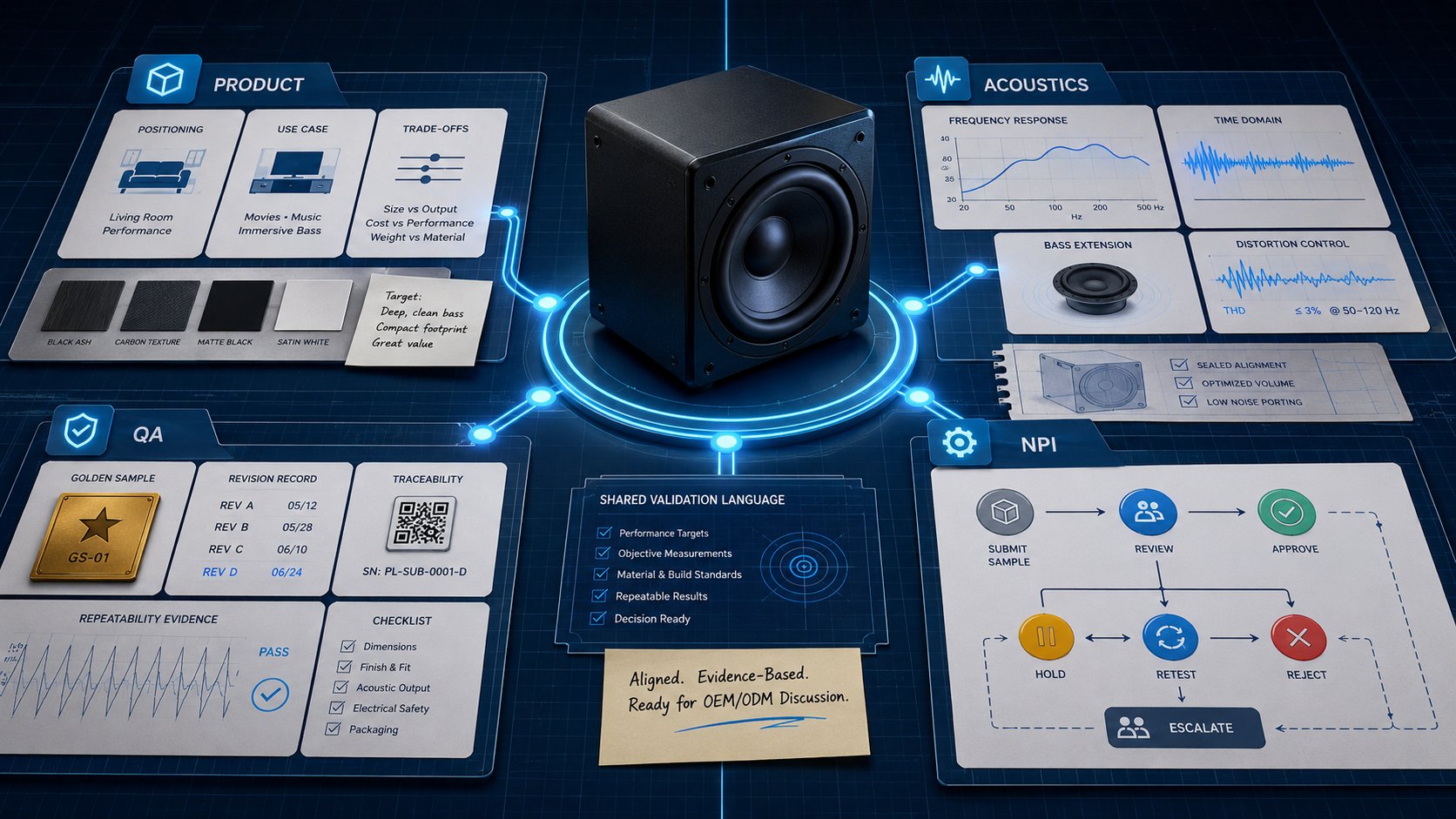
That distinction matters for QA, Product, Sourcing, Acoustics, and NPI teams. A sample review shows what one unit can do under one set of conditions. A mature subwoofer supplier validation process shows how targets are defined, how evidence is recorded, how repeatability is checked, and how the approved result carries into production QA.
The warning signs below are not automatic disqualifiers. They are risk signals. Each one should prompt a more focused supplier discussion before the team advances deeper into tooling, pilot production, or launch planning.
Why Validation Evidence Matters Before a Private-Label Subwoofer Launch
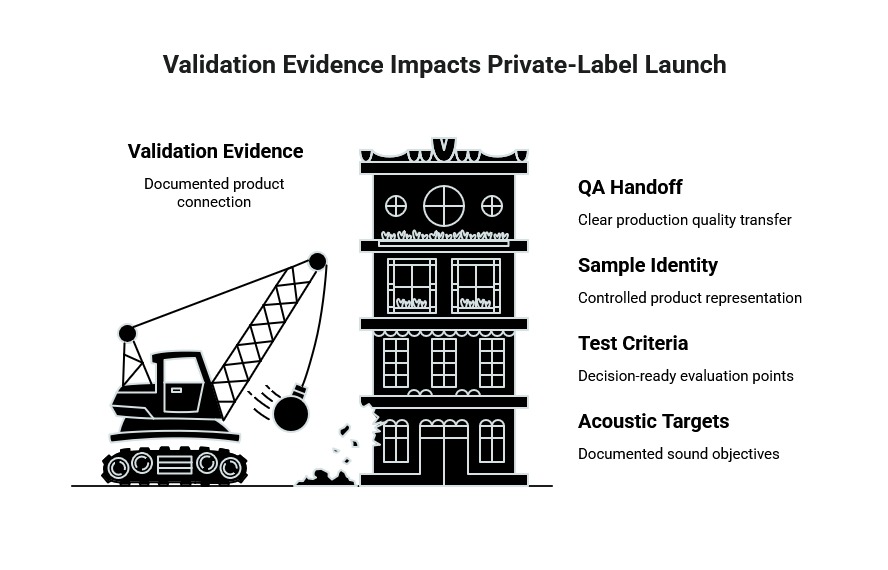
For a private-label launch, “validated” should mean more than “the sample sounded good.” Validation evidence is the documented connection between the product target, the test criteria, the sample identity, and the production QA handoff.
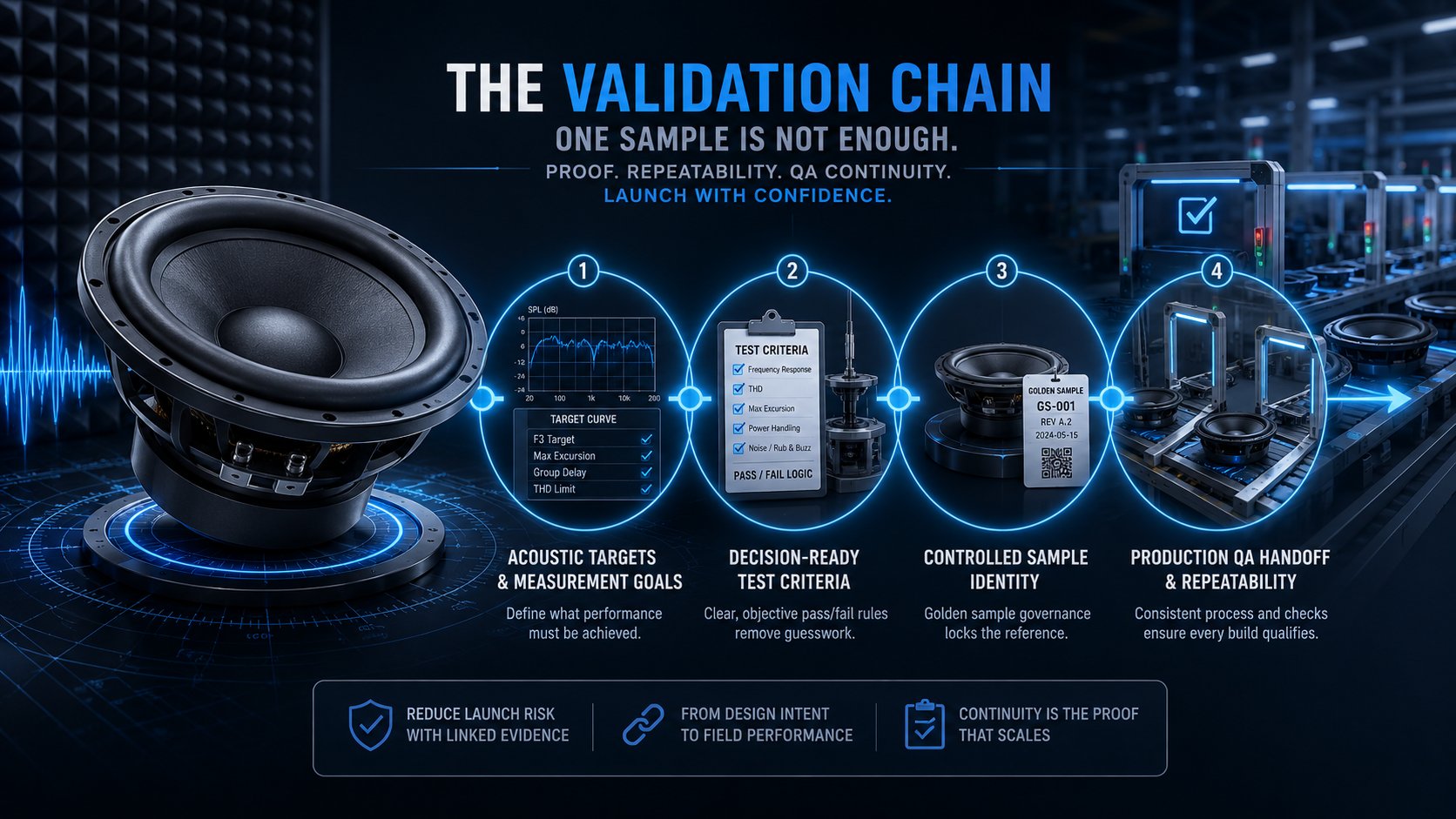
Validation evidence, in practical terms: documented acoustic targets + decision-ready test criteria + controlled sample identity + a clear handoff into production QA.
This definition is intentionally broad. Program requirements vary by product category, application, enclosure assumptions, power expectations, and brand positioning. However, the general principle is stable: a supplier should be able to explain what was validated, why it matters, and how the same logic will be controlled beyond the first sample.
External standards and measurement systems can help technical teams frame the conversation, but they should not be treated as automatic pass/fail shortcuts. For example, IEC 60268-21 specifies acoustical measurement methods for electro-acoustical transducers and sound systems, while KLIPPEL’s public measurement overview shows categories such as sound pressure, distortion, power handling, heat dissipation, and accelerated life or power testing. Those references can support technical review, but the supplier still needs to connect any measurement approach to the specific program requirements.
Six Warning Signs to Investigate
1. The Supplier Cannot Explain the Acoustic Target Behind the Sample
An acoustic target is the performance intention the supplier is validating against. In a subwoofer program, that may involve frequency-response expectations, power handling, distortion behavior, thermal behavior, excursion behavior, enclosure assumptions, or application context.
The issue is not whether every target is complex. The issue is whether the target is explicit enough for Product, QA, and Acoustics teams to review. If the supplier can only say the sample has “strong bass” or “good sound,” sample approval may become subjective.
A stronger answer explains what the sample was designed to achieve, how those targets were documented, and how later samples or production units will be compared. If acoustic design choices are part of the broader product discussion, related reading on custom audio line speaker technologies may help teams frame the design-side questions before supplier review.
2. Approval Depends on One “Good” Sample
One good prototype may be useful. It is not, by itself, proof of repeatability.
A controlled golden sample can help bridge that gap when it is used as a reference point for later comparison. In this context, a golden sample is a controlled reference sample used to compare future pilot or production output against approved requirements. The value comes from version control, custody, test records, and production comparison—not from the label alone.
A warning sign appears when the supplier cannot link the sample to a BOM version, test condition, enclosure assumption, measurement record, or production comparison plan. Teams evaluating this risk may want to review golden sample integrity before relying on a single approved unit.
3. Test Equipment Is Named, but Pass/Fail Criteria Are Vague
A supplier may list measurement systems, test benches, simulation tools, or QC equipment. Those capabilities can matter, but equipment names do not automatically prove validation maturity.
Pass/fail criteria are the documented conditions used to decide whether a sample or production unit meets the intended requirement. The criteria may vary by program. The practical question is whether the supplier can explain the acceptance logic clearly enough for the buyer’s internal reviewers.
If a supplier references KLIPPEL, finite element simulation, or other measurement tools, the brand team should ask how those tools support the program decision. KLIPPEL documentation, for example, presents application notes for loudspeaker design and quality assessment, but the supplier still needs to show which evidence is relevant to the product being launched.
The warning sign is not the absence of one specific tool. Rather, the risk lies in the gap between claimed testing capability and usable evidence.
4. Reliability Validation Is Treated as an Afterthought
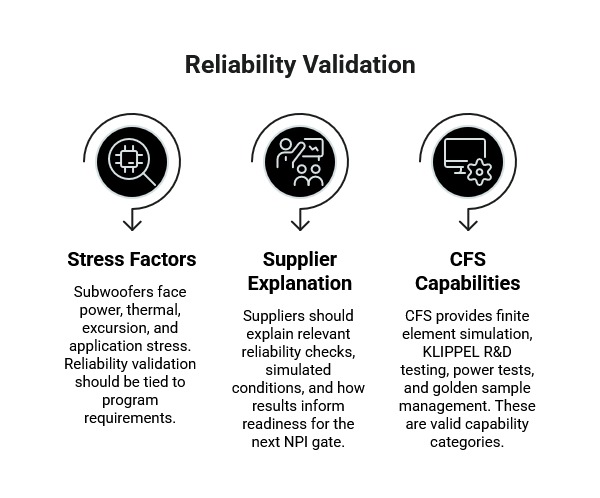
Subwoofers can face power, thermal, excursion, and application stress depending on the intended use case. Reliability validation should therefore be tied to program requirements, not added as a vague final comment after acoustic approval.
A supplier does not need to expose every lab procedure to a sourcing team. However, the supplier should be able to explain what reliability checks are relevant, what conditions are being simulated, and how the results inform readiness for the next NPI gate.
CFS provides comprehensive, source-supported capabilities in finite element simulation, KLIPPEL R&D testing, short-term destructive power tests, long-term power tests, and golden sample management. These are valid examples of capability categories, not universal requirements and not guarantees of launch success.
5. Validation Data Does Not Connect to Production QA
Validation should not stop at the sample bench. A private-label team needs to understand how the supplier transfers validation criteria into production QA.
This is where sample-to-production consistency becomes important. The supplier should be able to explain how approved sample data connects to IQC, IPQC, FQC, route control, golden samples, traceability, and exception handling. If the answer is unclear, Product and QA may disagree on whether the supplier is truly ready for pilot or mass production.
CFS quality practices include ISO9001-2015 quality management, ERP/WMS/FIFO controls, KLIPPEL QC with golden samples, barcode/QR traceability, IQC/IPQC/FQC, and reliability-lab testing. ISO describes ISO 9001:2015 as an international standard for quality management systems; that supports general QMS context, but program-specific validation still depends on how the supplier applies its system to the product.
For deeper internal alignment, teams can review the OEM audio vendor selection checklist and the role of testing route control in production QA handoff.
6. Communication Breaks Down When Evidence Is Requested
Validation maturity is partly technical and partly organizational. Strong suppliers should be able to translate validation evidence into buyer-relevant language without reducing the answer to a sales claim or a lab tutorial.
A warning sign appears when no one clearly owns the answer across acoustics, QA, engineering, and production. Another appears when the supplier gives different explanations to product managers, quality assurance, and sourcing teams.
Private-label teams do not need every stakeholder to become an acoustics specialist. They do need a shared evidence package that lets each function review the part it owns.
Subwoofer Supplier Validation Red-Flag Checklist
| Warning sign | Why it matters | Evidence to request | Internal reviewer |
|---|---|---|---|
| Acoustic targets are unclear | Sample approval may become subjective | Target summary, application assumptions, performance intent | Product, Acoustics |
| Approval depends on one good sample | Repeatability may not be demonstrated | Golden sample record, BOM version, sample identity, test conditions | QA, NPI |
| Pass/fail criteria are vague | Test capability may not support decisions | Acceptance criteria, deviation handling, test summary | QA, Acoustics |
| Reliability evidence is weak | Power, thermal, and usage risks may be under-reviewed | Reliability rationale, relevant power-test approach, usage assumptions | QA, NPI |
| Data does not transfer to production QA | Pilot or mass production may drift from approved intent | IQC/IPQC/FQC handoff, golden sample comparison, route-control logic | QA, Operations |
| Traceability is unclear | Sample, pilot, and production records may be hard to compare | Barcode/QR records, lot tracking, test-data linkage | QA, Operations |
| Communication ownership is unclear | Cross-functional approval becomes harder | Named owner, issue log, validation package, change-control path | Product, Sourcing, NPI |
This checklist should support supplier discussion, not replace technical review. The right evidence depth may vary by program risk, product complexity, customization level, and internal approval requirements.
What to Do Before Advancing the Supplier
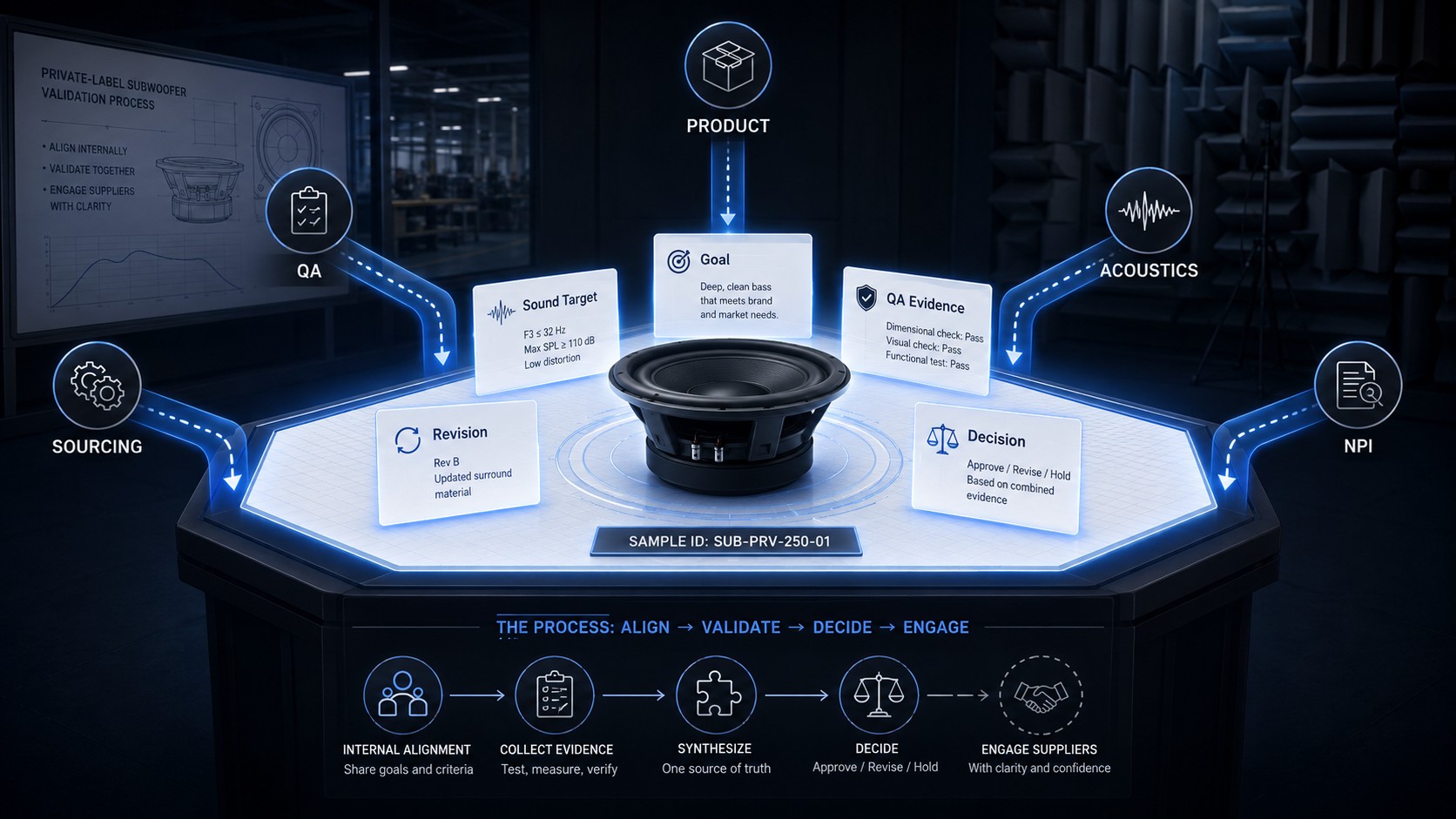
A practical next step is to align internal reviewers before asking the supplier for more information. Product, QA, Acoustics, Sourcing, and NPI should agree on the minimum evidence package needed for the next decision gate.
A simple framework can help:
Clarify targets → request evidence → check QA handoff → align internal reviewers.
If the supplier cannot answer, the safest response is not necessarily immediate rejection. It may be a pause in escalation until the supplier provides clearer documentation. That pause can protect the team from approving a supplier relationship based on impressions, equipment lists, or incomplete handoffs.
For broader evaluation structure, a supplier scorecard can help compare evidence quality across potential partners.
FAQs
What should a subwoofer supplier validate before a private-label launch?
At minimum, the supplier should be able to explain acoustic targets, sample repeatability, reliability assumptions, production QA handoff, and traceability. The depth of evidence may vary by program requirements.
Is one approved sample enough to choose a supplier?
Usually not by itself. A strong sample should be supported by repeatability evidence, controlled sample identity, production comparison logic, and QA handoff documentation.
What is a golden sample in subwoofer manufacturing?
A golden sample is a controlled reference sample used to compare later production output against approved requirements. It supports consistency only when it is version-controlled and connected to production checks.
Should buyers ask for lab data from every supplier?
Buyers should ask for decision-relevant validation evidence. The necessary depth depends on program risk, customization level, and internal technical requirements.
What is the biggest red flag in supplier validation?
There is no single universal red flag. The strongest risk signal is when acoustic targets, validation evidence, and production QA controls do not connect.
Conclusion
A private-label subwoofer launch should not depend only on a promising sample or a supplier’s claim that testing exists. Validation maturity is about documented targets, repeatable evidence, controlled samples, reliability logic, traceability, and communication that supports cross-functional decisions.
Use these warning signs to prepare the next supplier validation discussion. To continue evaluating fit, explore CFS subwoofer manufacturing capabilities or discuss your next program with the CFS team.
Disclaimer:
This article is for general informational purposes only and does not constitute compliance, safety, technical, or professional advice. Requirements, risks, and best practices may vary by context, jurisdiction, system, provider, or use case. Confirm important decisions with the appropriate qualified professional, authority, or technical expert.
Our Editorial Process:
Our expert team uses AI tools to help organize and structure our initial drafts. Every piece is then extensively rewritten, fact-checked, and enriched with first-hand insights and experiences by expert humans on our Insights Team to ensure accuracy and clarity.
About the China Future Sound Insights Team
The China Future Sound Insights Team is our dedicated engine for synthesizing complex topics into clear, helpful guides. While our content is thoroughly reviewed for clarity and accuracy, it is for informational purposes and should not replace professional advice.