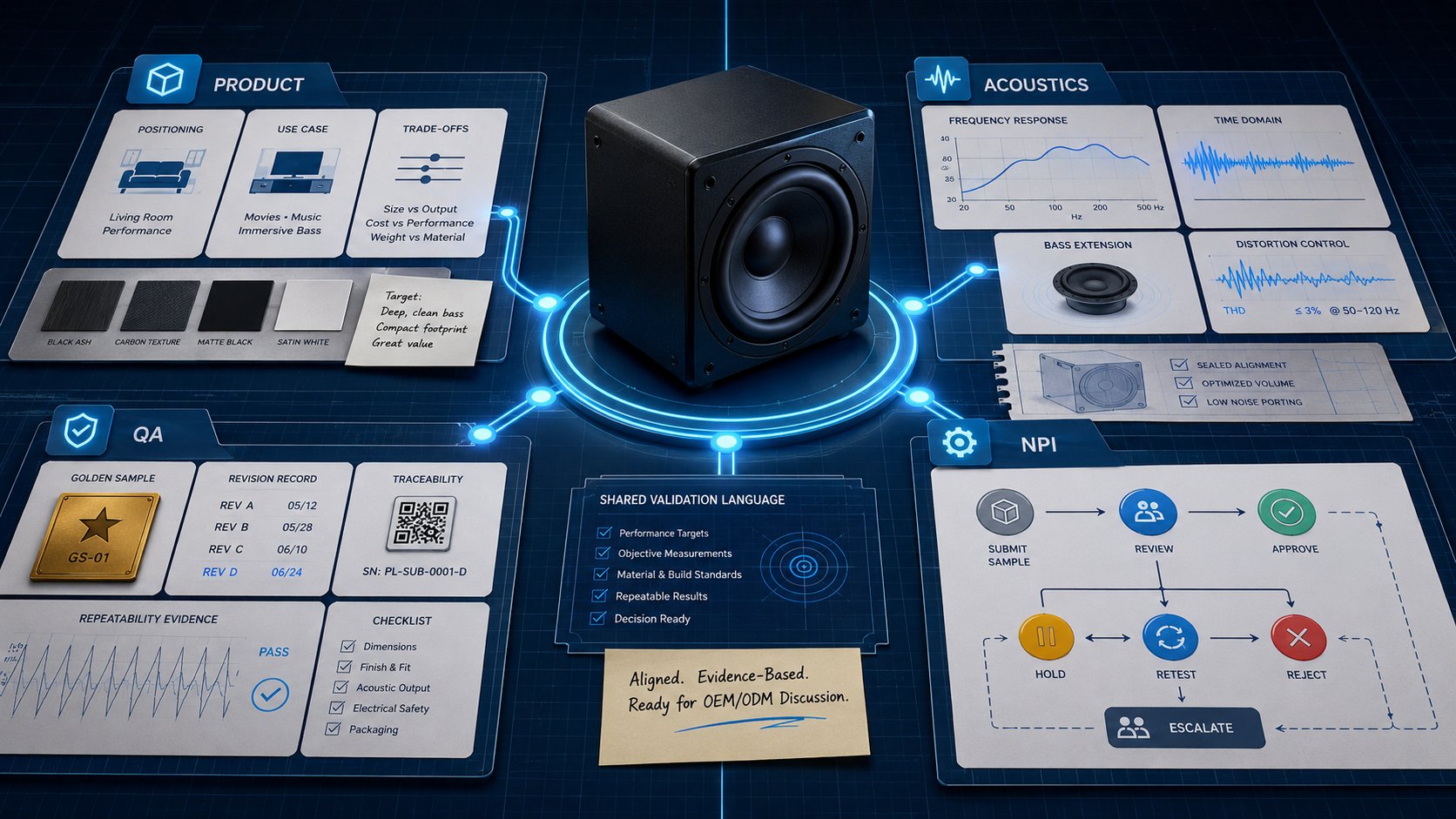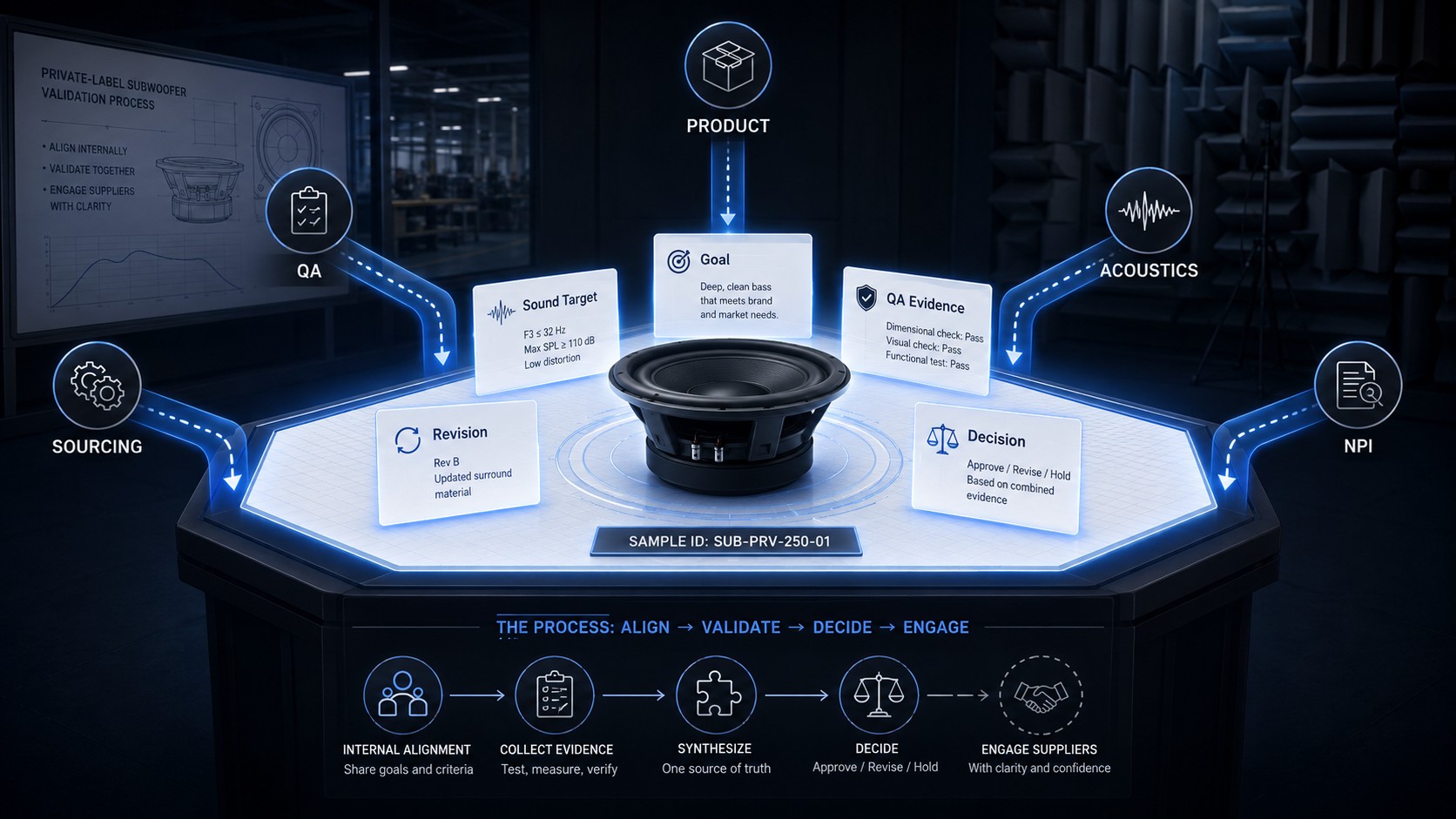
📌 Key Takeaways
Private-label subwoofer programs need clear internal rules before supplier outreach starts.
- Align Before Outreach: Product, QA, sourcing, and acoustics should agree on goals before judging supplier samples.
- Define The Goal: Each subwoofer program should prove one main outcome, such as fit, output, or sound.
- Set Sound Targets: Clear bass goals help teams judge samples by the same standard, not personal taste.
- Prepare QA Evidence: Sample IDs, test notes, and revision history help teams compare builds with more confidence.
- Name The Decision Owner: Clear approval rules stop circular debate when a sample sounds promising but needs more proof.
Shared language turns supplier talks from vague capability checks into focused program decisions.
Product leaders managing private-label subwoofer programs will clarify supplier-readiness decisions, preparing them for the detailed overview that follows.
~ ~ ~ ~ ~ ~ ~ ~ ~ ~ ~ ~ ~ ~ ~ ~ ~ ~
Strong supplier conversations start before the supplier is involved.
In a private-label subwoofer program, early confusion often comes from internal misalignment rather than supplier weakness. Product may want differentiation. Acoustics may want measurable bass targets. QA may want repeatable evidence. NPI may be thinking about revision control. Sourcing may need comparable answers from multiple OEM/ODM partners.
A sample can sound promising and still fail to answer the real business question: Is this subwoofer direction ready for quote, sample, or validation discussions?
Before outreach, Product should lead an internal conversation about what the program needs to prove, which trade-offs are acceptable, which validation metrics matter, and who owns the approve, revise, or hold decision. That shared language helps prevent vague supplier conversations and reduces the risk of reviewing samples against different internal definitions of “ready.”
1. What Product Outcome Is The Subwoofer Supposed To Validate?
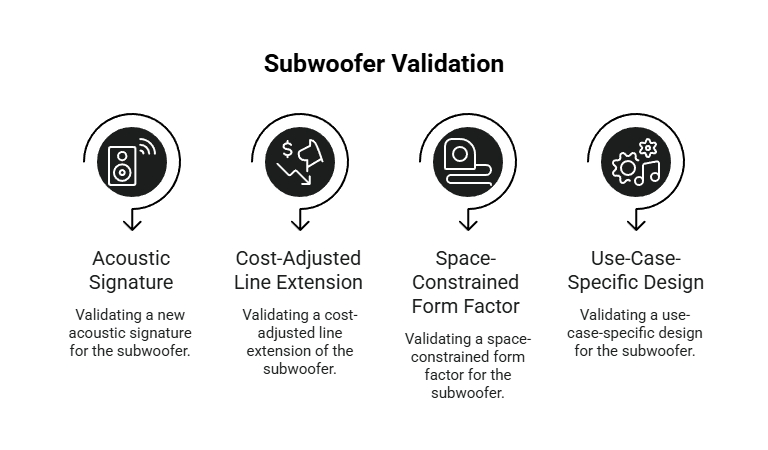
Validation starts with product intent, not test equipment.
A subwoofer program may be validating a new acoustic signature, a cost-adjusted line extension, a space-constrained form factor, or a use-case-specific design for automotive, marine, pro audio, or custom OEM applications. Each direction changes what evidence matters most.
For example, a compact automotive subwoofer may involve trade-offs between enclosure fit, low-frequency extension, and output. A pro audio program may place more emphasis on SPL, power handling, and thermal behavior. A marine-oriented program may need closer attention to environmental assumptions, but any specific claim about durability requirements should be verified against the actual application and program context.
The key internal question is: what customer-facing outcome matters most?
That outcome might be deeper bass extension, higher output, compact fit, thermal resilience, enclosure compatibility, or a tuning profile that supports the brand’s positioning. Once the outcome is clear, the team can decide which trade-offs are acceptable and which would change the program direction.
Without that agreement, supplier samples may optimize for the wrong target. Product leaders can reduce that risk by first turning performance goals into practical validation criteria before asking an OEM/ODM partner to interpret the program.
2. Which Acoustic Targets Need Agreement Before Sampling?
Acoustic alignment should separate must-have performance requirements from tuning preferences.
For a subwoofer program, generally accepted evidence categories may include frequency response, distortion, impedance, sensitivity, power handling, enclosure compatibility, and thermal behavior. The right mix depends on the product type, application, sample stage, and validation goal.
Product and Acoustics should agree on the listening or measurement conditions used for sample review. A subwoofer evaluated in one enclosure, with one amplifier configuration, under one listening setup may produce feedback that does not translate cleanly to another build. Subjective comments such as “more punch” or “sounds better” can be useful, but only when paired with enough context to guide the next revision.
When brand teams need to lock in their desired sound signature, subjective listening is not enough. Structured R&D measurement systems—such as KLIPPEL—translate these subjective acoustic preferences into empirical parameters (e.g., distortion metrics and power handling limits). Establishing these empirical baselines early creates a framework for strict golden sample management, ensuring future mass-produced units match the approved acoustic targets without spec drift.
Those references should inform the team’s vocabulary, not turn early supplier outreach into a lab procedure. The practical goal is to align subwoofer validation criteria before OEM sampling so each sample is reviewed against the same decision standard. When acoustic targets remain unclear, sample approval can break down because each stakeholder hears or measures against a different expectation.
3. What Evidence Does Qa Need Before A Sample Can Move Forward?
A subwoofer sample is not only a listening reference. It can become the first serious evidence point in the program.
QA needs enough information to understand what was tested, which sample version was reviewed, what changed from the previous version, and why the current decision is being made. At an early stage, this does not require a full production validation package. It does require disciplined sample context.
Useful evidence may include sample identity, revision history, measurement records, tuning notes, reliability observations, test-route evidence, and a decision record. If a sample becomes the internal reference, the team should also define how that reference will be managed so future builds are compared against the right version.
Golden sample control is one example of this discipline. Mature manufacturing discussions may also involve KLIPPEL QC, IQC/IPQC/FQC inspection links, reliability testing, ERP/WMS controls, barcode or QR traceability, and other evidence systems. Furthermore, operating under an ISO9001-2015 Quality Management System ensures that all of these processes are strictly controlled by document regulations, directly protecting your program’s consistency at scale.
The practical question for Product is not “How much evidence can be requested?” It is “Which evidence helps QA compare sample A against sample B and decide whether confidence is increasing?” That framing supports clearer QA and Product questions before NPI starts.
4. Who Owns The Approve, Revise, Or Hold Decision?
Sample decisions slow down when every stakeholder can object but no one owns the decision path.
Before supplier outreach, Product should define how decisions will be made when evidence is mixed. A first sample may sound close but lack reliability context. A measured response may look strong, but the tuning may not match the product position. A supplier may show a credible technical path, while timing, tooling, or cost remains unresolved.
The team needs shared definitions for three outcomes.
“Approve” should mean the sample is strong enough for a defined next step, not that every risk has disappeared. “Revise” should mean the team knows what needs to change and why. “Hold” should mean a specific blocker remains: missing evidence, unclear target, unresolved trade-off, or a supplier-readiness question.
| Validation area | Product-side question | Why it matters | Stakeholders to involve | Evidence to request or prepare |
|---|---|---|---|---|
| Product intent | What outcome must this subwoofer prove? | Keeps the program from optimizing for the wrong target | Product, PMM, Sourcing | Segment goal, use case, differentiation target |
| Acoustic target | Which bass trade-off is acceptable? | Makes tuning feedback actionable | Acoustics, Hardware, Product, QA | Measurement goals, tuning notes, sample comparison |
| QA evidence | What proof is enough for this decision? | Connects sample confidence to repeatability and quality risk | QA, NPI, Product | Sample ID, revision history, test evidence, risk notes |
| Supplier readiness | What must the manufacturer clarify first? | Prevents vague capability conversations | Sourcing, Product, Acoustics, QA | Use-case assumptions, evidence expectations, must-have answers |
| Move-forward decision | Who can approve, revise, or hold? | Reduces circular stakeholder debate | Product, NPI, QA, Acoustics, Sourcing | Decision record and next-step criteria |
This table is not a supplier script. It is an internal alignment tool. Once decision ownership is clear, teams can coordinate sample review and acoustic feedback in NPI without pushing every unresolved internal question into the supplier conversation.
5. What Should The Supplier Conversation Clarify First?
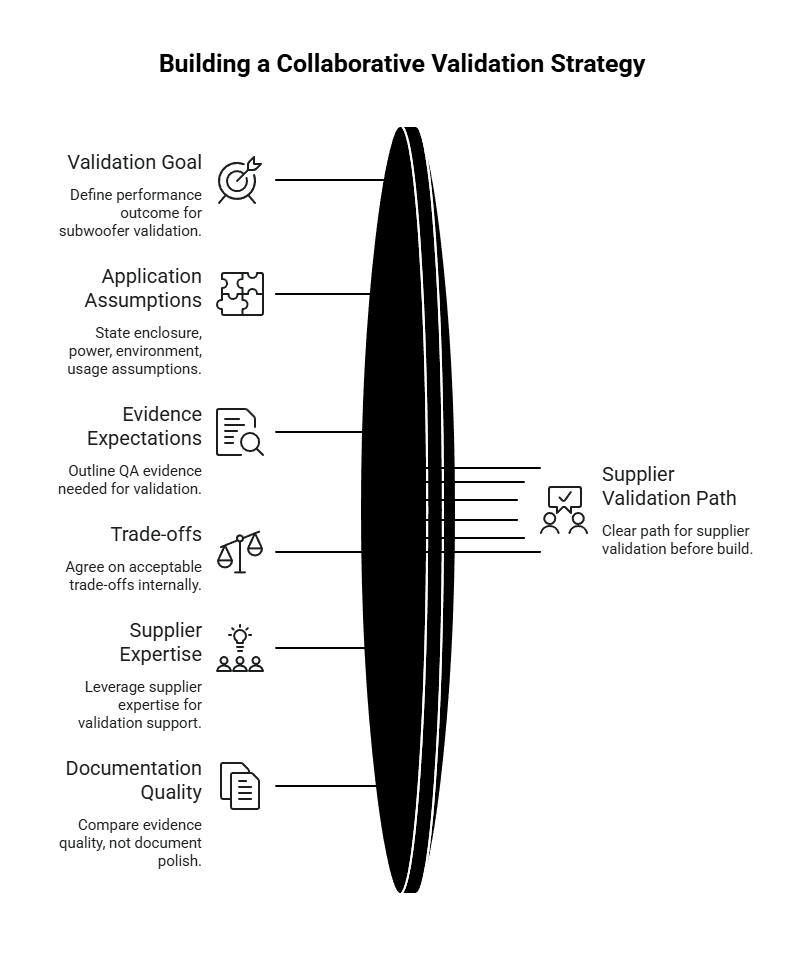
The first OEM/ODM conversation should clarify the validation path before it asks for a build.
Product should be ready to state the validation goal, application assumptions, evidence expectations, and trade-offs already discussed internally. Depending on the program, those assumptions may include enclosure type, power class, operating environment, expected usage pattern, acoustic priority, and acceptable evidence gaps before RFQ.
A weaker opening is: “Can you make this subwoofer?”
A more useful version is: “Here is the performance outcome the program needs to validate, the sample evidence QA will need, and the trade-offs the internal team has already agreed it can or cannot accept. How would your team support that validation path?”
That question gives the supplier room to contribute expertise while keeping the conversation anchored in the brand’s decision criteria. It also makes supplier comparison more meaningful. One partner may respond with stronger revision control. Another may ask better questions about application assumptions. Another may show clearer measurement or sample-history documentation.
If the discussion moves into documentation, Product should compare evidence quality rather than document polish. The goal is to compare validation documentation without turning it into a lab procedure.
Internal Alignment Questions to Resolve Before Outreach
Before contacting a subwoofer OEM/ODM partner, Product should be able to answer seven practical questions:
- What is the primary validation goal for the program?
- Which acoustic trade-off is most likely to create internal disagreement?
- What validation data will QA require before confidence increases?
- What use-case assumptions must the supplier understand?
- Who owns the decision if the first sample is promising but incomplete?
- Which documentation gaps are acceptable before RFQ, and which are not?
- What would make the team pause, revise, or reject a supplier path?
The answers do not need to be perfect. They need to be specific enough for Product, Acoustics, QA, NPI, and Sourcing to interpret supplier evidence through the same lens.
Clearer Supplier Conversations Start With Internal Validation Language
Product leaders do not need a perfect validation playbook before outreach. They do need shared language around goals, trade-offs, sample evidence, and ownership. When that language is clear, supplier conversations become less about generic capability and more about whether the partner can support the validation path the program actually needs.
Preparing a private-label subwoofer program? Talk with CFS about the validation goals, sample evidence, and QA expectations your team should clarify before supplier engagement, or review CFS subwoofer manufacturing capabilities before the next partner conversation.
Disclaimer: This article is for general informational purposes only and does not constitute compliance, safety, technical, or professional advice. Validation requirements, risks, and best practices may vary by product, application, supplier, market, and program context. Confirm important decisions with the appropriate qualified professional, authority, or technical expert.
Our Editorial Process:
Our expert team uses AI tools to help organize and structure our initial drafts. Every piece is then extensively rewritten, fact-checked, and enriched with first-hand insights and experiences by expert humans on our Insights Team to ensure accuracy and clarity.
About the China Future Sound Insights Team
The China Future Sound Insights Team is our dedicated engine for synthesizing complex topics into clear, helpful guides. While our content is thoroughly reviewed for clarity and accuracy, it is for informational purposes and should not replace professional advice.