📌 Key Takeaways
A sample approval only matters when teams turn it into controlled proof that production units can match it.
- Define The Sample: Tie the approved unit to its revision, BOM, tests, owner, and exact build assumptions.
- Lock The Specs: Replace “match the sample” with clear limits, test methods, pass/fail rules, and approval owners.
- Control Golden Samples: Treat golden samples as governed benchmarks, with custody rules, version records, and escalation triggers.
- Set Production Gates: Define IQC, IPQC, FQC, reliability checks, and traceability before the line starts.
- Control Every Change: Use ECO/ECR rules so material, supplier, fixture, or process changes never bypass review.
Sample approval starts readiness; controls prove it.
Private-label subwoofer teams will make cleaner launch calls, preparing them for the production-readiness checks that follow below.
~ ~ ~ ~ ~ ~ ~ ~ ~ ~ ~ ~ ~ ~ ~ ~ ~ ~
A private-label subwoofer sample can pass review and still leave the program unready for production. The sample may sound right, measure within the intended target, fit the enclosure, and satisfy the immediate Product team request. That does not automatically prove the supplier can reproduce the same result under production conditions.
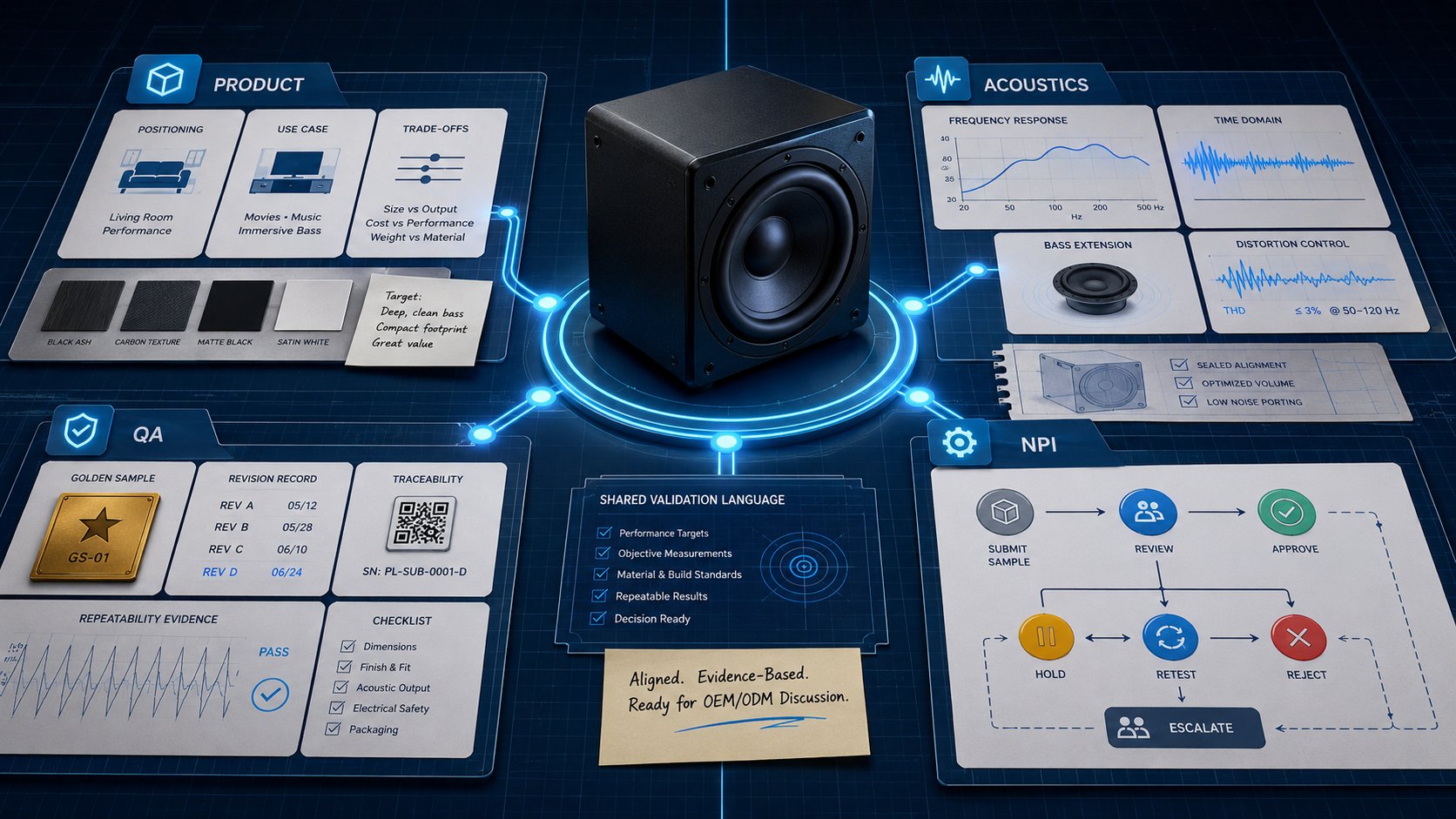
Sample approval answers one question: can this version meet the agreed target? Production readiness asks a harder question: can the program keep matching that target through controlled specifications, measurable test limits, golden sample governance, inspection gates, traceability, and change control?
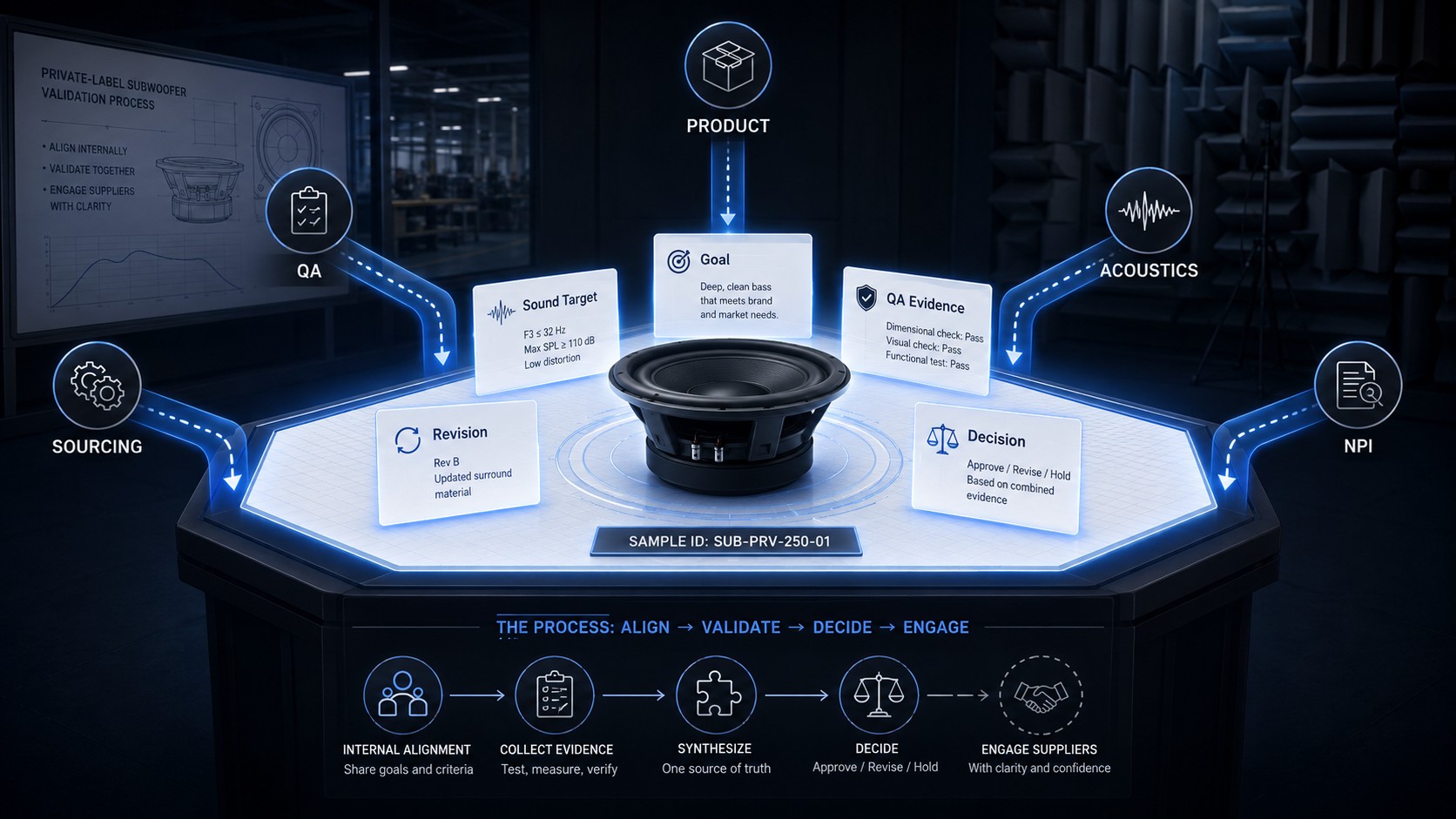
For product, QA, operations, sourcing, and NPI leaders, the quality-gate decision is not simply whether the sample is acceptable. It is whether enough evidence and governance exist to believe production units will match the approved subwoofer sample.
1. Decide What the Approved Sample Actually Proves
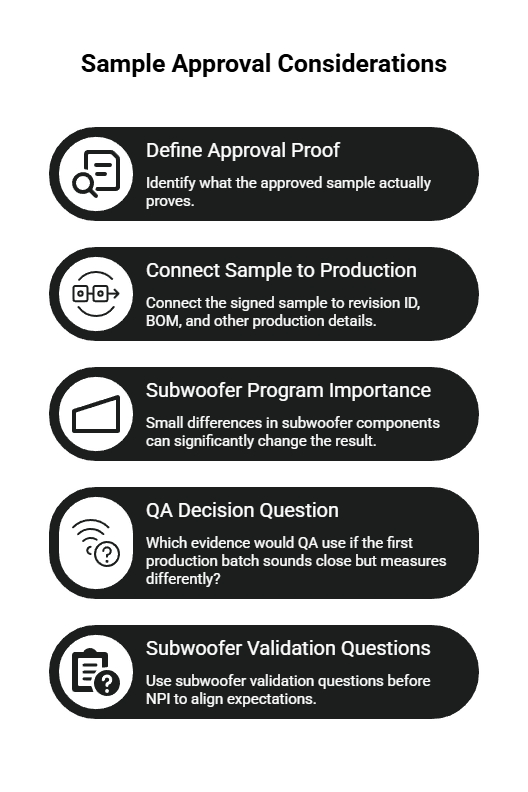
The first gate is a definition exercise. Before moving from sample approval to production, the team should identify exactly what the approved sample proved.
A subwoofer sample may be approved through listening review, acoustic measurements, mechanical fit checks, cosmetic review, thermal behavior, power handling, or some combination of those inputs. Each approval path creates a different level of confidence. A listening review can confirm subjective target fit. Acoustic measurements can support repeatable comparison. Mechanical and thermal checks can expose risks that may not appear during a short sound review.
This readiness issue appears when those approval inputs are not tied to the sample identity. A production-ready approval should connect the signed sample to a revision ID, BOM, impedance configuration, enclosure assumption, approved materials, test records, and sign-off owner. Without that connection, later production units may be compared against memory, preference, or an incomplete supplier spec sheet.
Subwoofer programs make this especially important because small differences can change the result. Bass output, distortion, excursion, heat under sustained power, voice coil behavior, cone material, spider, surround, adhesive, and fit constraints all affect whether the approved result can be repeated.
A useful decision question is: which evidence would QA use if the first production batch sounds close but measures differently? If the answer is unclear, the sample approval is not yet a production control.
For teams still defining what sample evidence should include, subwoofer validation questions before NPI provide a useful internal reference point for aligning Product and QA expectations before production pressure increases.
2. Decide Whether the Specification Handoff Is Production-Ready
The second gate is the specification handoff. Sample approval should become controlled manufacturing information, not a vague instruction to “match the sample.”
A production-ready handoff usually defines target specifications, tolerance bands, test methods, pass/fail criteria, approved materials, revision records, and approval owners. The principle is widely established in quality management: consistent output depends on controlled processes, clear requirements, and evidence that those requirements are being followed. While ISO 9001:2015 provides a foundational framework for process control, it is not a substitute for product-specific subwoofer validation.
For a private-label subwoofer, the handoff should answer four decisions before production release:
| If the team only has… | The readiness gap | Decision to make before production |
|---|---|---|
| Listening approval | The reference may be too subjective to reproduce consistently | Define measurable acoustic criteria and acceptable variance |
| One signed sample | The sample proves one approved build, not production repeatability | Tie the unit to golden sample governance and a production test route |
| Supplier spec sheet | Test conditions, tolerance bands, or revision control may be unclear | Confirm methods, limits, and revision ID |
| Verbal change approval | Accountability can weaken after launch | Require ECO/ECR rules and cut-in discipline before production |
This gate is not about turning the article into an APQP or PPAP manual. However, the general APQP concept is relevant: AIAG describes Advanced Product Quality Planning as a gated approach for moving projects from concept to launch. In a subwoofer program, the practical application is simpler: every critical requirement should have an owner, a test method, a tolerance, and a decision rule.
If the specification handoff still relies on phrases such as “same bass feel,” “similar output,” or “supplier standard,” the team should pause. Those phrases may help early discussion, but they are too soft for production release.
For more context on comparing supplier evidence without drifting into a lab procedure, review subwoofer validation documentation.
3. Decide How Golden Samples Will Govern Production
The third gate is golden sample control. A golden sample is not just a stored reference unit. It is a governed production benchmark.
Before production, the team should decide who controls the golden sample, whether duplicate signed samples exist for the brand and factory, how production units will be compared, and what happens when a unit deviates. The comparison method matters. A sample that sits on a shelf cannot control production unless it is tied to version records, test criteria, custody rules, and escalation triggers.
For example, China Future Sound (CFS) utilizes governed golden sample management to ensure consistency between mass-produced units and approved prototypes. This includes integrating KLIPPEL QC into the production line and relying on KLIPPEL R&D and sustained power testing during the development phase. KLIPPEL QC provides objective, automated measurement of loudspeaker parameters, ensuring that complex acoustic targets—such as linear excursion, distortion, and rub-and-buzz limits—are consistently met without relying on human subjectivity. These are evidence systems that can support review discipline; they should not be presented as guarantees that production drift cannot occur.
A practical golden sample gate should answer:
Who owns the reference unit? Which revision does it represent? Which measurements compare production units against it? What deviation requires hold, retest, engineering review, or formal change request?
The last question is often the most important. A deviation does not always mean the product is unusable. It means the team needs a controlled decision path. That path protects the brand from informal substitutions, undocumented process changes, and late arguments over whether a production unit is “close enough.”
For a deeper internal reference on this topic, Golden Sample Integrity explains why version-controlled custody and traceable QC comparison matter over long production cycles.
4. Decide Whether Production Gates, Traceability, and Change Control Are Clear
The fourth gate is the production control system. Decision-makers do not need a station-by-station factory tutorial, but they do need to know whether inspection gates are defined before the line runs.
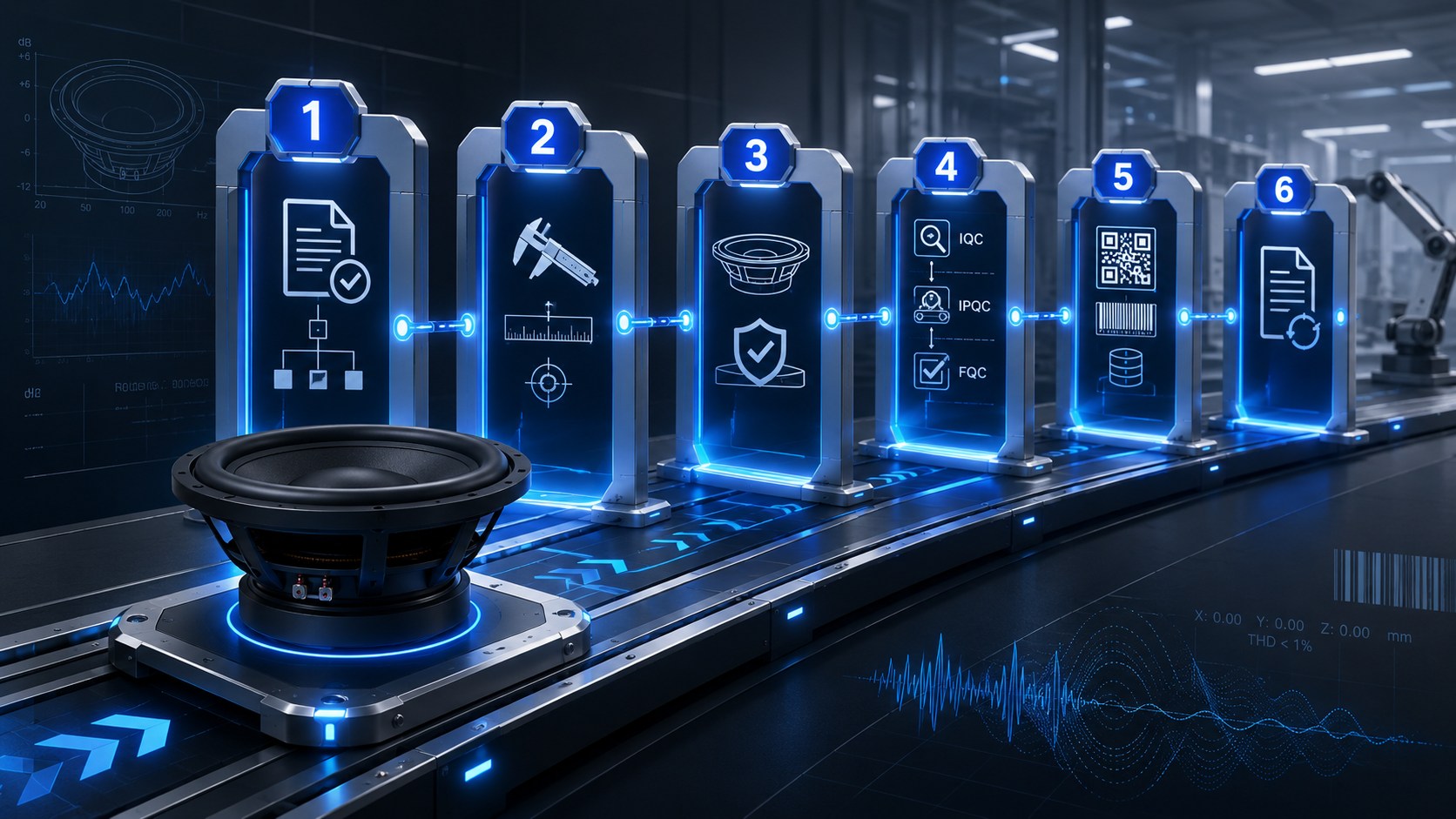
At a program level, IQC should confirm whether incoming materials match approved requirements. IPQC should check critical in-process characteristics before repeated defects move downstream. FQC should verify finished units against defined acceptance criteria. Reliability testing should confirm that production assumptions remain aligned with the design intent and application risk.
A robust quality-control environment—such as the ISO9001:2015-certified framework at CFS—integrates ERP/WMS inventory management (FIFO), KLIPPEL QC, and barcode/QR route control. By linking test data directly to barcode systems across IQC, IPQC, FQC, and reliability labs, brands can verify compliance at every station. These systems can be used as capability examples, with one important qualification: systems create reviewable evidence, not automatic outcomes.
Traceability is valuable because production questions rarely stay abstract. If a lot, component, or test route needs investigation, barcode/QR-linked data can make root-cause review more structured. ASQ’s quality resources distinguish quality assurance from quality control at a general level, which is a useful reminder: QA is about the system that helps prevent problems, while QC is about checking outputs against requirements. A strong subwoofer production release needs both.
Change control is the final part of this gate. ECO/ECR rules should define how material changes, supplier substitutions, fixture changes, process adjustments, and design revisions are proposed, reviewed, tested, approved, and cut into production. Without this rule set, a program can drift after approval even when the first sample was technically sound.
For a related internal resource, barcode testing route control explains how route discipline can help brands review whether production units are passing through the intended checks.
Production-Readiness Decision Matrix
| Readiness area | Decision before production | Evidence to request | Risk if skipped |
|---|---|---|---|
| Sample identity | Which exact sample version is approved? | Revision ID, BOM, sign-off record, test data | Wrong or incomplete reference enters production |
| Critical specifications | Which specs are locked and which allow variance? | Tolerances, test conditions, pass/fail limits | Subjective approval becomes the production standard |
| Golden sample control | How will production units be compared? | Custody record, duplicate sample, comparison method | Drift may not be detected early |
| Inspection gates | What must pass at IQC, IPQC, and FQC? | Inspection plan, route control, acceptance criteria | Units may move forward without meaningful checks |
| Traceability | What data follows each unit or lot? | Barcode/QR records, linked test data | Root-cause review becomes slower or incomplete |
| Change control | How are post-approval changes handled? | ECO/ECR workflow, retest rule, cut-in plan | Material or process changes bypass brand review |
Final QA Checklist Before Production Release
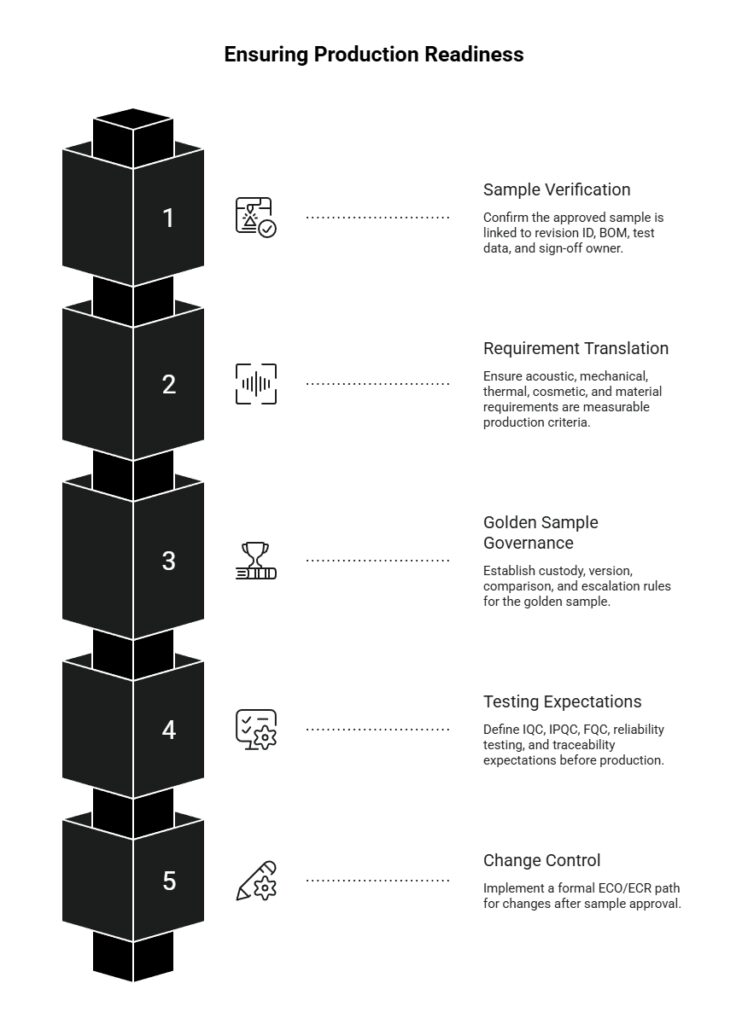
Before approving the sample-to-production transition, Product and QA leaders should be able to answer these questions clearly:
Is the approved sample tied to revision ID, BOM, test data, and sign-off owner?
Are acoustic, mechanical, thermal, cosmetic, and material requirements translated into measurable production criteria?
Is the golden sample governed by custody, version, comparison, and escalation rules?
Are IQC, IPQC, FQC, reliability testing, and traceability expectations defined before the line runs?
Is there a formal ECO/ECR path for changes after sample approval?
If any answer is uncertain, the safer decision is not necessarily to reject production. It is to hold the release until the missing evidence or governance is clarified.
Treat Sample Approval as an Input, Not the Final Gate
A private-label subwoofer program should not move to production simply because one sample passed review. The stronger readiness decision is whether the approved sample has been translated into controlled specifications, objective comparison rules, golden sample governance, production inspection gates, traceability, and change-control discipline.
That distinction gives Product, QA, Operations, and Sourcing teams a shared language. Product can protect the intended sound and fit. QA can define measurable evidence. Operations can confirm route discipline. Sourcing can evaluate supplier readiness without reducing the discussion to unit cost or schedule pressure.
To review sample evidence, golden sample control, production QC gates, and change-control expectations for your next private-label subwoofer program, discuss your production-readiness questions with China Future Sound.
Disclaimer: This article is for general informational purposes only and does not constitute compliance, safety, technical, or professional advice. Quality requirements, production risks, and validation needs may vary by product design, supplier process, application, and program requirements. Confirm production-readiness decisions with the appropriate qualified engineering, QA, and compliance professionals.
Our Editorial Process:
Our expert team uses AI tools to help organize and structure our initial drafts. Every piece is then extensively rewritten, fact-checked, and enriched with first-hand insights and experiences by expert humans on our Insights Team to ensure accuracy and clarity.
About the China Future Sound Insights Team
The China Future Sound Insights Team is our dedicated engine for synthesizing complex topics into clear, helpful guides. While our content is thoroughly reviewed for clarity and accuracy, it is for informational purposes and should not replace professional advice.